Elevance Health (ELV): Supplier Footprint and What It Means for Investors
Elevance Health operates and monetizes as a scale health benefits platform: it underwrites and administers health plans, collects premiums, and manages care delivery and pharmacy benefits through affiliated operating units. Revenue is driven by premium flows and fee-based services, while margins hinge on claims management, delegated service arrangements, and third‑party pharmacy relationships that convert administration into predictable recurring fees. For investors and operators, the supplier map is therefore a route to understanding margin stability, operational concentration, and counterparty risk. For a quicker look at supplier exposure across portfolios, visit https://nullexposure.com/.
How the supplier relationships actually function in practice
Elevance uses a mix of internal operating units and delegated third‑party providers to deliver core services. The company explicitly delegates core pharmacy services from its CarelonRx business to an external PBM provider, turning a portion of operational execution into contractual supplier risk and governance responsibilities. That posture converts operational complexity into contract management and cash‑flow predictability, but it also concentrates service criticality outside the firm.
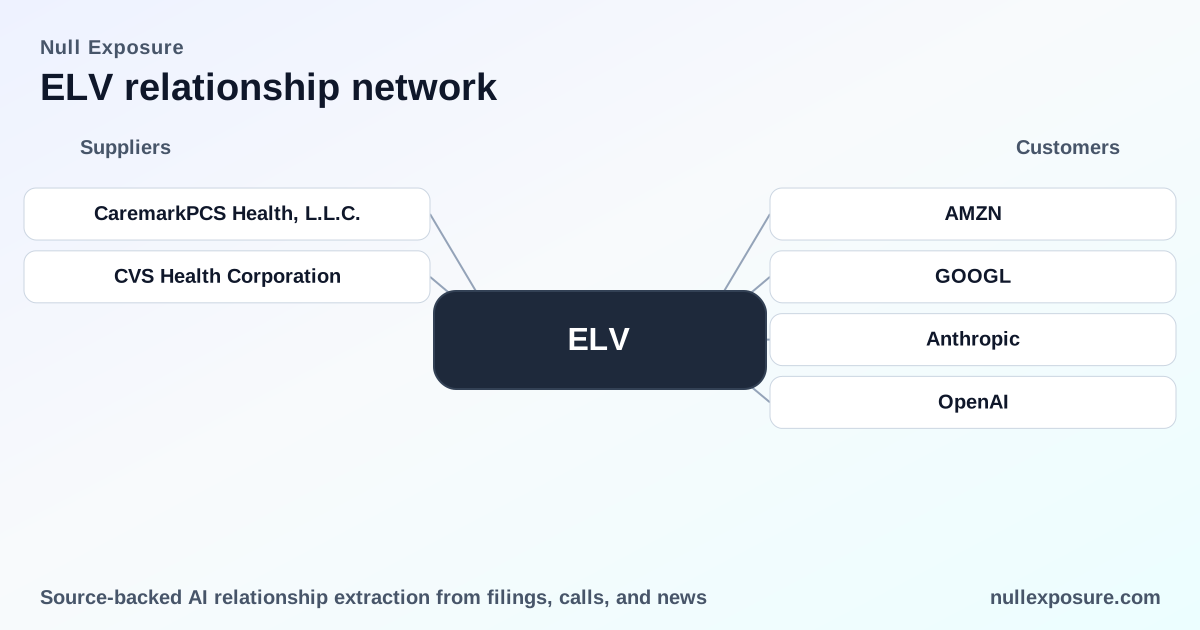
CaremarkPCS Health, L.L.C. — the delegated PBM counterparty
CaremarkPCS Health, L.L.C. receives delegated pharmacy service responsibilities from Elevance’s CarelonRx business under a contractual arrangement. This delegation covers core pharmacy services, shifting execution risk and operational control for a material functional area to CaremarkPCS. According to Elevance’s FY2025 Form 10‑K filed in early 2026, CarelonRx delegates certain core pharmacy services to CaremarkPCS Health, L.L.C. (the CVS Agreement).
CVS Health Corporation — the ultimate corporate counterparty
CaremarkPCS is a subsidiary of CVS Health Corporation, which makes CVS the effective third‑party corporate counterparty for the delegated PBM functions. The 10‑K confirms the relationship structure: CarelonRx delegates core pharmacy services to CaremarkPCS, a CVS subsidiary, pursuant to the CVS Agreement (Elevance FY2025 Form 10‑K).
What the disclosed constraints tell you about Elevance’s operating model
The company‑level constraints extracted from filings are not tied to any single supplier, but they reveal the architecture of Elevance’s supplier governance and financial exposure:
-
Service‑provider orientation: Filings emphasize reliance on hospitals, physicians, pharmacy service providers and other healthcare providers as operational partners, signaling a contracting posture that treats many critical functions as outsourced or delegated. That creates a governance emphasis on contract performance, SLAs and operational audits rather than line‑by‑line internal execution.
-
Large dollar scale: Evidence in the filing shows material liabilities tied to medical claims and leases (for example, medical claims payable of about $17,084 million at December 31, 2025), signaling 100m+ spend bands at the enterprise level and indicating that supplier relationships are large enough to be material to results and cash flow.
-
Risk transfer and reinsurance behavior: The company states it reinsures certain risks and assumes risk from other companies, which indicates a hybrid risk posture—Elevance both delegates and selectively retains financial exposure, using reinsurance and contractual structuring to stabilise earnings.
-
Operational criticality and maturity: Delegation of “core pharmacy services” signals that the relationships for PBM services are critical to clinical outcomes and to margin management, and the contractual language in a 10‑K implies mature, formal agreements rather than informal arrangements.
Taken together, these firm‑level signals imply high spend, high criticality, and a governance model built around managed outsourcing rather than in‑house execution.
Why investors should treat these suppliers as strategic counterparties
The CVS/Caremark relationship is not a peripheral vendor link; it is a strategic operational dependency that affects claims flow, cost of goods sold for pharmacy benefits, and ultimately underwriting margins.
-
Counterparty concentration risk: Delegating core pharmacy services to a dominant PBM structure concentrates execution risk with a single corporate counterparty (CVS via CaremarkPCS), which can influence pricing, formulary design, and operational resilience.
-
Earnings underwrite through contracts: Because Elevance monetizes via premiums and fee income tied to claims management, contractual performance from PBM partners directly affects operating margin, medical cost trends and cash conversion.
-
Governance and remedy focus: Given the criticality and spend scale, Elevance’s procurement posture will emphasize robust SLAs, indemnities, and reinsurance arrangements; investors should interpret supplier disclosures as part of the company’s risk mitigation narrative, not as purely operational noise.
Practical implications for portfolio risk and operations teams
For investors performing counterparty or operational due diligence, the following points translate the filing language into action:
-
Stress test PBM reliance: Quantify scenarios where PBM pricing or fulfillment shifts by a few percentage points and model the impact on loss ratios and cash flow; this relationship is large enough to move earnings.
-
Evaluate contract cadence and termination mechanics: Contracts that delegate core services should be evaluated for renewal timing, termination triggers, and transition costs—these are the levers that determine how quickly Elevance can change counterparties if needed.
-
Monitor regulatory and competitive dynamics: PBM relationships are subject to regulatory scrutiny and pricing pressure; operational disputes, regulatory change, or competitive contract wins/losses at CVS can have outsized effects on Elevance’s pharmacy cost profile.
For more structured supplier intelligence and scenario modeling tailored to healthcare counterparties, explore actionable tools at https://nullexposure.com/.
Quick, bold takeaways for decision makers
- Elevance delegates core PBM services to CaremarkPCS (a CVS subsidiary), making CVS a strategically material counterparty (Elevance FY2025 10‑K).
- Supplier relationships are large and critical—the filing cites multi‑billion dollar claims liabilities and a spend posture consistent with $100m+ supplier bands.
- Risk transfer is deliberate: the company uses reinsurance and formal delegation to manage volatility, so supplier governance is central to margin stability.
Final recommendation and next steps
Investors should treat the CVS/Caremark relationship as a first‑order factor in any thesis on Elevance’s margin durability and operational risk, and incorporate contract, regulatory and counterparty stress scenarios into valuations. Operators should prioritize contractual KPIs, contingency plans for transition, and ongoing audit of PBM performance.
For a deeper look across suppliers and to build comparative counterparty risk models, visit https://nullexposure.com/. If you want supplier‑level intelligence tailored to portfolios or operations, start at https://nullexposure.com/—we provide the structured supplier context that investors need to convert filings into actionable risk signals.