Electrovaya (ELVA): Supplier relationships, financing signals, and operational implications
Electrovaya designs, develops, and manufactures advanced lithium‑ion batteries and battery systems in North America and monetizes through the sale of cells, integrated battery packs, and system-level solutions to industrial and mobility customers. Its near‑term growth narrative is capital‑intensive: product revenue is scaling while the company relies on external financing to complete its Jamestown plant and to support day‑to‑day operations. Investors should evaluate Electrovaya not only on product adoption but on its lender relationships and governance posture, which directly affect execution risk and project completion timelines.
For more on supplier risk and counterparty exposure frameworks, visit https://nullexposure.com/.
What the public relationships reveal about immediate funding and governance
-
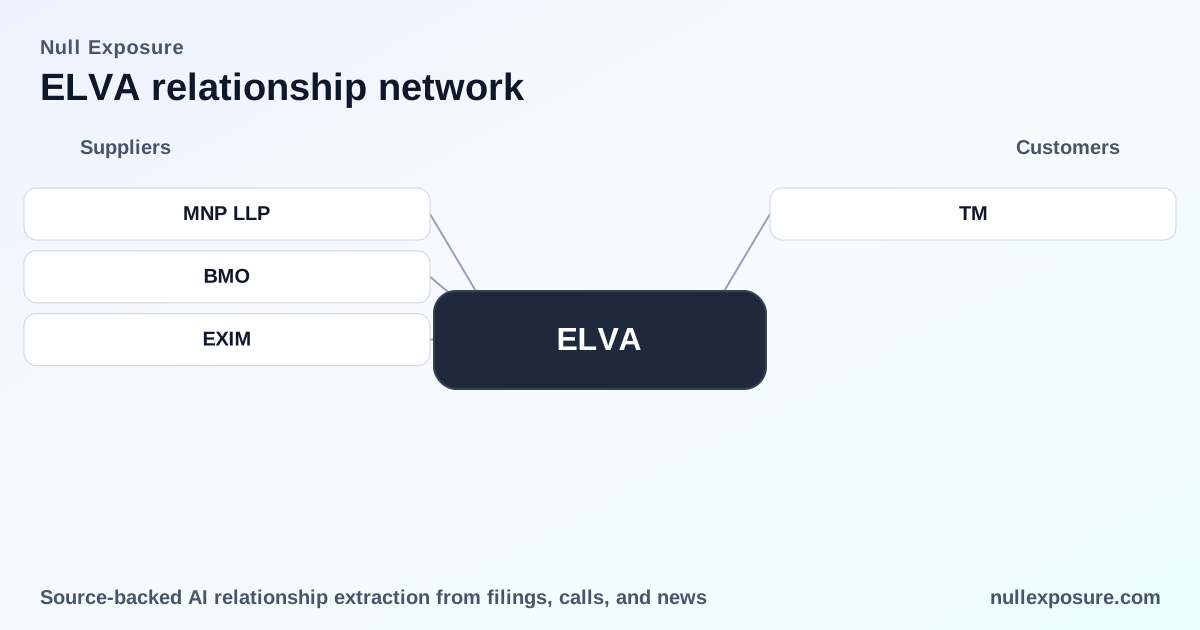
MNP LLP — Electrovaya re‑appointed MNP LLP as its external auditors at the FY2026 annual meeting. This is a standard corporate governance action that confirms continuity in financial reporting oversight for the latest fiscal year. Source: Electrovaya annual meeting release, March 2026 (Newswire and FinancialContent).
-
BMO — Electrovaya states it is utilizing a BMO facility to support general operations, indicating a bank credit line role in working capital and liquidity management. This positions BMO as an operational lender rather than a project‑specific financier. Source: Electrovaya FY2026 Q1 results release, March 2026 (Newswire).
-
EXIM — Electrovaya continues to draw on an EXIM facility specifically to support the build‑out of the Jamestown plant, signaling project finance that is tied to capital expenditure and expansion. The EXIM facility is functionally critical to the plant completion timeline. Source: Electrovaya FY2026 Q1 results release, March 2026 (Newswire).
Why these three relationships matter for valuation and risk assessment
Electrovaya’s business model requires meaningful upfront capital to convert product and backlog into steady revenue. The split between a bank facility (BMO) for operating liquidity and an EXIM facility for plant capex is a constructive financing profile—it aligns lenders to distinct cash‑flow buckets: working capital vs. project build. However, using a small set of counterparties concentrates execution risk: if either facility tightens terms or access, the company’s near‑term cash runway and plant completion schedule would be directly affected.
The auditor reappointment (MNP LLP) is a governance signal that financial controls and reporting continuity remain in place. For counterparties and institutional investors, consistent external auditing reduces informational friction and supports comparability across quarters. Governance continuity is a positive, but it does not substitute for capital resilience.
Key commercial implications:
- Execution risk is concentrated: a handful of financing relationships carry outsized influence over capital projects and operations.
- Capital intensity remains the principal growth constraint: revenue growth must be paired with on‑time plant completion funded by the EXIM facility.
- Operational liquidity depends on bank facilities: the BMO relationship functions as the backstop for working capital and day‑to‑day spend.
Explore deeper supplier and counterparty analytics at https://nullexposure.com/.
Financial and operational context you need to factor in
Electrovaya reported trailing revenue of roughly $63.8 million and positive operating margins in the latest public metrics, but the company is still in a growth capital phase. High capital expenditure needs and reliance on credit facilities increase sensitivity to interest cost, lender covenants, and project schedule slippage. Market capitalization and valuation multiples reflect both growth expectations and execution risk; institutional holdings are modest while insider ownership is material, which can affect strategic decisions and access to follow‑on funding.
Operating model and business‑model constraint signals (company‑level)
With no explicit constraint excerpts naming specific counterparties in the available disclosure, the public signals describe Electrovaya’s operating posture:
- Contracting posture: Electrovaya uses formal bank and export‑credit facilities rather than short‑term vendor finance, indicating structured lending arrangements and formal covenants typical of mid‑stage industrial projects.
- Concentration: A limited number of lenders (BMO, EXIM) means counterparty concentration risk is material to liquidity and project execution.
- Criticality: Financing is directly tied to the Jamestown plant; the EXIM facility is critical for capex completion, while the BMO facility is critical for ongoing operations.
- Maturity and governance: Reappointment of an external auditor reflects governance continuity, and the company’s fiscal calendar (year end September) and recent quarterly reporting cadence provide regular transparency to investors.
These are company‑level signals investors should fold into stress tests and covenant scenario planning when modeling cash flow and project completion timelines.
Practical takeaways for investors and commercial counterparties
- Monitor drawdowns and covenant language on both the EXIM and BMO facilities; changes in availability will directly affect the Jamestown completion schedule and working capital runway.
- Treat lender concentration as an active risk when underwriting credit exposures or negotiating supplier terms with Electrovaya.
- Value governance continuity (MNP LLP reappointment) as a positive but not a substitute for hard liquidity metrics and milestone‑based financing disclosures.
If you are evaluating supplier risk or structuring exposure to Electrovaya, start your due diligence with a focused review of project financing milestones and covenant compliance—find practical tools and counterparty profiles at https://nullexposure.com/.
Conclusion: where to focus your diligence
Electrovaya’s commercial prospects are underpinned by product demand for advanced battery systems, but near‑term outcomes hinge on financing execution. The EXIM facility's role in plant build‑out and BMO’s role in running capital are the two most consequential relationships for operational delivery, while the auditor reappointment supports reporting stability. For investors and counterparties, the priority is clear: stress‑test operational cash flows against possible disruptions to those two financing sources and demand timely disclosure on drawdowns and covenant headroom.
For a structured briefing on Electrovaya’s supplier and lender exposures tailored to institutional due diligence, visit https://nullexposure.com/ and request the supplier‑risk pack.