Enliven Therapeutics (ELVN): Supplier relationships and what they mean for investors
Enliven Therapeutics develops oncology drugs and monetizes by advancing candidates through clinical milestones toward licensing and commercialization while funding operations through equity markets and capital raises. The company outsources virtually all manufacturing, packaging and clinical trial operations to third parties, and it funds R&D and commercialization readiness primarily via public offerings and strategic financing. This combination makes underwriting partners and contract manufacturers both strategic growth enablers and concentrated operational risks.
Explore more supplier intelligence at https://nullexposure.com/.
Why the financing partners matter to an investor’s thesis
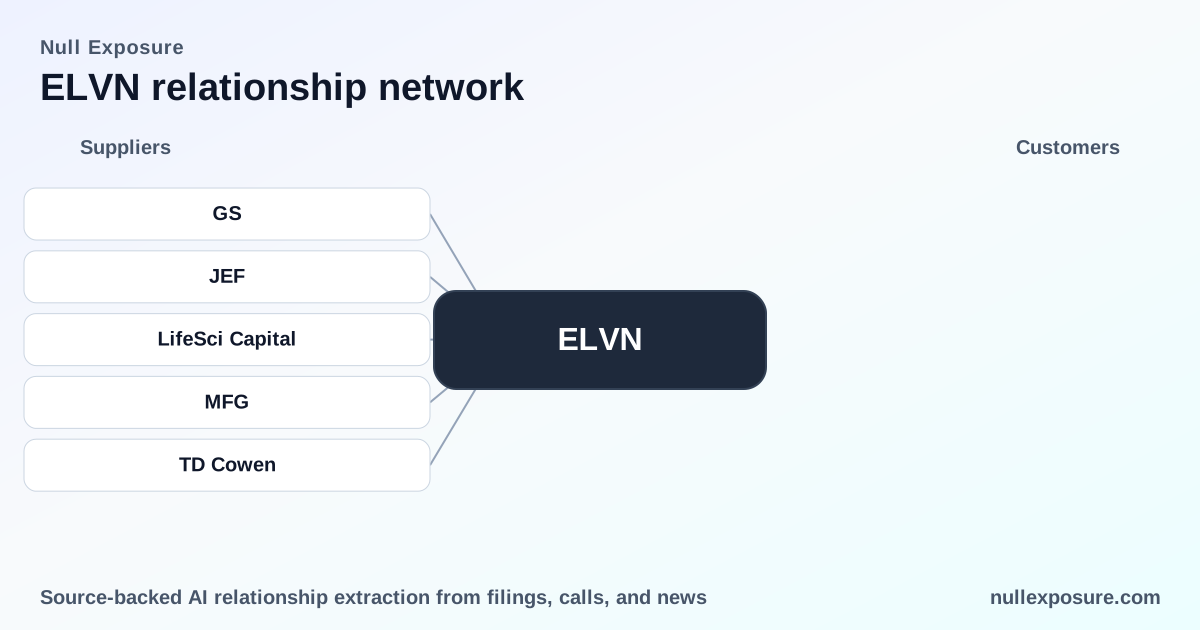
Enliven’s most visible supplier relationships in the public record are capital markets engagements: major investment banks and specialty life-science managers ran a public offering that directly funds clinical development. That institutional distribution matters for pricing, investor access and the company’s near-term runway. According to a PR Newswire release dated March 9, 2026, Jefferies, Goldman Sachs, TD Cowen and Mizuho acted as joint book-running managers for the offering while LifeSci Capital served as lead manager. This syndicate gives Enliven breadth of distribution and institutional reach that supports aggressive enrollment and development spending over the coming quarters — at the cost of dilution inherent to equity financings.
Counterparties and plain-English summaries
Below are every relationship referenced in the public results, each summarized in one or two sentences with source notes.
Goldman Sachs & Co. LLC
Goldman Sachs served as a joint book-running manager on Enliven’s public offering, providing top-tier institutional distribution and underwriting capacity that supports larger equity raises. — PR Newswire, March 9, 2026.
Jefferies
Jefferies participated as a joint book-running manager, bringing sell-side coverage and life-science syndication capabilities that help place the deal with both institutional and crossover investors. — PR Newswire, March 9, 2026.
LifeSci Capital
LifeSci Capital acted as lead manager for the offering, providing a specialist life-sciences placement function that targets sector-focused funds and high-conviction biotech investors. — PR Newswire, March 9, 2026.
Mizuho
Mizuho participated as a joint book-running manager, expanding the underwriter syndicate’s distribution channels across institutional clients. — PR Newswire, March 9, 2026.
TD Cowen
TD Cowen joined the syndicate as a joint book-running manager, contributing sector research and a placement network concentrated in healthcare investors. — PR Newswire, March 9, 2026.
What the company filings reveal about manufacturing and supplier posture
Company disclosures (FY2025 filings and related risk language) make several structural points about Enliven’s operating model that matter for supplier risk and investment due diligence:
-
Contracting posture: Enliven expects to rely on a mix of framework agreements and spot purchase orders with CMOs and other vendors. The firm intends to put in place framework contracts for project-by-project supply while also acknowledging that it purchases on a purchase-order basis and does not have fully long-term supply guarantees. This dual posture gives flexibility but increases exposure to supplier renegotiation and interruption.
-
Geographic footprint and exposure: Supply and trial operations are geographically dispersed — CMOs in China and Europe are in current use, clinical trials run across the United States, Australia, major European markets, South Korea, Canada, Spain, Israel, Japan and the UK — creating both diversification and complexity, with notable EMEA and APAC exposure. The company specifically cites CMOs based in China and Europe and established clinical trial sites in Israel. These locations increase logistical and geopolitical operational vectors investors must monitor.
-
Criticality and materiality: Third-party manufacturers and distributors are material to Enliven’s development timeline; inability to secure clinical- or commercial-grade supply would impair development and commercialization and adversely affect financial results. The company explicitly flags manufacturing failures, regulatory non-approval of third-party facilities, and distribution interruptions as material risks.
-
Roles and maturity: Enliven relies on third parties as manufacturers, distributors and service providers (CROs/CMOs) and has no owned manufacturing capacity or immediate plans to build it. This is consistent with an asset-light R&D commercialization model common in early biotech but increases dependency on counterparty performance and regulatory approvals of vendor facilities.
-
Relationship lifecycle: Disclosed suppliers and service relationships are active, reflecting ongoing use of CRO/CMO partners for preclinical and clinical supplies as well as clinical trial conduct.
Key takeaways: Enliven’s supplier model is deliberately outsourced and multi-jurisdictional, which accelerates development but creates concentrated operational dependency on third parties and on continuing capital access to fund contingency measures.
Explore supplier analytics and comparative profiles at https://nullexposure.com/.
Investment implications — where to focus your diligence
-
Capital structure and dilution: The March 2026 offering and the participation of major book-runners signal ready access to equity markets, but investors must account for ongoing financing needs given zero revenue and negative EBITDA. Analyst consensus target is $41.29; execution of clinical milestones will be the primary value driver.
-
Operational risk concentration: Outsourced manufacturing and distribution are material operational risks. Investors should demand visibility into CMO capacity, dual-sourcing plans, and regulatory inspection histories to assess continuity of supply.
-
Geopolitical and regulatory vectors: APAC and EMEA manufacturing footprints and active trial sites in Israel add complexity — monitor import/export controls, inspection schedules, and site-specific enrollment performance.
-
Catalyst calendar and dependency: Clinical readouts, regulatory filings, and successful commercialization partnerships will determine value realization; underwriting relationships support financing flexibility, but execution on supply-chain and trial delivery is the gating factor.
Actionable next steps for operators and investors
- Request full CMO/vendor lists, inspection reports and any framework agreement summaries to evaluate supply continuity and cost exposure.
- Monitor near-term clinical milestones and the company’s cash runway post-offering; underwriter syndication reduces placement risk but does not eliminate funding needs.
- Assess geopolitical risk controls for APAC/EMEA suppliers and contingency sourcing plans, especially for pivotal-study supply.
For a structured view of supplier risk across the lifecycle, visit https://nullexposure.com/ for additional supplier profiles and benchmarking.
Conclusion — the tradeoff is capital efficiency versus supplier dependency
Enliven’s model is capital-efficient and development-focused, relying on external banks for financing and on CROs/CMOs for manufacturing and distribution. That structure accelerates clinical progress but concentrates operational risk in third parties and across international jurisdictions. Investors and operators evaluating ELVN relationships should weigh the underwriting strength and funding availability against the documented materiality of supplier dependencies and the mixed contracting posture of framework and spot arrangements. For ongoing monitoring and supplier relationship intelligence, return to https://nullexposure.com/.