Elauwit Connection (ELWT): supplier relationships, operating posture, and investor implications
Elauwit Connection operates broadband and managed Wi‑Fi networks for multifamily and student housing owners and monetizes through recurring property-level service contracts, deployment/installation revenue and managed network services that feed steady subscription-like cash flows. The company’s go‑to‑market relies on property operator contracts and third‑party technology and capital partners; public market actions (IPO underwriting) and investor communications are material to near‑term financial access and governance. For a concise vendor and capital-market map, visit https://nullexposure.com/.
What investors need first: the business model in one paragraph
Elauwit sells network access and resident experience services to apartment and student housing owners, collecting ongoing fees and installation margins that contributed roughly $20.3 million in trailing twelve‑month revenue and $5.15 million in gross profit as of the latest reporting. The P&L profile shows negative net earnings (-$0.24 per diluted share) but a positive operating margin signal, indicating operating scale on services while corporate costs and recent accounting adjustments influence bottom‑line volatility. Insider ownership is high (66%), institutional stakes are modest (11%), and market capitalization is roughly $46 million, framing both governance concentration and a narrow public float.
How the supplier and capital relationships shape commercial execution
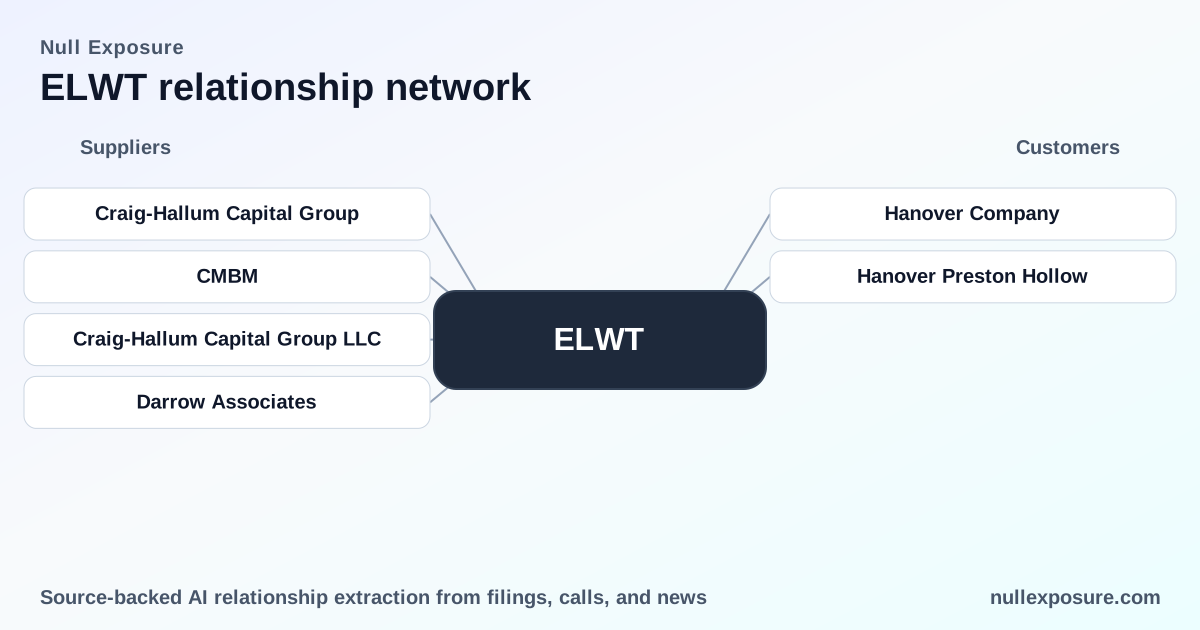
Elauwit is not an island: deployment partners, public market underwriters and investor‑relations firms are visible in recent disclosures. These relationships influence procurement of hardware and network software, the speed at which properties are brought online, and the company’s access to capital. Key takeaways: Cambium provides a turnkey network platform used in customer deployments; Craig‑Hallum is underwriting the company’s IPO; and Darrow Associates is the retained investor‑relations contact across multiple announcements. Learn more on the company’s profile at https://nullexposure.com/.
Detailed relationship map (every result in the record)
Below are plain‑English summaries for each relationship item in the file, each with the original news source noted.
Craig‑Hallum Capital Group — Renaissance Capital / IPO coverage (FY2025)
Craig‑Hallum is described as the sole bookrunner for Elauwit’s public offering, positioning the firm as the primary underwriter managing the capital raise. Source: Renaissance Capital IPO coverage (reported March 2026).
Cambium — Yahoo Finance managed Wi‑Fi case study (FY2026)
Elauwit deployed the Cambium ONE Network platform as an end‑to‑end solution in a customer case study, confirming a technology partnership for managed Wi‑Fi infrastructure. Source: Yahoo Finance case study on Elauwit’s managed Wi‑Fi deployment (March 2026).
Craig‑Hallum Capital Group LLC — Newsfile IPO announcement (FY2025)
The company’s Newsfile release names Craig‑Hallum Capital Group LLC as acting as the sole book‑running manager on the offering, reinforcing the underwriter role in the IPO process. Source: Newsfile press release announcing the launch of the IPO (reported 2026).
Darrow Associates — Newsfile investor contact (FY2025)
Darrow Associates and its Managing Director Matt Kreps are listed repeatedly as Elauwit’s investor relations contact across press releases, indicating a retained IR/communications relationship. Source: Newsfile press release listing investor relations contact information (2026).
Cambium — Newsfile case study release (FY2026)
A separate Newsfile case study reiterates the use of the Cambium ONE Network platform in Elauwit’s managed Wi‑Fi deployments, underlining a recurring vendor role in customer projects. Source: Newsfile managed Wi‑Fi case study release (2026).
Darrow Associates — FinancialContent reporting on restatement (FY2026)
FinancialContent’s syndication of Elauwit’s restatement announcement repeats Darrow Associates as the investor relations contact, connecting Darrow to corporate communications around material accounting actions. Source: FinancialContent markets release on revenue restatement (February 2026).
Darrow Associates — TradingView / Reuters article on executive hire (FY2026)
A Reuters item distributed on TradingView covering the appointment of a chief accounting officer lists Darrow Associates as the IR contact, indicating the firm handles outreach for significant management changes. Source: Reuters/TradingView distribution on Kyle Huffman appointment (February 2026).
Darrow Associates — Newsfile restatement release (FY2026)
The Newsfile release announcing the restatement of revenue for the first nine months of 2025 again cites Darrow Associates for investor contact, tying the IR firm to an important accounting update. Source: Newsfile restatement announcement (2026).
Darrow Associates — Globe and Mail distribution of executive appointment (FY2026)
A Globe and Mail post republishing the company announcement on an executive appointment references Darrow Associates’ contact information, showing consistent reuse of the same IR channel across outlets. Source: Globe and Mail investment news distribution (2026).
Darrow Associates — Newsfile appointment of VP Customer Experience (FY2026)
The press release on the appointment of a Vice President of Customer Experience lists Darrow Associates for investor queries, reinforcing that Darrow is the central communications and investor‑relations conduit. Source: Newsfile release on Michele Levingston appointment (2026).
Operating posture, concentration and maturity — company‑level signals
- Contracting posture: Elauwit operates B2B property‑level service agreements with multifamily and student housing owners; revenue is driven by recurring resident connectivity services and deployments, which make contracts operationally sticky and commercially critical to property owners.
- Concentration and governance: Insiders control roughly two‑thirds of the equity (66%), producing a concentrated ownership structure that affects takeover dynamics, liquidity and minority investor influence; institutional ownership at ~11% indicates limited sell‑side coverage and lower passive support.
- Supply and technology dependency: Public case studies identify Cambium as a named network platform provider for deployments, reflecting dependency on third‑party network hardware/software to deliver services at scale.
- Maturity and financial profile: With ~$20.3M revenue and negative EPS, Elauwit exhibits a growth‑stage revenue base with nascent public‑company costs and a recent revenue restatement that introduces accounting and governance risk to near‑term comparability.
- Capital markets access: The engagement of Craig‑Hallum as sole bookrunner for the offering is a direct signal of how Elauwit sources equity capital — underwritten public placement — which is material for funding rollouts and working capital.
Investment implications and near‑term watchlist
- Execution risk is operational and accounting: the restatement announcement and appointment of a new chief accounting officer are red flags for financial control improvements and warrant monitoring of audit outcomes and SEC filings.
- Revenue quality is central: recurring property contracts are a strength, but investors should monitor churn, installation margins and the pace of property rollouts announced in company releases.
- Liquidity and governance risk: concentrated insider ownership compresses the public float and increases volatility; underwriter and IR relationships will shape market reception of the IPO.
For a quick vendor and capital‑relationship summary and to track future updates, see https://nullexposure.com/. If you are evaluating supplier risk or considering operational partnerships with Elauwit, review the Cambium case studies and the company’s communications handled through Darrow Associates for the latest deployment metrics and governance disclosures — more on https://nullexposure.com/.
Bottom line
Elauwit’s model sells recurring connectivity to property operators using third‑party networking platforms and current public‑market underwriting to fund growth. Investors should weigh the stability of recurring contract cash flows against governance concentration, accounting restatement risk, and limited institutional coverage. For ongoing coverage on supplier ties and capital‑market developments, visit https://nullexposure.com/.