Smart Share Global Ltd (EM): How its ADS mechanics and supplier signals affect valuation and governance
Smart Share Global Limited (NASDAQ: EM) operates a consumer-facing mobile device charging business in China and monetizes through the operation and sale of charging services and related products, generating nearly $1.9 billion in trailing twelve‑month revenue while trading at a market capitalization of roughly $287 million. For investors and operators evaluating EM as a supplier counterparty or portfolio holding, the key lenses are governance plumbing (ADS depositary relationships), margin dynamics, and the absence of disclosed supplier constraints — all of which drive counterparty risk, operational continuity, and valuation upside or downside. Learn more about supplier relationship intelligence at https://nullexposure.com/.
What the headline financials tell investors about operational risk
Smart Share posts high revenue relative to market capitalization: RevenueTTM $1.894B versus MarketCapitalization $286.6M. EBITDA is positive at $80.145M, while operating margin and net profit are slightly negative, indicating operational scale with margin compression rather than a revenue problem. Price-to-sales and enterprise multiples are compressed (PriceToSalesRatioTTM 0.151; EVToRevenue 0.139), signaling the market prices in execution and governance risk more than growth shortfall.
- Concentration and maturity: The business is consumer‑technology and transaction‑driven, implying high-frequency, low-ticket transactions and dependence on distribution and service footprint in China.
- Contracting posture: Expect predominantly transactional B2C and operator agreements rather than long-term supplier contracts; supplier relationships that are strategic or custodial (for example, depositary banks) therefore carry outsized governance importance.
- Criticality: A US depositary relationship is a critical enabler for ADR trading, shareholder voting, and cross‑border custody — this infrastructure relationship is central to investor rights and corporate actions.
How to interpret the absence of disclosed supplier constraints
The supplier-relationship extraction returned no explicit constraints for EM. This absence is a company-level signal: there are no recorded supplier exclusivities, contractual supply limits, or embargoes disclosed in the sourced relationship set. For a consumer-facing services operator, the lack of disclosed constraints means counterparty risk assessment must rely more on observed operational metrics and governance links than on contract excerpts.
The one recorded relationship you must factor into diligence
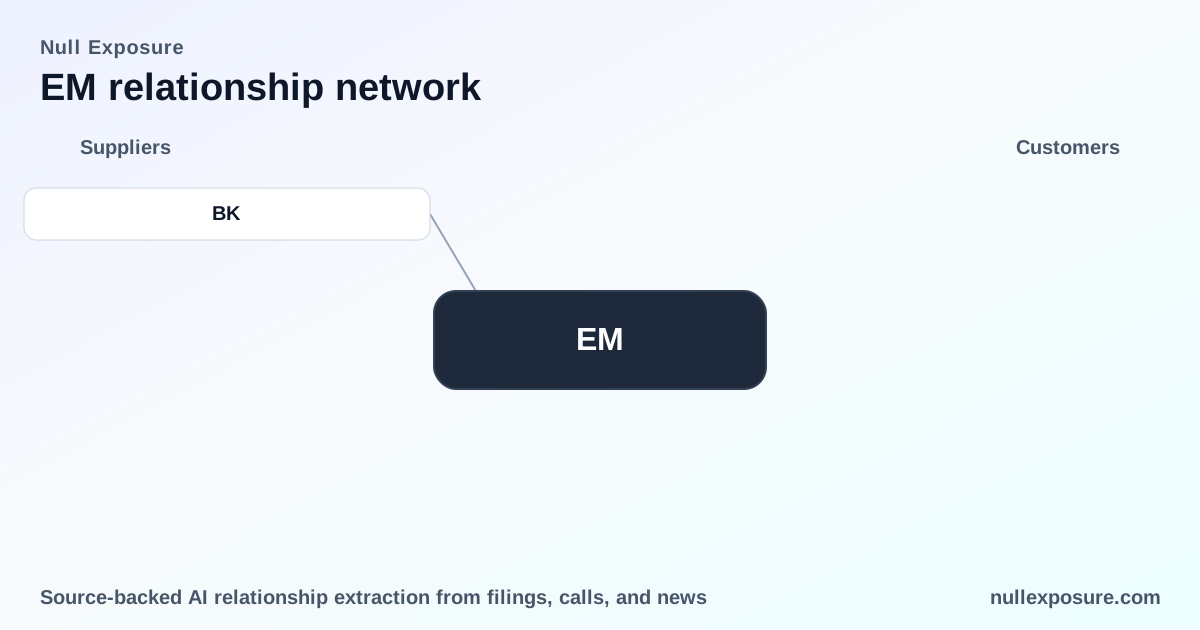
Bank of New York Mellon — ADS depositary and voting intermediary
Bank of New York Mellon serves as the ADS depositary for Smart Share Global; the company’s shareholder communications confirm that ADS holders as of the close of business on November 25, 2025, were entitled to instruct BNY Mellon to vote the underlying shares at an extraordinary general meeting. According to a GlobeNewswire press release dated November 28, 2025, BNY Mellon is the operational custodian for ADS voting and transfer mechanics.
Implication: This is not a typical supplier vendor relationship — it is core governance infrastructure. The depositary controls ADS‑level voting instruction flow, affects ease of shareholder action, and shapes how corporate events (EGMs, dividends, restructurings) translate to ADR holders. For institutional counterparties and operators, this relationship reduces settlement friction but concentrates governance execution through a single custodian.
Source: GlobeNewswire press release, November 28, 2025, reporting on ADS holder voting instructions via Bank of New York Mellon.
Why the depositary link matters to investors and operators
- Governance transmission: An ADS depositary converts underlying China‑domiciled equity rights into US ADR mechanics; shareholder voting, proxy distribution, and communications travel through the depositary, so investors must model timing and control levers accordingly.
- Operational continuity: Any operational disruption at the depositary level would impair ADR trading and corporate action execution — the business impact is indirect but material to liquidity and investor remedy.
- Cost and contractual terms: Deposit agreement terms (fees, replacement mechanics) are not quoted here, but depositary relationships typically have low direct cost to the issuer while creating a single point of governance routing.
For investors who want systematic supplier and governance intelligence on cross‑listed issuers, visit https://nullexposure.com/ to see how depositary and counterparty signals should be integrated into diligence.
Practical takeaways for capital allocators and supplier managers
- Treat depositary relationships as a governance supplier: For EM, Bank of New York Mellon is the single recorded custodian for ADS mechanics; this is a critical, non‑redundant supplier in the governance stack.
- Balance scale vs. valuation skepticism: High revenue and positive EBITDA alongside negative operating margins point to operational stress rather than demand insufficiency; governance and execution are primary value levers.
- No disclosed supplier constraints increases reliance on public governance signals: With no supplier contract excerpts available, due diligence must weight governance, cash conversion, and depositary mechanics more heavily than contractual protections.
Actionable steps:
- Request the full ADS deposit agreement and recent proxy materials to validate fee schedules, substitution mechanics, and voting timelines.
- Monitor operating margins and quarterly revenue growth to confirm margin recovery or continued compression.
- Model liquidity sensitivity to any delays in depositary operations; include scenarios where ADS voting or transfers face administrative lags.
Key takeaways and next steps
- Bank of New York Mellon is the operational trilateral between EM and US ADR holders; this is the only supplier‑class relationship recorded in the available relationship set (GlobeNewswire, Nov 28, 2025).
- Financial profile shows scale with compressed valuation: Revenue $1.894B, Market Cap $286.6M, EBITDA $80.145M — governance and execution determine upside.
- No supplier constraints disclosed is a company‑level signal that increases the importance of governance and depositary diligence.
For a deeper, actionable supplier‑risk brief and complete governance mapping, go to https://nullexposure.com/. If you want a tailored supplier relationship report on EM or comparable ADR issuers, start with https://nullexposure.com/ for structured intelligence and next‑step recommendations.