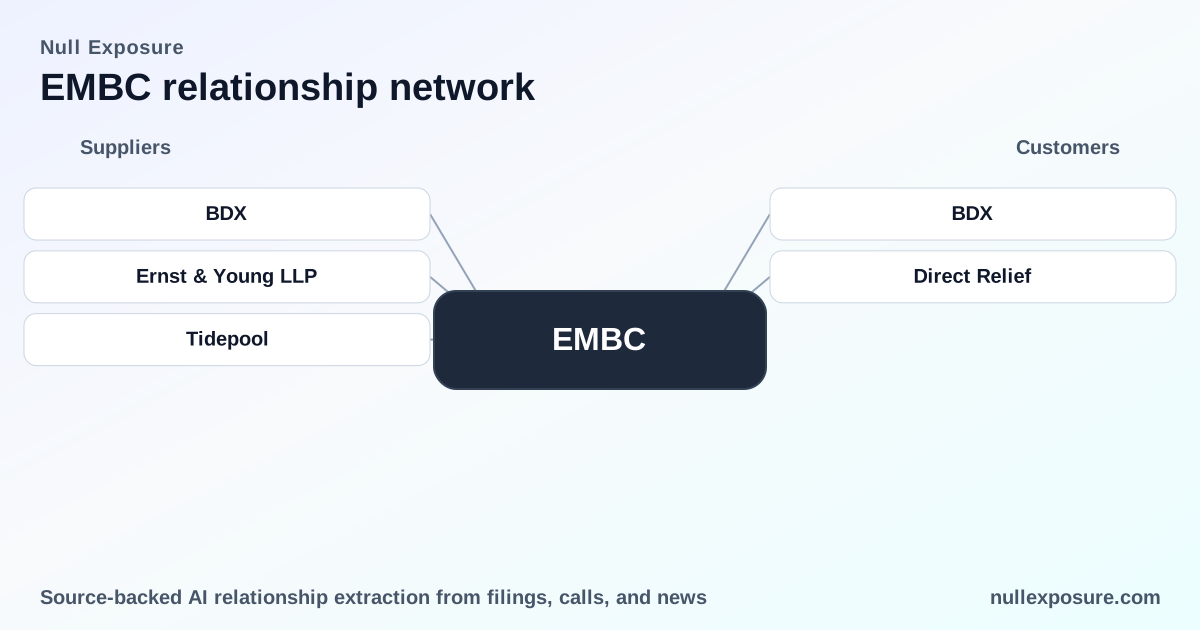
Embecta Corp (EMBC): Supplier relationships that shape production and risk
Embecta Corp is a pure-play diabetes devices company spun out of Becton, Dickinson and Company. The business monetizes through the sale of insulin delivery products—pen needles, syringes and related components—while retaining contractual and licensed ties back to BD for critical inputs and intellectual property. With roughly $1.08 billion in trailing revenue and $366.7 million of EBITDA (TTM), Embecta runs a capital-light distribution and product assembly model that depends on a small set of strategic partners for manufacturing, licensing and software integration. For investors assessing supplier counterparty risk, the BD relationship is the principal operational lever, complemented by third-party software partners and standard external audit oversight. For a quick supplier-risk profile and continuous monitoring, visit https://nullexposure.com/.
Why supplier relationships matter for valuation and operations
Embecta’s financial profile—double-digit operating margin and a modest price-to-sales multiple (0.48x)—reflects a business that scales its devices while outsourcing several capital-intensive nodes of the value chain. That structure accelerates margin expansion but concentrates operational risk where suppliers and license agreements are material or exclusive. Embecta’s public filings and earnings releases flag three categories of counterparties investors must weigh: legacy BD arrangements that control cannula supply and IP licensing, external software collaborators for dosing algorithms, and external audit and governance providers that validate financial controls. A focused diligence on contract length, termination triggers and replacement lead times is decisive when modeling downside scenarios.
For direct supplier intelligence and continuous supplier mapping, see https://nullexposure.com/.
Becton, Dickinson and Company — the dominant operational partner
Embecta’s most consequential supplier relationship is with Becton, Dickinson and Company (BD/BDX). Embecta continues to source cannulas from BD under a long-term cannula supply agreement executed in connection with the 2022 separation; BD retained cannula production and related IP while granting Embecta a license to use certain BD intellectual property. Embecta’s disclosures highlight contractual long-dated elements (including a 10‑year effective protection against early termination and explicit license terms) and quantify amounts due to BD in FY2025 reporting. According to a Globenewswire Q3 FY2025 press release and the company’s FY2025 results, those balances are disclosed directly within the financial statements. (GlobeNewswire, FY2025; trading coverage and FY2025 filings summarized via Yahoo Finance and TradingView, FY2025).
Operational implications:
- Criticality: Embecta’s filings state that if BD fails to perform or terminates supply and Embecta cannot source or manufacture cannulas elsewhere, Embecta could face material disruption to product availability—this is a high‑impact supplier constraint named in the company’s risk disclosures.
- Contract posture and maturity: The cannula supply arrangement is active and structured with long-term protections; other transactional terms include BD licensing of IP under a defined intellectual property matters agreement connected to the spin-off.
- Concentration: BD is both a license giver and manufacturer for a component central to Embecta’s product, concentrating replacement risk and adding transition costs if sourcing changes are required.
Source: Embecta FY2025 press releases and earnings materials; company SEC filing excerpts summarized in FY2025 news releases (GlobeNewswire, Yahoo Finance, TradingView, InsiderMonkey).
Tidepool — software collaborator on the dosing algorithm
Embecta collaborates with Tidepool on the insulin-dosing algorithm used in its insulin patch pump program, a partnership that underpins product differentiation for automated dosing and regulatory submissions. FierceBiotech reported that Tidepool provided algorithm development support tied to Embecta’s FDA-cleared insulin patch pump (coverage referencing FY2024 milestones).
Implication: software partnerships are strategic but non-exclusive levers of differentiation—algorithm collaboration reduces time-to-market and regulatory risk for digital dosing, while leaving Embecta free to upgrade or change vendors if performance, data integration, or commercial terms require it.
Source: FierceBiotech coverage of Embecta’s FDA clearance and partnership disclosures, FY2024.
Ernst & Young LLP — auditor and governance reassurance
Shareholders ratified Ernst & Young LLP as Embecta’s independent auditor for fiscal 2026, reflecting standard corporate governance practice and external financial oversight. A Globe and Mail report (FY2026) noted investor approval of EY at the company meeting.
Implication: external audit continuity supports financial credibility for investors modeling cash flows and compliance risk, though audit selection is a governance indicator rather than an operational dependency.
Source: The Globe and Mail reporting on shareholder meeting outcomes, FY2026.
Operating-model signals that shape supplier risk (company-level)
Beyond named counterparties, Embecta’s public disclosures communicate several cross-cutting operating features that investors must bake into scenario analysis:
- Global footprint with concentrated nodes. Embecta operates manufacturing sites in Ireland, the United States and China, and maintains a global security operations center—this supports geographic diversification but concentrates manufacturing at a limited number of plants, creating node-level risk exposure.
- Long-term contracts and real estate commitments. The company executed a corporate headquarters lease with an initial 10‑year term and other long-tenor agreements, indicating a contracting posture that favors multi-year stability over short-term flexibility.
- Reliance on third-party infrastructure and service providers. Embecta uses industry-standard ERP, cloud, and IT services that are externally managed, making IT and data continuity dependent on service providers—this is an infrastructure segment exposure rather than a single-vendor lock.
- Contractual criticality vs. replaceability. Company disclosures explicitly call out that some agreements (notably those with BD) are functionally critical and not immediately replaceable; other supplier roles (software, audit, IT hosting) are operationally important but structurally replaceable over longer timelines.
These signals feed directly into valuation stress tests: project timelines for alternative sourcing, quantify inventory and lead‑time buffers, and model margin impacts from supplier renegotiation or reshoring efforts.
Investment implications and risk checklist
- Upside engine: Embecta’s product revenue and strong operating margin profile position the company to capture incremental value if it can scale the insulin patch pump and pen/syringe volumes while preserving gross margins.
- Concentration risk: BD is a single point of failure for cannulas and critical IP rights; any material change to that relationship alters production economics and timing materially.
- Operational levers: Software partners like Tidepool accelerate regulatory acceptance and product capability; audit and governance via EY preserve investor confidence.
- Actionable next steps for investors: verify contract lengths and termination triggers with BD, quantify contingency manufacturing lead times and costs, and stress-test operating margins under a supplier premium scenario.
For a deeper supplier mapping and monitoring workflow tailored to medical-device supplier risk, visit https://nullexposure.com/.
Conclusion: a supplier profile that defines the downside
Embecta is a focused medical‑devices company with a clear monetization path and attractive operating margins, but the supplier landscape—most notably the entrenched BD relationships for cannula supply and IP licensing—defines the primary operational downside. Investors should treat BD as the fulcrum of operational continuity and prioritize diligence on transition options and contractual exit mechanics when modeling downside cases. Software partnerships and audit arrangements provide complementary governance and product capabilities but do not offset the core manufacturing concentration risk.
For ongoing supplier intelligence and scenario-building tools, go to https://nullexposure.com/.