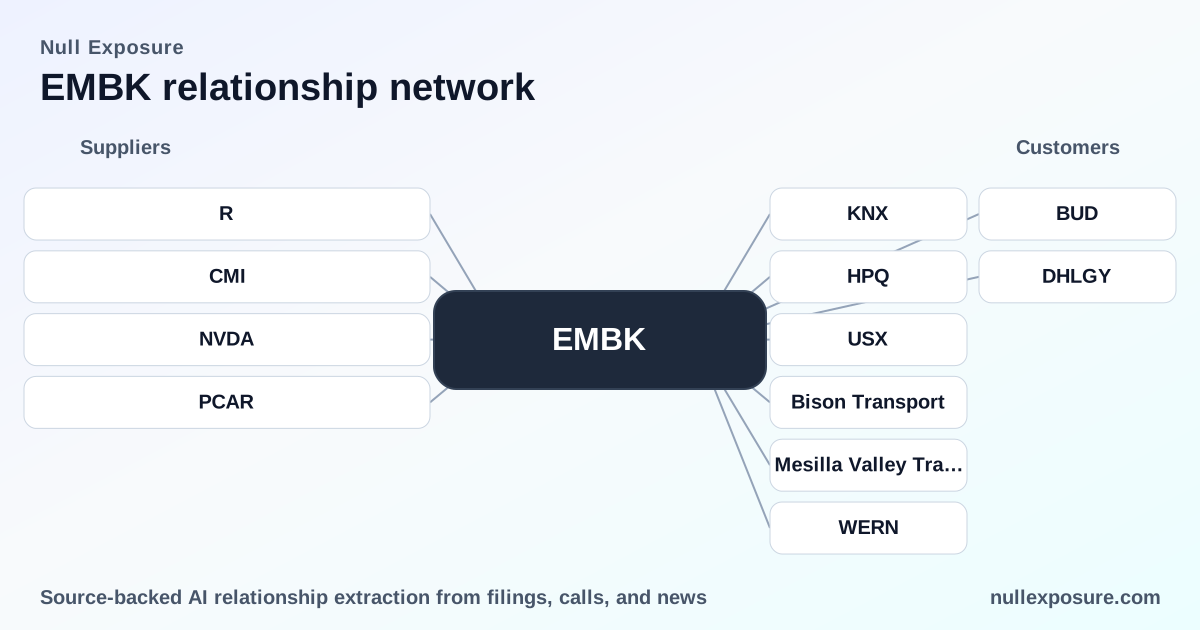
Embark (EMBK) — Strategic supplier relationships that operationalize autonomous trucking
Embark monetizes autonomous trucking by licensing its driving software and integration hardware, then partnering with fleet operators and service providers to scale operations without owning trucks at scale. Revenue derives from software and systems integration fees, recurring fleet services, and outsourced yard and maintenance partnerships that enable coast-to-coast autonomous routes. This supplier footprint reveals a company structured to outsource critical hardware and operational functions while retaining control of the autonomy stack.
If you evaluate supplier risk or partnership upside, review Embark’s external integrations and operational posture on the company page at https://nullexposure.com/ for the most current supplier mapping.
Operational architecture: partnerships, integrations, and outsourced operations Embark’s go-to-market model relies on three operational pillars: (1) a proprietary autonomy stack (the core intellectual property), (2) hardware and powertrain integrations supplied by established OEM and component partners, and (3) third-party logistics and yard/maintenance providers that handle the physical fleet footprint. This structure supports capital-light scaling: Embark sells or licenses the autonomy interface and coordinates maintenance, while partners supply vehicles, compute platforms, and yard services.
- Business driver: Licensing and systems-integration revenue that scales with fleet deployments rather than vehicle ownership.
- Operational characteristic: Contracting posture is partnership-focused and modular — Embark integrates third-party hardware and services rather than vertically integrating.
- Concentration & criticality: A small set of high-criticality partners (compute, powertrain, chassis/vehicle OEMs, and yard ops vendors) are essential to uptime and route economics.
- Maturity signal: Relationships range from development/test integrations to commercial network rollouts, indicating a transition from pilot stage toward operational scaling.
Explore Embark’s supplier map and deeper analysis at https://nullexposure.com/ to assess partner concentration and service-level exposure.
What the public record shows about Embark’s supplier relationships Below I cover every supplier relationship captured in the provided results. Each entry contains a plain-English takeaway and a concise source reference.
Ryder System, Inc. Embark partnered with Ryder to create a nationwide network of up to 100 freight transfer points where Ryder will handle yard operations, maintenance, and fleet management to support Embark’s autonomous fleet partners, enabling coast-to-coast handoffs and localized services. According to a Ryder press release announcing the collaboration, the arrangement is designed to create a physical operations backbone for Embark’s transfer-point strategy (Ryder Newsroom, 2021).
Cummins Inc. Embark is testing Cummins’ automated driving system (ADS) powertrain interface to control powertrain operations, signaling a direct integration between Embark’s autonomy stack and Cummins’ engine/electrification systems. A technology report summarized Embark’s testing activity with Cummins’ ADS interface (Samoa Observer, reported 2026).
NVIDIA Embark selected NVIDIA’s DRIVE platform to power the Embark Universal Interface (EUI), tying Embark’s perception and planning workloads to NVIDIA’s compute and drive software capabilities. Embark publicly unveiled the collaboration with NVIDIA as the compute backbone for its EUI (Samoa Observer technology coverage, reported 2026).
Kenworth (PACCAR) Embark chose the Kenworth T680 as the chassis platform for vehicles outfitted with the Embark Universal Interface under its Truck Transfer Program, reflecting a hardware partnership where Embark installs its autonomy interface on an established OEM tractor. FreightWaves covered Embark’s selection of the Kenworth T680 for program vehicles (FreightWaves, FY2022).
What these relationships imply about risk, concentration, and execution These supplier links form a coherent operational picture: Embark depends on a limited set of deep integrations that are high in operational criticality but allow the company to remain asset-light. The partners fall into clear functional buckets — yard & fleet ops (Ryder), powertrain control (Cummins), compute/perception (NVIDIA), and vehicle chassis (Kenworth/PACCAR) — which together enable end-to-end service delivery without Embark owning all underlying physical assets.
Key strategic takeaways:
- Critical dependencies are concentrated. Loss of any single high-integration partner (compute, powertrain, chassis, or yard ops) would materially impact operations until an alternative is qualified.
- Contracting posture is modular and partnership-oriented. Embark’s model favors technical integrations and service contracts over owning trucks or maintenance facilities.
- Maturity is mixed but advancing toward scale. Ryder’s announced network of transfer points and Kenworth chassis selection indicate movement from pilot integrations to explicit operational rollouts.
Risks and mitigants
- Concentration risk: reliance on a handful of partners increases counterparty exposure. Mitigation requires multiple qualified suppliers for key functions or robust transition plans.
- Operational execution: scaling a transfer-point network and maintaining SLA-driven uptime will test third-party coordination; Ryder’s logistics expertise is a strategic hedge here.
- Technology lock-in: choosing NVIDIA for compute accelerates time-to-market but creates dependency on a single compute stack; the tradeoff is performance and integration speed.
For portfolio managers and partners, the relevant evaluation axis is whether Embark’s partnership network is sufficiently diversified and contractually protected to sustain commercial route economics at scale.
Company-level constraints and the shape of disclosure The provided records include no formal constraints or contract excerpts. That absence is itself a company-level signal: public disclosures prioritize partnership announcements and technology integrations rather than detailed contracting constraints. Evaluate Embark under the assumption that most supplier obligations are commercial partnerships rather than long-term captive contracts, and validate key terms (exclusivity, termination, SLAs) directly with counterparties or through diligence.
If you want a deeper, granular map of Embark’s supplier exposures and contractual posture, review the supplier profile at https://nullexposure.com/ — the platform consolidates partner disclosures and news into an operationally focused view.
Final assessment and next steps for investors and operators Embark’s supplier strategy is a deliberate choice: outsource specialized physical services and hardware to established vendors while owning the autonomy layer that captures recurring revenue. This reduces capital intensity and accelerates network deployment but concentrates operational risk on a few integration partners. Investors should watch (1) the pace and coverage of the Ryder transfer-point rollout, (2) the depth of powertrain and compute integrations with Cummins and NVIDIA, and (3) fleet conversions on Kenworth chassis for evidence of durable, scalable economics.
To monitor partner developments and supplier exposure consistently, visit the Embark supplier page at https://nullexposure.com/. If you need tailored analysis or a supplier risk briefing for portfolio diligence, start with the company hub at https://nullexposure.com/ and request a focused supplier risk memo.