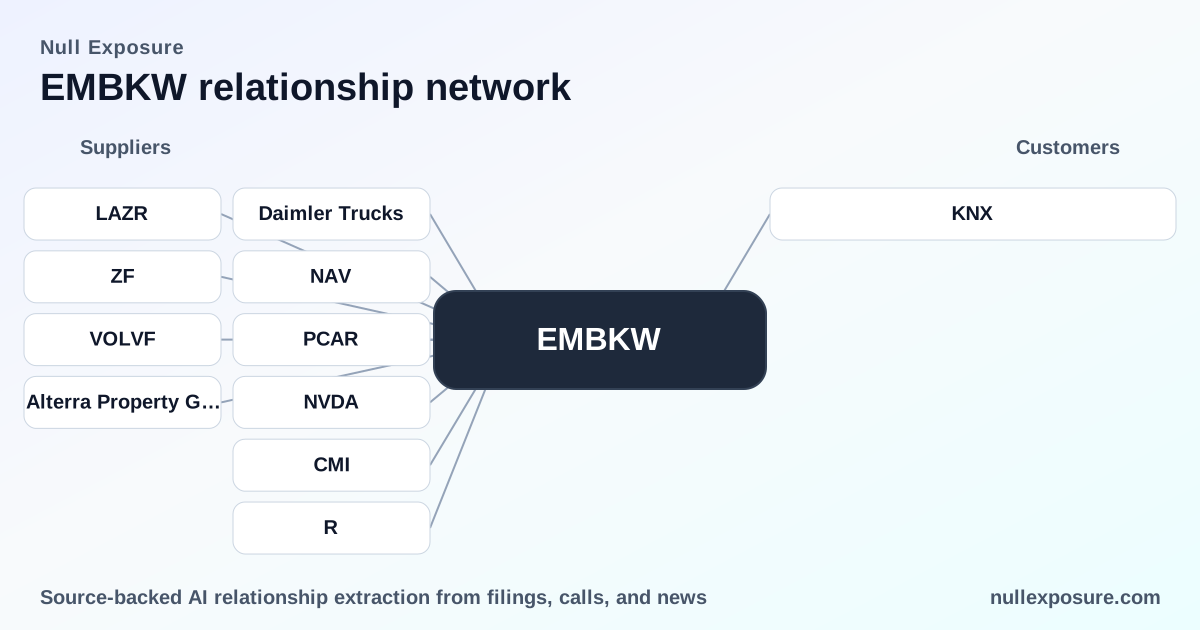
EMBKW — Supplier relationships that define an autonomous trucking platform
Embark builds and commercializes autonomous trucking software through a platform-based integration strategy: the company develops the Embark Universal Interface and partners with OEMs, Tier‑1 suppliers, and logistics operators to embed its autonomy stack into a wide range of heavy-duty vehicles and terminal operations. Revenue and value capture come from software integration, supplier co‑development, and operational services tied to real estate and fleet support rather than from manufacturing vehicles — a supplier role that scales so long as OEMs and Tier‑1s adopt the interface at fleet scale.
Learn more about supplier exposure and relationship risk at https://nullexposure.com/.
Why the partnership map matters to investors
Embark’s business model is integration-first: the Universal Interface reduces per-OEM engineering costs and enables software reuse across platforms. That lowers marginal deployment cost and positions Embark as a supplier to multiple truck manufacturers and systems integrators. For investors, the partnership roster signals three company-level characteristics:
- Contracting posture: Embark acts as a systems supplier and integrator, contracting around software licensing, integration engineering and site services rather than hardware OEM deals.
- Concentration and criticality: Partnering with multiple major OEMs and Tier‑1s reduces single‑customer concentration risk, while relationships with key suppliers (sensors, compute, powertrain) make Embark’s software operationally critical to deployment success.
- Maturity of relationships: Public reporting and press releases show collaboration and site‑support partnerships, reflecting a move from R&D pilots toward commercial deployment infrastructure.
No specific corporate constraints were supplied in the dataset; that absence is itself a company‑level signal that no explicit contractual limitations, exclusivity clauses, or disclosed supply constraints were provided for investor review.
Relationship map — who Embark works with and what each partner brings
Below are every relationship mentioned in the compiled coverage, with a concise investor‑oriented takeaway and the source context.
-
Daimler Trucks — Embark’s Universal Interface is designed to run on trucks from the major OEMs, including Daimler Trucks, enabling the company to target a broad installed base of heavy trucks rather than a single chassis. According to FreightWaves (FY2021 coverage of Embark’s SPAC-era activities), the Universal Interface supports Daimler platforms.
(Source: FreightWaves, FY2021) -
Navistar — Embark’s software is engineered to operate on Navistar vehicles as part of the same multi‑OEM strategy, reducing the need for bespoke software stacks per manufacturer. FreightWaves documents Navistar as one of four major manufacturers compatible with Embark’s interface.
(Source: FreightWaves, FY2021) -
PACCAR Inc. (PCAR) — PACCAR is listed among the OEMs that can accept Embark’s software via the Universal Interface, giving Embark access to PACCAR’s global truck fleet footprints if integration is executed. FreightWaves notes PACCAR in its FY2021 profile of Embark.
(Source: FreightWaves, FY2021) -
Volvo — Volvo is included in the OEM compatibility set for Embark’s Universal Interface, which positions Embark to address fleets that standardize on Volvo platforms. FreightWaves references Volvo alongside other major manufacturers in FY2021 reporting.
(Source: FreightWaves, FY2021) -
NVIDIA (NVDA) — Embark lists NVIDIA as a technology partner to accelerate integration of compute hardware and its autonomy stack into OEM platforms, indicating reliance on industry‑leading edge compute for perception and planning. TTNews included NVIDIA among Tier‑1 and tech partners in its FY2021 article on Embark’s public listing.
(Source: TTNews, FY2021) -
Cummins Inc. (CMI) — As a powertrain and propulsion supplier, Cummins is cited as a partner to help integrate Embark’s software with vehicle power and control systems, a necessary step for production‑grade autonomy. TTNews reported Cummins in Embark’s partner list during FY2021 coverage.
(Source: TTNews, FY2021) -
Luminar (LAZR) — Luminar is identified as a sensor partner in Embark’s integration program, supplying lidar and perception hardware that complement Embark’s software stack for highway autonomy. TTNews lists Luminar among the FY2021 collaborators.
(Source: TTNews, FY2021) -
ZF — ZF appears among the Tier‑1 collaborators helping to accelerate integration of the Universal Interface into OEM platforms, reflecting Embark’s need to coordinate with steering, braking and control suppliers. TTNews included ZF in its FY2021 partner summary.
(Source: TTNews, FY2021) -
Ryder (R) — Embark has secured optimized real‑estate sites and operational support through a partnership with Ryder, signaling a move to practical depot and maintenance arrangements critical for scaling driverless logistics. Embark’s Q3 2022 financial release cited Ryder as a partner for real estate and support services.
(Source: GlobeNewswire press release, Q3 2022) -
Alterra Property Group — Alterra is named alongside Ryder as a real‑estate partner providing optimized sites for Embark’s operations, indicating that Embark is locking in physical infrastructure and logistical support as part of commercialization. Embark disclosed this in the same Q3 2022 release.
(Source: GlobeNewswire press release, Q3 2022)
What this arrangement implies for commercial outcomes
The partnership set shows Embark pursuing a platform supplier model: broad OEM compatibility plus close cooperation with sensors, compute and powertrain suppliers and logistics operators. This structure drives two primary investor conclusions:
- Upside: If OEMs and Tier‑1s adopt the Universal Interface, Embark secures recurring value capture through integration contracts, software licensing and operations support across multiple truck families. Broad OEM compatibility reduces resale friction and accelerates fleet conversions.
- Key risk vectors: Execution hinges on cross‑supplier engineering, certification, and the ability to convert pilot sites into recurring revenue; delays or integration issues with compute/sensor partners, OEMs, or site operators will compress value realization.
Learn more about supplier concentration and integration risk at https://nullexposure.com/.
Tactical risk checklist for due diligence
- Validate depth of integration agreements (commercial terms, exclusivity, SLAs) with OEMs and Tier‑1s.
- Confirm compute and sensor supply stability given reliance on partners like NVIDIA and Luminar.
- Assess real‑estate scalability and partner commitments from Ryder and Alterra to support route density and maintenance operations.
Bottom line and investor action
Embark’s network of OEM, Tier‑1, sensor, compute and operations partners demonstrates a clear supplier strategy to scale autonomy via integration rather than manufacturing. That model lowers capital intensity but raises execution demands across complex supplier interfaces. For investors and operators evaluating supplier exposure, the priority is to confirm contractual depth and operational readiness with the named partners — the relationship roster is strong, but commercial outcomes depend on converting compatibility into deployed, revenue‑generating fleets.
Explore supplier risk profiles and relationship analytics at https://nullexposure.com/.