EMBX Supplier Relationships: What investors must know before underwriting exposure
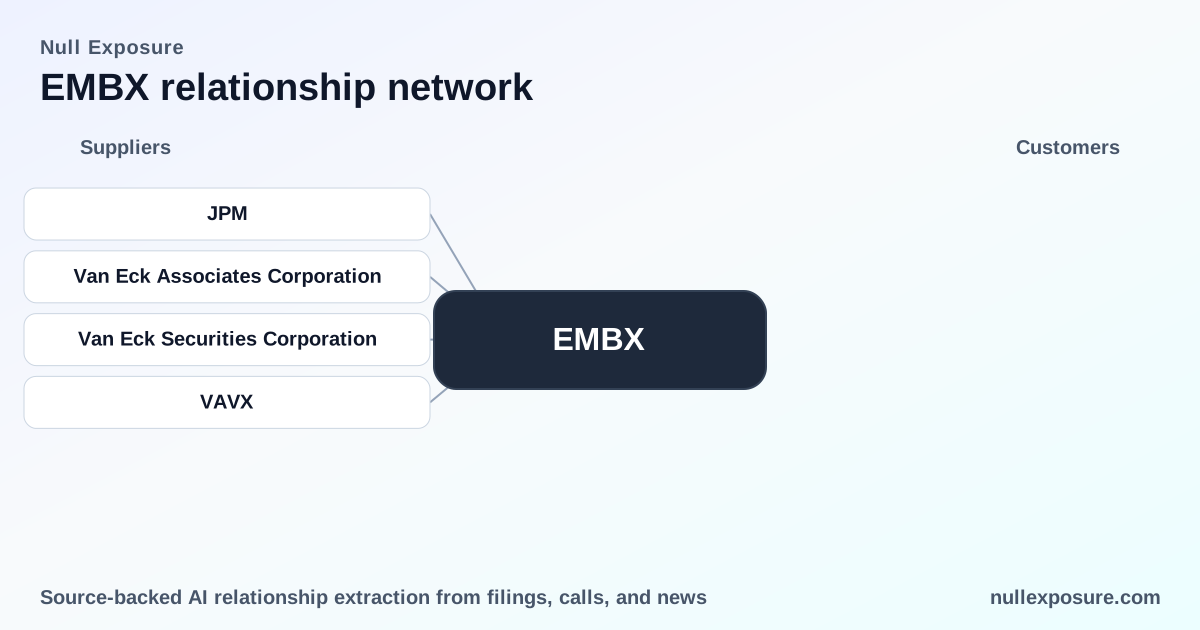
The VanEck Emerging Markets Bond ETF (EMBX) is an actively managed exchange-traded fund built around a 50/50 blended benchmark of J.P. Morgan’s GBI‑EM Global Diversified and EMBI indices and is monetized through management and distribution fees, plus the normal ETF trading/spread economics. VanEck’s adviser and distribution architecture absorbs a large share of operating friction — the adviser contractually covers most fund expenses while certain fees and trading costs remain borne by the fund — and the fund relies on third‑party index licensing and a captive distribution vehicle to deliver product-level scale. For deeper supplier mapping and operational diligence, visit https://nullexposure.com/.
How EMBX’s supplier posture shapes economics and operational risk
EMBX presents a classic ETF supplier model: intellectual property (index) licensed from a market-data provider, core investment and expense control from an in‑house adviser, and distribution through a wholly owned broker‑dealer. This mix delivers margin control for VanEck while concentrating critical dependencies externally and internally at the same time.
- Contracting posture: VanEck delegates index construction and brandable benchmarks to J.P. Morgan while the adviser contractually covers routine expense items, retaining direct control over day‑to‑day fund administration and marketing.
- Concentration: The fund’s benchmark is entirely dependent on J.P. Morgan indices, creating a single‑vendor exposure for performance and methodology risk.
- Criticality: Index licensing and distribution are core—index changes or licensing disputes would materially affect tracking and product positioning; distribution controls the share‑class placement and liquidity.
- Maturity: The ETF wrapper and the use of established indices indicate operational maturity, but reliance on a small set of suppliers concentrates counterparty and legal risk.
What the public record shows about supplier relationships
Below I cover every supplier relationship surfaced in the available results and the specific evidence that ties each party to EMBX.
J.P. Morgan Chase & Co.
J.P. Morgan supplies the two benchmark indices that form EMBX’s blended benchmark: the J.P. Morgan Government Bond Index‑Emerging Markets (GBI‑EM) Global Diversified and the J.P. Morgan Emerging Markets Bond Index (EMBI). According to a VanEck blog (March 2026), the Fund’s benchmark is a 50/50 blend of those two J.P. Morgan indices, making J.P. Morgan the single source of the index framework that underpins EMBX’s market exposure (VanEck blog, Mar 2026: https://www.vaneck.com/us/en/blogs/emerging-markets-bonds/em-bonds-outshine-dm-as-fundamentals-drive-stability/). The same index attribution is repeated in a separate VanEck post (Mar 2026) reinforcing the arrangement: https://www.vaneck.com/us/en/blogs/emerging-markets-bonds/em-bonds-extend-gains-as-the-dollar-faces-mounting-pressure/.
Key takeaway: J.P. Morgan is a critical, single‑vendor index provider for EMBX.
Van Eck Associates Corporation
Van Eck Associates acts as the Fund adviser and contractually pays most fund expenses, with explicit carve‑outs for the management‑fee payment under the investment management agreement, acquired fund fees and expenses, interest, offering costs, trading expenses, taxes and extraordinary expenses. That expense allocation is documented in VanEck commentary tied to fund operations (VanEck blog, Mar 2026: https://www.vaneck.com/us/en/blogs/emerging-markets-bonds/em-bonds-outshine-dm-as-fundamentals-drive-stability/).
Key takeaway: The adviser absorbs routine expense volatility, which centralizes operational accountability within VanEck while leaving some cost line items exposed to the fund.
Van Eck Securities Corporation
Van Eck Securities Corporation is the distributor of VanEck mutual funds and ETFs and is identified as a wholly‑owned subsidiary handling distribution activities for the firm’s ETFs, including EMBX (VanEck blog, Mar 2026: https://www.vaneck.com/us/en/blogs/emerging-markets-bonds/em-bonds-outshine-dm-as-fundamentals-drive-stability/).
Key takeaway: Distribution is captive to the VanEck group, reducing third‑party placement risk but concentrating execution and compliance risk within the corporate family.
VanEck (ex‑dividend signals)
Market notices show VanEck’s EMBX trading ex‑dividend on public market dates: December 29, 2025 and February 2, 2026, reflecting routine cash distribution mechanics and calendared shareholder payouts (Futunn market notices, Dec 2025 and Jan 2026: https://news.futunn.com/en/post/66686650/vaneck-emerging-markets-bond-etf-to-go-ex-dividend-on and https://news.futunn.com/en/post/68217895/vaneck-emerging-markets-bond-etf-to-go-ex-dividend-on). These records document the expected cashflow behavior for investors and liquidity providers.
Key takeaway: Dividend scheduling is routine and publicly announced, useful for cash management and ETF arbitrage planning.
Operational and counterparty risk implications for investors and operators
EMBX’s supplier footprint gives clear areas for focused diligence:
- Index dependency risk: The fund is entirely benchmarked to J.P. Morgan indices; investors should review index licensing terms, reconstitution schedules, and governance mechanisms because index methodology changes can alter tracking and liquidity.
- Expense responsibility and margin control: Van Eck Associates’ decision to absorb most expenses is a commercial advantage for the fund’s competitiveness but requires scrutiny of the adviser contract length, termination penalties, and scenario modeling for stress periods where extraordinary expenses rise.
- Distribution concentration: Using Van Eck Securities as distributor centralizes go‑to‑market but creates single‑point distribution risk; confirm operational resilience and market‑maker relationships if you operate liquidity provision or underwriting.
- Transparency of cashflow timing: Public ex‑dividend notices confirm scheduled distributions; investors trading around record/ex‑dividend dates should factor these into short‑term performance and tax treatment.
For execution teams and operational underwriters, focus on contractual terms with J.P. Morgan (index licensing, termination and fees), examine the adviser‑fund expense allocation schedule, and validate distribution operating SLAs with Van Eck Securities.
For a structured supplier risk memo and contract checklist, see practical resources at https://nullexposure.com/.
Practical next steps and recommended diligence
Institutional investors and operations teams should prioritize these actions before deepening exposure or extending credit:
- Review the index licensing agreement with J.P. Morgan or the fund’s prospectus language about index usage and substitution rights.
- Obtain a copy of the adviser agreement to confirm expense allocations, fee waterfalls, and termination provisions.
- Validate distribution and market‑making arrangements governed by Van Eck Securities, including emergency failover procedures.
- Monitor announced dividend schedules and reconcile historical ex‑dividend events with cashflow models.
A compact checklist is useful:
- Confirm index methodology and change governance.
- Verify adviser contract terms and expense carve‑outs.
- Audit distribution SLAs and market‑maker commitments.
If you want a tailored supplier risk note or a contract checklist built for investors and operations teams, return to https://nullexposure.com/ for services and templates.
Conclusion: succinct commercial judgment
EMBX is a mature ETF product that leverages a well‑known index provider and an in‑house adviser/distributor model to control margins and market access. That structure delivers operational clarity and cost control while concentrating strategic dependency on J.P. Morgan for benchmarks and on VanEck’s adviser/distributor infrastructure for execution and expense governance. Investors should treat the index license and adviser contract as the two priority negotiation and monitoring points for any supplier‑level due diligence. For supplier mapping, contract playbooks, and investor briefs tailored to ETFs like EMBX, visit https://nullexposure.com/.