EMISR — A concise map of counterparties, market positioning, and what rights investors should price
Emmis Acquisition Corp. Rights (EMISR) is a SPAC rights instrument tied to a blank-check vehicle focused on media and entertainment. The sponsor monetizes through a standard acquisition vehicle model: raise capital via an IPO, list units on Nasdaq, and convert proceeds into a business combination where equity value is created (or destroyed) by target selection and deal execution. For investors in the rights strip, returns are driven by liquidity at listing, sponsorship quality, and the success of the eventual merger.
If you want a clear, supplier-focused view for diligence or portfolio allocation, start with the counterparties that enable listing and capital formation — they define liquidity channels and underwriting quality. Learn more at https://nullexposure.com/.
How EMISR’s public relationships shape the capital raise story
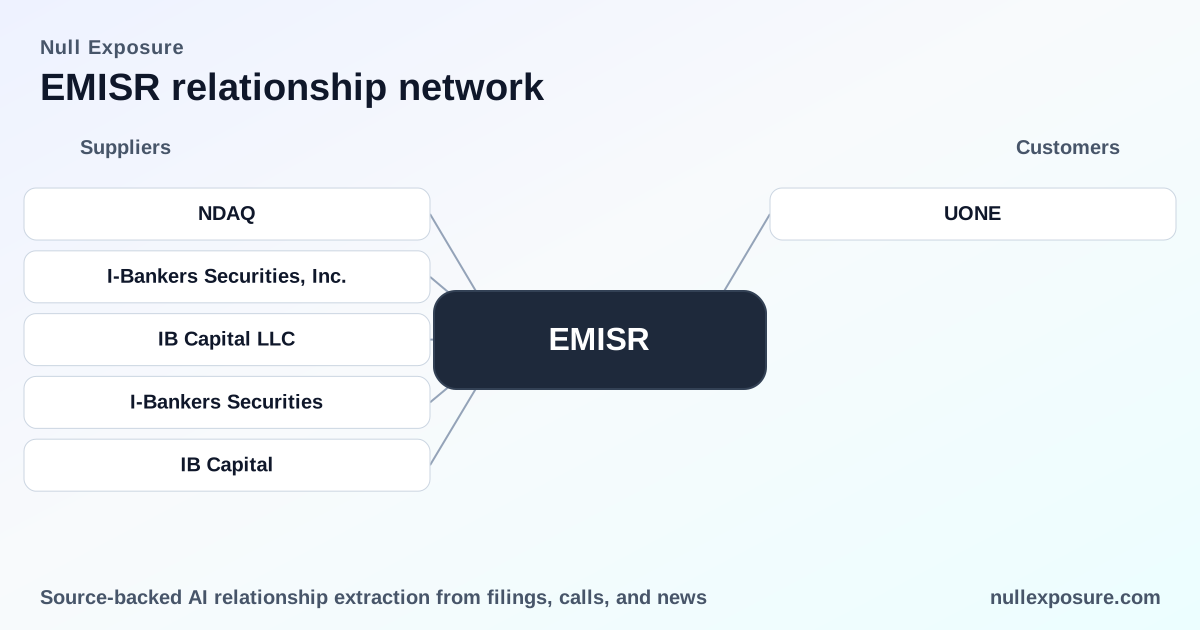
SPACs are short chains: exchange, underwriters, and the sponsor team. For EMISR, public reporting highlights three counterparties that determined distribution and market access at IPO and initial listing. These relationships are operational levers for investor liquidity and issuance credibility.
Nasdaq — the market gatekeeper
According to a QuiverQuant news release covering FY2025, the Emmis Acquisition Corp. units began trading on the Nasdaq Global Market on September 25, 2025, under the ticker EMISU (https://www.quiverquant.com/news/Emmis+Acquisition+Corp.+Completes+$115+Million+Initial+Public+Offering+on+Nasdaq, FY2025). Nasdaq provides the listing venue and ongoing market liquidity that makes rights tradable; its role is structural and critical to secondary pricing.
I-Bankers Securities, Inc. — book-running manager
A QuiverQuant report (FY2025) and Renaissance Capital’s IPO profile identify I-Bankers Securities as one of the book-running managers for the offering (https://www.quiverquant.com/news/Emmis+Acquisition+Corp.+Completes+$115+Million+Initial+Public+Offering+on+Nasdaq; https://www.renaissancecapital.com/Profile/EMISU/Emmis-Acquisition/IPO, FY2025). I-Bankers’ involvement signals the underwriting path and distribution network used to place units with institutional and retail channels.
IB Capital LLC — co-manager on the underwriting
QuiverQuant and Renaissance Capital list IB Capital LLC as a co-book-running manager on the IPO (https://www.quiverquant.com/news/Emmis+Acquisition+Corp.+Completes+$115+Million+Initial+Public+Offering+on+Nasdaq; https://www.renaissancecapital.com/Profile/EMISU/Emmis-Acquisition/IPO, FY2025). IB Capital’s participation contributes additional placement capacity and underwriter coverage; underwriting quality is a visible signal for early liquidity and retail uptake.
What the relationship map implies for investors and operators
The public counterparties form a concentrated but familiar SPAC supply chain: a major exchange for listing and two underwriting houses for distribution. That structure creates a set of observable operating characteristics:
- Contracting posture: Standardized, exchange-driven listing terms and underwriter agreements are the operating norm. The relationship set indicates transactional, market-standard contracts rather than bespoke, vendor-locked arrangements.
- Supplier concentration: The counterparty list is small and focused; this produces low supplier breadth but high functional coverage — exchange plus underwriters cover primary issuance and secondary listing.
- Criticality: Nasdaq is critical for liquidity and price discovery; underwriters are critical at formation and distribution, less so after the units achieve secondary market equilibrium.
- Maturity and provenance: The counterparties are established market participants, indicating a mature underwriting and listing pathway consistent with mainstream SPAC issuance practices.
These are company-level signals drawn from the public relationship map and the absence of additional supplier disclosures.
Learn more about how supplier maps inform risk-adjusted exposure at https://nullexposure.com/.
Constraints and disclosure signals
The supplier-relationship data set for EMISR contains no explicit constraint excerpts or vendor-specific caveats. That absence is itself a company-level signal: no public supplier constraints were recorded in the examined feed. For diligence, treat that as an indicator of limited supplier-level disclosure in public summaries, not as confirmation of absence of contractual limits or obligations.
Do not attribute operational constraints to the named counterparties unless a constraint excerpt specifically names them; none do in this feed.
Key investment risks and operational takeaways
- Liquidity is central. Rights instruments are sensitive to listing liquidity; Nasdaq’s presence reduces friction but does not guarantee tight spreads for a new SPAC rights class.
- Underwriter quality affects demand and distribution costs. The participation of I-Bankers Securities and IB Capital provides distribution depth, but investors should price the rights with awareness that smaller or niche underwriters produce different aftermarket dynamics than top-tier global bookrunners.
- Execution risk is sponsor-driven. Counterparties enable access and placement; the sponsor’s selection of targets and deal execution determine intrinsic value creation.
- Disclosure depth is limited. Public relationship entries are concise; deep diligence on sponsor alignment, PIPE commitments, and redemption terms is required to convert counterparty signals into portfolio action.
Practical next steps for allocators and operators
- Review the IPO documentation and prospectus for detailed underwriting fees, lock-up provisions, and exact rights conversion mechanics.
- Model liquidity scenarios using observed early trading (post-9/25/2025 listing date) and underwriter syndicate reach.
- Use counterparty presence (exchange + underwriters) as a baseline for market access, then layer sponsor credibility and PIPE commitment analysis for execution risk.
For more supplier-mapping intelligence and actionable diligence workflows, visit https://nullexposure.com/.
Bottom line
EMISR is a conventionally structured SPAC rights instrument with a clear market-access chain: Nasdaq for listing and two market-focused underwriters for distribution. That combination creates straightforward liquidity mechanics and concentrated supplier exposure; investors should focus their valuation work on sponsor execution, PIPE depth, and early aftermarket liquidity rather than exotic supplier dependencies.
If your mandate requires a deeper counterparty dossier or scenario-backed liquidity modeling, start your next step with the supplier mapping tools at https://nullexposure.com/.