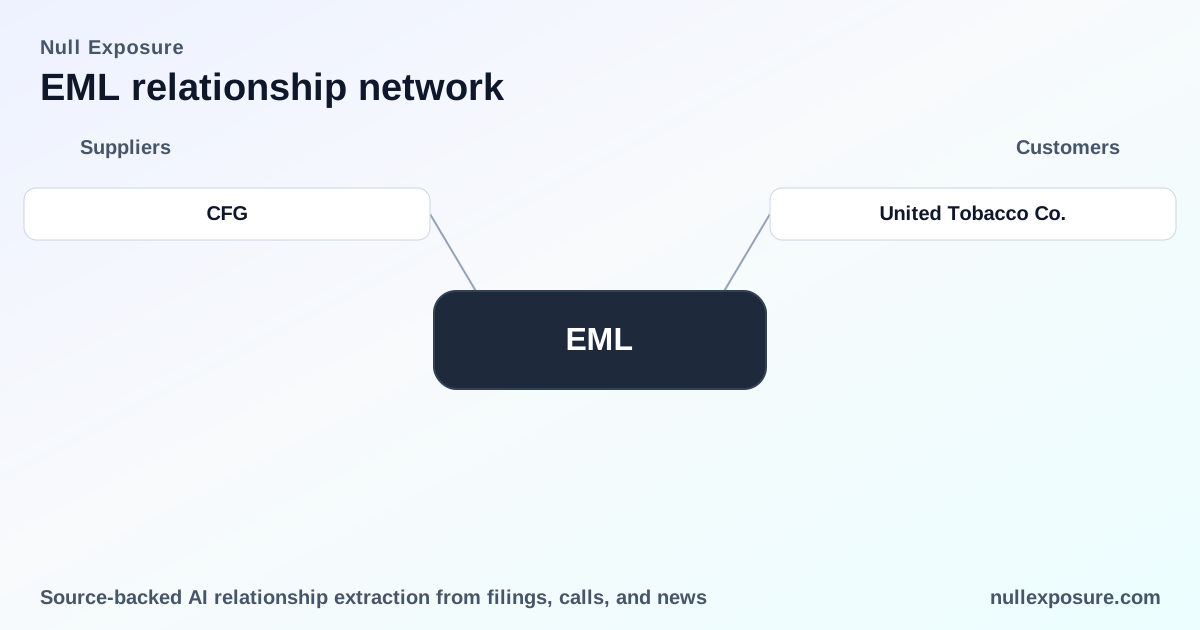
Eastern Company (EML) — supplier relationships and what they mean for investors
Eastern Company designs and manufactures engineered components and access solutions for industrial customers, monetizing through product sales across its manufacturing divisions and aftermarket / replacement parts. The company is a small-cap industrial (Market Cap ≈ $124m) with roughly $249m in trailing revenue and thin operating margins, relying on working capital finance and an international mix of suppliers to keep production flowing. For investors evaluating supplier and counterparty risk, the financing relationships and the geographic footprint of vendors are as material to operations as raw-material contracts. Learn more at https://nullexposure.com/.
A short read on the financing tie that matters
Eastern disclosed a credit agreement executed on October 28 (FY2025) with Citizens Bank. This is a lender relationship, not a raw-material supplier, but it directly affects Eastern’s liquidity, purchasing flexibility, and the company’s ability to fund inventory and production cycles. A committed facility with a bank improves near-term financial runway and reduces immediate counterparty procurement pressure.
According to an SEC filing reported by Reuters and carried on TradingView on March 9, 2026, Eastern entered a credit agreement with Citizens Bank on October 28 (FY2025). MarketScreener also reported the same SEC notice on March 9, 2026. Both references confirm the timing and counterparty for the facility.
What the Citizens Bank credit facility means in plain English
Citizens Bank — Eastern executed a formal credit agreement with Citizens Bank on Oct. 28, FY2025, establishing a banking relationship designed to support the company’s short-term liquidity and working capital requirements; the disclosure surfaced in an SEC filing later reported in March 2026 by Reuters and MarketScreener. According to the SEC filing reported by Reuters via TradingView on March 9, 2026, the credit agreement is a formalized financing relationship. MarketScreener’s March 9, 2026 coverage echoes the same SEC disclosure.
Key takeaway: this is a financing counterparty that materially affects Eastern’s procurement flexibility and operational resilience.
How Eastern sources inputs — constraints that shape supplier risk
Eastern’s public disclosures signal two clear company-level supply characteristics that matter to investors and operators:
- APAC sourcing presence. Eastern obtains materials from unaffiliated and affiliated sources in Asia as well as domestic suppliers. This indicates a geographically diversified supply base that balances cost and capacity advantages from Asia with proximity and stability of domestic vendors. Geographic diversification reduces single-region concentration but introduces logistics and geopolitical tail risks that procurement must manage.
- Manufacturer / commodity posture. Raw materials are sourced from numerous suppliers and are generally available on the open market under normal conditions, implying a transactional contracting posture for many inputs rather than exclusive or single-source strategic partnerships. This reduces supplier concentration risk but leaves Eastern exposed to commodity price swings and market tightness.
Viewed together, these constraints imply that Eastern’s purchasing model is largely transactional and capacity-driven, with mixed supplier maturity (domestic incumbents plus Asian affiliates) and low to moderate concentration across vendors. Materials are critical to production but are not inherently unique, so supply criticality is operationally important but not monopolistic.
Financial and operational implications investors should weigh
- Liquidity and leverage: A bank credit facility with Citizens Bank strengthens working-capital capacity, which directly supports procurement cycles and inventory management. For a company with modest margins (Operating Margin ≈ 4.38%, Profit Margin ≈ 2.87%) and near-term revenue pressures (quarterly revenue growth negative year-over-year), access to committed financing matters to continuity of supply.
- Cost vs. continuity trade-off: APAC sourcing provides cost benefits but increases lead times and exposure to shipping and trade disruption risk. Procurement should prioritize dual-sourcing and safety stock where lead-time variability is high.
- Supplier bargaining posture: Because raw materials are available from many producers, Eastern retains negotiating leverage on commodities but must remain disciplined around quality and supplier performance to avoid production disruptions.
- Investor signal: Institutional ownership is high (≈75.7%), suggesting professional scrutiny of these operational and financing arrangements; dividend yield (~2.1%) and modest EPS indicate a company balancing returns with capital needs.
Risk to watch: disruptions in APAC logistics or sudden commodity tightness would force Eastern to draw on financing lines more heavily and could compress margins further.
For deeper supplier counterparty analysis and monitoring, visit https://nullexposure.com/.
Catalog of documented relationships (complete)
Citizens Bank — Eastern entered a credit agreement with Citizens Bank on October 28 (FY2025), disclosed in an SEC filing and reported publicly in March 2026. This relationship is a lender-facility arrangement that provides working capital capacity and directly influences Eastern’s procurement flexibility and liquidity position; reporting sources include an SEC filing cited by Reuters on TradingView (March 9, 2026) and a MarketScreener report (March 9, 2026).
Actionable takeaways for investors and procurement operators
- Confirm facility terms and covenants. Investors should review the covenant package behind the Citizens Bank agreement to understand borrowing base constraints and any operational covenants that could affect supplier payments during stress.
- Stress-test APAC supply lines. Operators must quantify lead times, freight exposure, and alternate sourcing options for key components sourced from Asia to determine realistic safety stock and contingency financing needs.
- Monitor commodity exposure and inventory days. Because raw materials are widely available, price swings—not availability—are the main lever; hedging or contract terms with suppliers can protect margins.
For a practical supplier-risk heatmap and tailored monitoring, start at https://nullexposure.com/.
Bottom line
Eastern’s operational profile combines broad supplier availability with geographic dispersion into Asia and a newly disclosed credit facility with Citizens Bank that reduces immediate liquidity pressure. Investors should view the Citizens Bank relationship as a direct credit support that improves operational resilience, while APAC sourcing requires active procurement management to mitigate logistics and geopolitical risk. Operators should prioritize dual sourcing, inventory discipline, and covenant awareness to keep production reliable and margins stable.