EMO-R supplier review: what two documented counterparties reveal for investors
EMO-R operates as a contract supplier to capital-markets participants, monetizing through fee-for-service engagements tied to fund communications and offering logistics rather than recurring product sales. The public record links EMO-R into at least two discrete engagements supporting a transferable rights offering for a midstream energy fund, which implies a revenue model driven by event-based contracts, short-duration engagements, and client concentration around financial-services issuers. For a quick gateway to ongoing coverage and data, visit https://nullexposure.com/.
Why these relationships matter to investors: event-driven revenue, not subscription income
EMO-R’s visible business activity centers on supporting capital-markets transactions. That business profile drives a handful of predictable characteristics: revenues spike around offerings; retention depends on repeat wins with asset managers and agents; and margins reflect the intensity and timing of discrete projects. These are important for modeling cash flow: assume episodic billing and potential lumpy quarterly results rather than steady, subscription-like receipts.
For broader context or to track new counterparties, see https://nullexposure.com/ — the platform aggregates supplier relationships for underwriting and investment diligence.
Relationship facts: the counterparties in the public record
-
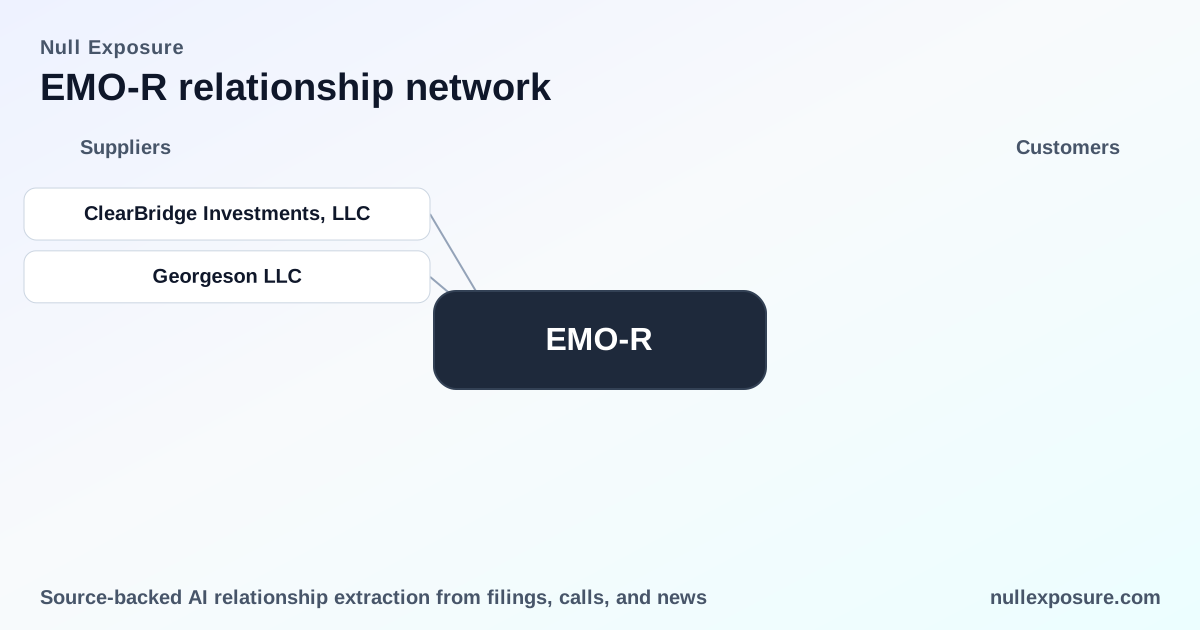
ClearBridge Investments, LLC — EMO-R is associated with services tied to a transferable rights offering for the ClearBridge Energy Midstream Opportunity Fund; the public release notes that ClearBridge is the manager responsible for the Fund’s investments, with standard active-management disclosures. This linkage is documented in a BizWire release distributed via FinancialContent on October 16, 2025. (FinancialContent / BizWire, Oct 16, 2025: https://markets.financialcontent.com/wedbush/article/bizwire-2025-10-16-clearbridge-energy-midstream-opportunity-fund-inc-announces-final-results-of-transferable-rights-offering)
-
Georgeson LLC — EMO-R is tied to work involving the Information Agent function for the same transferable rights offering, with public materials directing inquiries to Georgeson’s toll-free contact number. This appears in the October 13 and October 16, 2025 BizWire notices that circulated via FinancialContent and related outlets. (FinancialContent / BizWire, Oct 13–16, 2025: https://markets.financialcontent.com/statesmanexaminer/article/bizwire-2025-10-13-clearbridge-energy-midstream-opportunity-fund-inc-announces-preliminary-results-of-transferable-rights-offering)
Each named counterpart comes from regulatory- and offering-related press distributions; the pattern points to EMO-R operating as a supplier embedded in the offering lifecycle — communications, information agent support, or similar services.
What the relationships signal about EMO-R’s operating model
-
Contracting posture — project and event-driven: Public evidence links EMO-R to a specific offering. The company’s engagements are therefore transaction-oriented and scheduled around issuer timetables, not long-term master service agreements with continuous revenue.
-
Concentration — client exposure is concentrated by design: The visible ties are to a single fund transaction and its agents, which is consistent with high single-event concentration risk when those transactions represent a material share of revenue.
-
Criticality — niche but essential for issuance: Services like information-agent coordination and offering communications are operationally critical to completing a rights offering; losing a supplier mid-process would be disruptive to an issuer’s timetable, which increases EMO-R’s bargaining leverage for spot contracts.
-
Maturity — established cash-cycle, variable scale: The engagement model implies an experienced delivery pattern (e.g., documented procedures to support filings and investor communications), but growth depends on winning successive capital-markets mandates rather than expanding recurring product lines.
These operating signals should be treated as company-level characteristics derived from the observed offering work; they are not assigned to any single counterpart beyond the scope of the disclosed events.
Investment implications: risks, levers, and valuation posture
-
Revenue volatility: The event-driven model creates lumpy top-line performance. For valuation, apply a lower revenue multiple or model higher cash-flow variance unless there is evidence of diversified recurring work.
-
Customer concentration risk: A handful of fund sponsors and agents can drive a large share of near-term revenue; loss of one mandate materially affects short-term results.
-
Defensible niche: Work tied to regulated offering processes has switching frictions; EMO-R can command fee premiums for reliable execution, giving room for margin stability during active periods.
-
Pipeline visibility matters: Investors should prioritize forward-looking evidence of repeat mandates or retainer agreements to shift the narrative from episodic to semi-recurring revenue.
For further dossier-style tracking of counterparties and new disclosures, visit https://nullexposure.com/ to monitor updates and filings.
How to read the public disclosures (what the sources show)
The public references for these connections are press releases covering the ClearBridge Energy Midstream Opportunity Fund transferable rights offering. Those releases name ClearBridge as the manager of the Fund and Georgeson as the information agent, and they provide the operational framing where a supplier like EMO-R would supply services tied to investor communications or offering administration. Examples include the FinancialContent-distributed BizWire notices dated October 13 and October 16, 2025 that reported preliminary and final results for the offering and listed contact points for the Information Agent (see the FinancialContent/BizWire releases linked above).
Bottom line — what investors should do next
-
Treat EMO-R as a transaction-driven supplier with operational leverage during offerings and exposure to concentration risk. Model cash flows accordingly and treat any single-offer revenue as transient unless you find evidence of multi-offer or retainer relationships.
-
Prioritize diligence on contract pipelines and repeat business with asset managers and information agents. Confirming recurring engagements is the fastest path to upgrading revenue certainty.
-
Monitor filings and press releases associated with fund offerings for additional counterparties or repeated name-checks that signal scaling beyond one-off engagements.
For ongoing monitoring and to see updated supplier relationships as they are disclosed, go to https://nullexposure.com/. If you want a tailored briefing or a relationship map for EMO-R and its trading counterparties, start with the homepage at https://nullexposure.com/ and request a targeted report.