Enbridge Inc. (ENB) — supplier relationships, constraints, and what institutional investors should know
Thesis: Enbridge monetizes a portfolio of regulated and commercial energy infrastructure — principally pipelines, storage and growing power-and-storage services — by charging tariffed transportation and fixed-fee contracts while harvesting stable cash flows for a large dividend. The company combines regulated tariff income with merchant-like tolling and O&M arrangements for new power and battery assets; these contracts transfer operational delivery risk to suppliers while locking in long-term economics for Enbridge. For sourcing teams and investors, the supplier mix and credit exposure profile are central to counterparty risk and operational continuity. Explore structuring and counterparty oversight with Null Exposure: https://nullexposure.com/
How Enbridge operates and where the cash comes from
Enbridge is an energy infrastructure operator headquartered in Calgary that generates revenue through a combination of regulated pipeline tariffs, long-term service contracts, and commodity-related pass-throughs. The business blends low-volatility regulated cash flows with higher-growth but contractually defined returns from power and storage projects. Financials through the latest quarter (Q4 2025) show $65.2 billion in trailing revenue and $17.5 billion in EBITDA, supporting a sizable market capitalization (~$119 billion) and a dividend yield near 6.97% (latest published metrics). According to company disclosures through December 31, 2025, Enbridge’s operating model is capital intensive and contractor-driven: the firm outsources specialized equipment and maintenance for new battery energy storage (BESS) assets while retaining tariffed revenue streams.
- Key commercial driver: regulated tariffs and fixed-price service agreements that convert capital into predictable cash flow.
- Operating posture: mix of long-term contracting for third-party supply and internal O&M for core pipeline assets.
- Capital intensity: large upfront investments with long payback profiles; procurement and supplier contracting materially affect project returns.
If you want systematic supplier intelligence for infrastructure counterparties, start here: https://nullexposure.com/
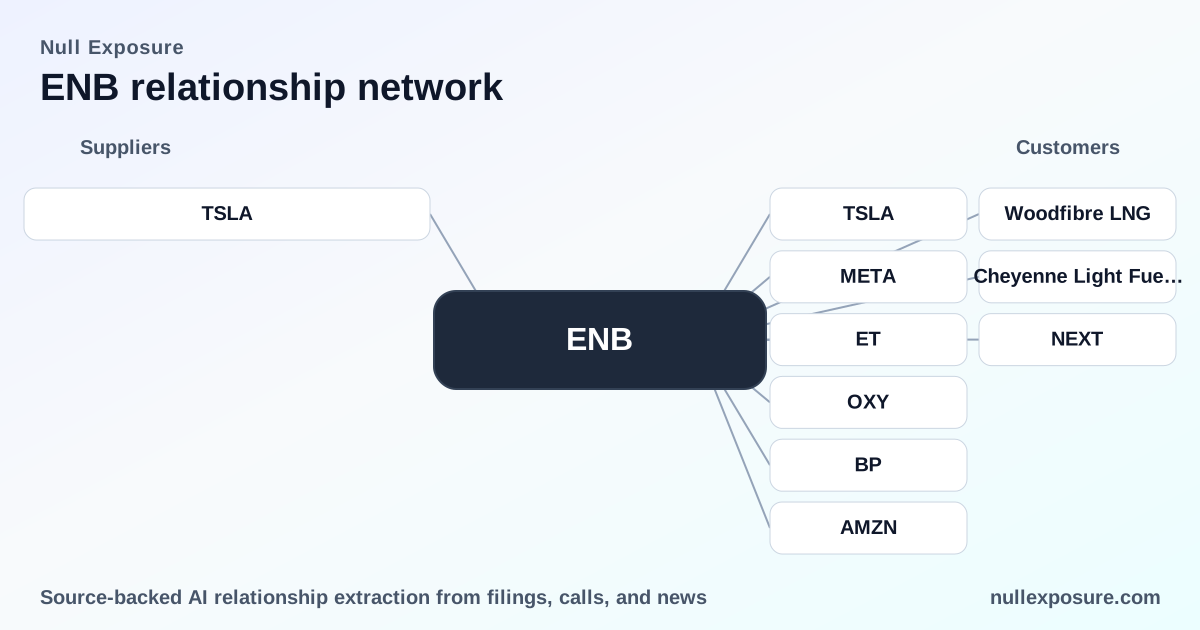
Supplier relationship in the results: Tesla
Tesla will supply and maintain battery systems under a long-term fixed-price battery tolling agreement tied to the same customers and LPCS tariff that support Enbridge’s operations; the BESS capacity is contracted to support those customers' operations and is supplied and maintained by Tesla. This was disclosed in an Enbridge media release dated March 9, 2026. (Enbridge press release, March 9, 2026 — https://www.enbridge.com/media-center/news/details?id=123871&lang=en)
What that contract means in plain English: Enbridge has contracted Tesla to provide the BESS hardware and ongoing maintenance under a fixed-price tolling structure, which delivers predictable service costs while Enbridge or its customer retains the tariffed revenue stream; Tesla therefore acts as a vendor for critical plant equipment and O&M under a long-term commercial commitment. (Enbridge press release, March 2026.)
Company-level constraints and what they reveal to investors
The disclosed constraints in Enbridge’s filings are not vendor-specific except where stated. Treat these as company-level signals that shape procurement risk appetite, counterparty selection and credit controls.
- Geographic counterparty exposures: Enbridge’s December 31, 2025 disclosure lists credit concentrations across regions — Asian financial institutions (39), European financial institutions (57), Canadian financial institutions (200) and US financial institutions (260), plus an “Other” category (302) that includes commodity clearing houses and energy counterparties. This indicates diversified but material credit exposure across NA, EMEA and APAC, requiring global credit oversight for counterparties and netting arrangements (Enbridge FY2025 disclosure).
- Buyer posture on commodities: The company explicitly records purchases of natural gas and crude oil with several significantly influenced investees as commodity costs. Enbridge acts as a counterparty purchaser in commodity markets, which creates procurement concentration and settlement exposure that procurement teams must manage (Company reporting, FY2025).
- Scale of spend categories: Line items such as operating and administrative costs (615), gas distribution costs (149) and commodity costs (38) in company disclosures point to >US$100m spend bands for critical categories and imply high spend concentration in a few supplier pools. Treat these categories as strategic sourcing priorities for risk mitigation (Company reporting, FY2025).
What these signals imply for contracting, concentration and criticality
- Contracting posture: Enbridge favors long-duration, fixed-price service arrangements for non-core assets (battery tolling with Tesla is a clear example), which transfers technology and operational risk to suppliers while preserving tariffed cash flows. This contracting posture supports capital allocation discipline and predictable unit economics.
- Concentration risk: The credit exposure table shows meaningful bilateral exposures to financial institutions across multiple regions and sizeable exposure to commodity counterparties. Concentration is both geographic and functional — financial counterparties plus physical commodity counterparties — demanding active collateral, netting and credit limit frameworks.
- Criticality and maturity: Pipeline assets are mission-critical and mature; BESS and power contracts are growth initiatives that require proven vendor capabilities and robust O&M SLAs. Supplier maturity and maintenance arrangements are decisive for operational continuity.
Investment implications and risk factors
- Counterparty credit management is a first-order risk. Large notional exposures to banks and clearinghouses across markets require strong netting clauses and active margining. (Enbridge FY2025 disclosure.)
- Fixed-price tolling reduces price volatility for Enbridge but concentrates execution risk on vendors. For investors, vendor performance under long-term equipment supply and maintenance contracts is a disclosure item to track.
- Procurement concentration elevates operational risk. Given the >$100m spend bands in several categories, loss or disruption with a major supplier can affect project schedules and returns.
- Regulatory and tariff overlay remains the earnings anchor. The regulated tariff construct insulates much of the business from commodity swings, but merchant and contracted power activities introduce execution variability.
Mid-read action: For deeper supplier counterparty intelligence and proactive exposure mapping visit https://nullexposure.com/
Practical recommendations for sourcing and portfolio teams
- Institute regional credit limits and continuous monitoring given multi-jurisdictional exposures (NA, EMEA, APAC and clearing/commodity counterparties).
- Prioritize performance bonds, parent guarantees or service-credit mechanisms for large fixed-price equipment-and-O&M contracts.
- Align procurement KPIs to asset criticality: pipelines get redundancy and conservative SLAs; newer BESS contracts require tight operational performance metrics and spares provisioning.
- Map >$100m spend buckets to a small set of strategic suppliers and run scenario stress tests on supplier failure or credit downgrade.
Bottom line and next steps
Enbridge combines regulated, tariffed cash flows with strategically contracted power and storage arrangements that offload hardware and O&M risk to suppliers like Tesla under fixed-price tolling. Investors should focus on counterparty credit exposure, procurement concentration, and contract terms that protect cash flow while enabling growth in non-regulated segments.
For institutional-grade supplier visibility and to translate these signals into actionable exposure reports, start a conversation at Null Exposure: https://nullexposure.com/