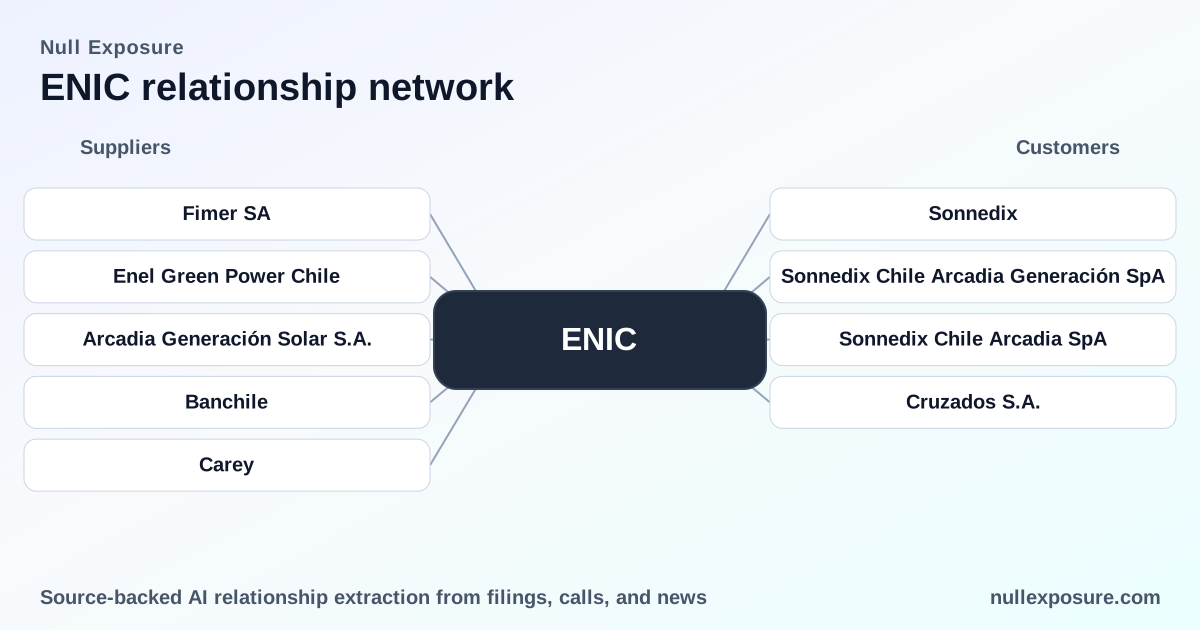
Enel Chile (ENIC) — supplier relationships that matter for investors and operators
Enel Chile operates and monetizes as a vertically integrated electricity platform: it generates, transmits and distributes power in Chile and sells energy through a mix of regulated tariffs, commercial contracts and asset-level transactions. The company captures margins through operating scale in generation and distribution, periodic asset rotations and long-term supply contracts that stabilize cash flow. For investors and procurement operators, understanding Enel Chile’s supplier and advisor relationships clarifies where operational risk, legal exposure and strategic flexibility sit on the balance sheet. For a concise vendor risk view, visit https://nullexposure.com/.
Quick financial snapshot — why supplier risk matters here
Enel Chile is a listed utility (NYSE: ENIC) with a market capitalization near $5.6 billion and trailing EBITDA around $1.28 billion (latest TTM). The business posts mid-single-digit returns on assets and double-digit returns on equity, with a trailing P/E near 10.5x and an EV/EBITDA around 5.2x — metrics consistent with a capital-intensive regulated/merchant hybrid. Supplier failures, equipment disputes or regulatory friction directly affect utilisation and cash conversion, so supplier relationships are material to valuation and operations.
Explore authoritative supplier-risk profiles at https://nullexposure.com/.
Who’s on the supplier and advisor list — concise relationship summaries
-
Fimer SA
A dispute with Italian equipment maker Fimer has escalated to arbitration over a series of fires at two solar plants managed by Enel Chile; the case is lodged at the Chamber of Commerce of Santiago’s Arbitration and Mediation Center. According to CIAR Global (March 2026), Enel Green Power Chile opened arbitration against Fimer over equipment-related fires. Source: https://ciarglobal.com/enel-green-power-chile-gana-arbitraje-a-italiana-fimer-en-conflicto-por-equipos-solares/ (first seen Mar 2026). -
Enel Green Power Chile
Enel Green Power Chile is the in-country builder/operator of major photovoltaic projects, including the Valle del Sol plant in Antofagasta; the entity is effectively the internal generation arm delivering project development and operations services to Enel Chile. Company information on the Valle del Sol plant confirms the build and operational role. Source: https://www.enel.cl/en/meet-enel/our-power-plants/valle-del-sol-photovoltaic-plant.html (accessed Mar 2026). -
Arcadia Generación Solar S.A.
Arcadia Generación Solar will continue supplying energy to Enel Chile under the terms of a sale contract announced by Enel; the arrangement preserves an offtake or supply relationship post-transaction. LexLatin reported that Enel confirmed Arcadia Generación Solar will remain a supplier via a commercial sale agreement. Source: https://lexlatin.com/noticias/enel-chile-arcadia-generacion-solar-sonnedix (Mar 2026). -
Banchile
Banchile acted as financial adviser on the asset sale referenced in the Arcadia transaction; the bank’s involvement indicates conventional investment-banking structuring and regulatory clearance processes were pursued. LexLatin noted Banchile’s role as financial adviser to the transaction, which is conditional on competition authority approval. Source: https://lexlatin.com/noticias/enel-chile-arcadia-generacion-solar-sonnedix (Mar 2026). -
Carey (law firm)
Carey provided legal advice to Enel Chile’s directors on the transaction, illustrating use of top-tier Chilean counsel for deal execution and regulatory filings. LexLatin cited Carey as the legal adviser to Enel Chile in the Arcadia sale process. Source: https://lexlatin.com/noticias/enel-chile-arcadia-generacion-solar-sonnedix (Mar 2026).
What these relationships reveal about Enel Chile’s operating posture
- Vertical integration with selective external exposure. Enel relies on its subsidiary, Enel Green Power Chile, to execute and operate core renewables assets, preserving control over generation margins and operations. Simultaneously, Enel contracts with third-party equipment suppliers (for example, Fimer) and third-party generators (Arcadia) when transaction economics or capacity needs dictate.
- Contracting posture is transactional but institutional. The use of formal arbitration (CAM Santiago) and engagement of major advisors (Banchile, Carey) show Enel operates with formal contract enforcement and investment-banking/legal rigor rather than ad hoc vendor management.
- Concentration and criticality are asset-driven. Generation assets and EPC/equipment suppliers are critical points of failure; the dispute with Fimer demonstrates that a single equipment supplier can generate outsized operational and legal risk when hardware reliability intersects with plant availability.
- Maturity and market behavior. The Arcadia sale with ongoing supply obligations and formal advisor roles signals a mature, portfolio-management approach: Enel monetizes assets while retaining supply continuity through contractual arrangements.
Constraints and disclosure signals
No supplier-level constraints were present in the provided intelligence. The absence of explicit constraints in public supplier reporting is itself a company-level signal: there is limited public disclosure of supplier-specific performance covenants or material supplier concentration metrics in the available relationship records. Investors should treat this silence as a monitoring mandate rather than comfort — regulatory approvals, arbitration filings and advisor roles are visible proxies for supplier and transaction risk.
Operational and investor implications — what to watch next
- Arbitration outcome and liability sizing. The Fimer arbitration will determine direct repair/replacement liabilities, insurance recoveries and potential operational downtime claims; these outcomes affect near-term cash outflows and future equipment sourcing strategies.
- Regulatory clearance for asset transfers. The Arcadia sale is conditional on competition authority approval (FNE), which can alter deal timing and transitional supply terms. LexLatin reporting identifies FNE approval as a gating item. Source: https://lexlatin.com/noticias/enel-chile-arcadia-generacion-solar-sonnedix (Mar 2026).
- Vendor diversification and sourcing policy. Recurrent equipment disputes should push procurement to tougher warranty and testing regimes and increase focus on vendor performance guarantees. Enel’s reliance on in-house generation capabilities reduces some supplier dependence, but third-party equipment remains a critical vector.
- Advisory chain as governance signal. Engagement of Banchile and Carey signals standard market governance for major disposals; investors should interpret advisor involvement as a sign that Enel is executing portfolio optimization within conventional financial and legal frameworks.
For deeper vendor exposure mapping and tailored counterparty risk reports, visit https://nullexposure.com/.
A practical checklist for monitoring ENIC supplier risk
- Monitor CAM Santiago arbitration filings and outcomes for the Fimer dispute.
- Track FNE and other Chilean regulatory notices tied to the Arcadia sale for timing risk.
- Review Enel Chile’s operational reports for plant availability metrics tied to assets built with third-party equipment.
- Watch contractual language in investor filings for warranty, indemnity and insurance recovery clauses that affect supplier liability allocation.
Closing: what investors and operators should take away
- Enel Chile operates a hybrid model combining in-house generation control with selective third-party equipment and third-party supply contracts; this structure balances operational control and portfolio flexibility.
- The Fimer arbitration is the most immediate supplier-related operational risk, while the Arcadia sale highlights ongoing asset rotation and structured supply continuity.
- Lack of public supplier-constraint disclosures requires active monitoring of legal proceedings and regulatory approvals to assess downstream cash and availability risk.
To subscribe to more supplier-centric intelligence and counterparty risk briefings for utilities, go to https://nullexposure.com/. For on-demand supplier relationship research and alerts tailored to ENIC counterparties, visit https://nullexposure.com/ today.