Entergy New Orleans (ENO): Supplier Relationships and Strategic Implications for Investors
Entergy New Orleans (ENO) operates as a rate-regulated utility providing electric and gas services in the New Orleans area, monetizing through regulated tariffs, fuel and purchased-power recovery mechanisms, and long-term contracted energy purchases. ENO's commercial model is dominated by supplier contracts that transfer operational risk (fuel delivery, transport, and maintenance) to counterparties while embedding cost recovery into regulated rates, creating predictable cash flows but concentrated supply exposures. For deeper coverage of utility supplier relationships and contract analytics, visit https://nullexposure.com/.
How ENO runs the business and gets paid
ENO is a retail utility within the Entergy group and earns its return primarily through regulated rate structures that recover fuel, purchased power, and transportation costs. The company acts largely as a buyer of energy and transport services and as a service consumer for third-party maintenance and audit providers, which is reflected in recurring, long-dated contractual commitments and line-item pass-throughs to customers under rate mechanisms. The FY2024 disclosures show a mix of long-term purchase and service agreements, material spend bands that range from single-digit millions to well over $100 million, and active vendor oversight programs that govern security and investment trust arrangements.
- Contracting posture: The business relies on long-term and no-notice purchase arrangements as well as long-term service agreements, creating structural lock-ins but allowing cost recovery under regulation.
- Concentration and criticality: Contracted suppliers for fuel transport and gas supply are operationally critical; large payments to energy suppliers and transportation providers are routine and recoverable through rates, concentrating counterparty risk in fuel and logistics providers.
- Maturity and spend profile: Evidence points to mature, high-dollar arrangements (multi-year commitments with projected payments through 2031 for some agreements) alongside recurring audit and professional services in the $1–12 million band annually.
For a practitioner’s view on supplier exposures and to benchmark ENO against peers, see https://nullexposure.com/.
Supplier relationships disclosed in the FY2024 filing
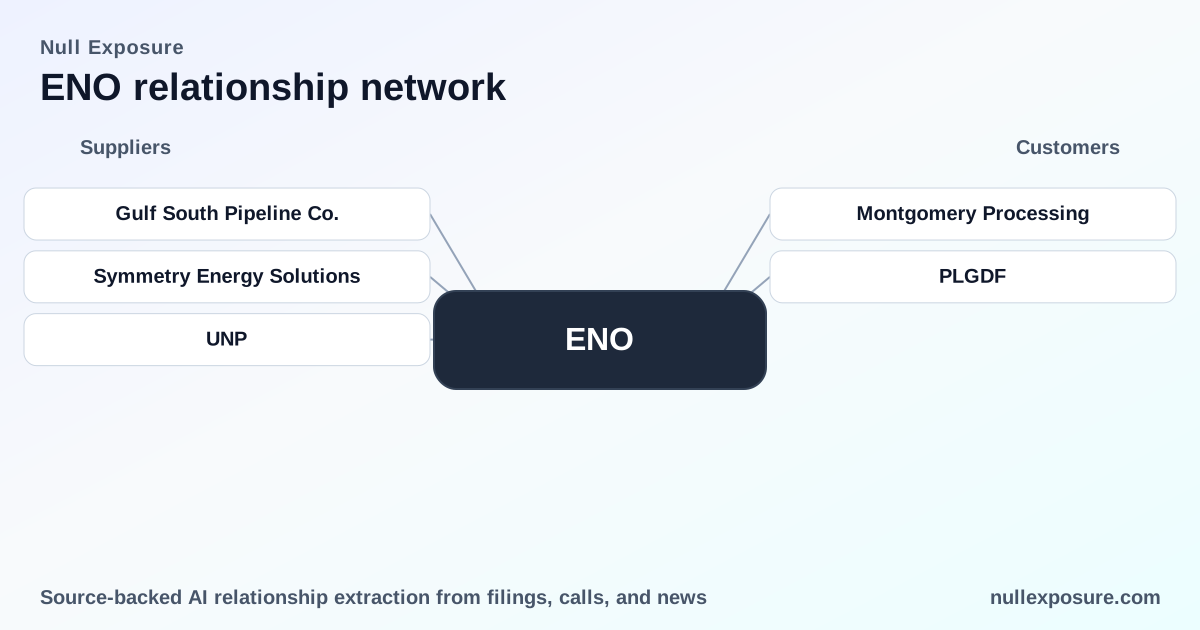
The FY2024 Form 10‑K lists specific supplier and transport relationships that shape ENO’s operational reliability and cost profile. Below are the relationships extracted from that filing, each summarized in plain English with source context.
Gulf South Pipeline Co.
Entergy New Orleans receives gas that is transported under a transportation service agreement with Gulf South Pipeline Co., which moves gas sourced from its supplier(s) to ENO delivery points. This arrangement underpins ENO’s physical ability to accept gas supplies for local distribution. According to the FY2024 Form 10‑K, the Symmetry-sourced gas is carried pursuant to this Gulf South transportation agreement (FY2024 10‑K).
Symmetry Energy Solutions
ENO has a no‑notice gas purchase contract with Symmetry Energy Solutions that guarantees gas delivery at specified delivery points and permits deliveries at any volume within contract minimums and maximums, providing operational flexibility and short-notice supply capability. This provision is described in ENO’s FY2024 Form 10‑K as a no-notice service gas purchase contract (FY2024 10‑K).
Union Pacific (UNP)
The filing notes that coal destined for Arkansas will be transported under an existing Union Pacific agreement expected to meet Entergy Arkansas’s rail transportation needs for 2025; the mention reflects system-wide logistics arrangements within the Entergy group that include rail transport providers. The FY2024 Form 10‑K references Union Pacific’s role in transporting coal to Entergy facilities (FY2024 10‑K).
What the contractual and spend signals imply
The disclosures and constraint signals outline a disciplined, rate-regulated procurement posture and several material strategic implications:
- Long-term commitments dominate the supplier landscape. The company-level evidence highlights long-dated contracts (examples extend through 2031) and long-term service agreements for generation assets, indicating predictable, contractually secured supply but also multi-year counterparty exposure.
- ENO functions primarily as a buyer of fuels, transport, and services. Constraint-level signals label the company’s role as buyer for capacity and energy allocations across Entergy subsidiaries, reflecting centralized procurement dynamics and embedded cost recovery in rates.
- Spend concentration is material. Company disclosures show payments in the $100m+ band for certain contracts and numerous $1–10m and $10–100m relationships (audit and professional services), indicating that supplier performance and contract terms have direct balance-sheet and rate-case implications.
- Global sourcing and supplier diversity for certain inputs. ENO’s parent-level disclosures reference global uranium buying and diversified sellers, signaling exposure to global commodity markets for some fuel types—this is a company-level sourcing signal rather than a counterparty-specific note.
- Mature vendor governance is in place. The registrant relies on vendor risk management and third-party trusts with defined investment guidelines, an operational control that reduces, but does not eliminate, counterparty and operational risk.
Collectively, these characteristics make supplier performance a core driver of regulatory filings and near-term rate cases; suppliers that fail to deliver can trigger tariff adjustments, operational constraints, or reputational risk for the utility.
Risk vectors and investor implications
- Counterparty concentration: A small number of transport and fuel counterparties are operationally critical; disruption to pipeline or rail services would be quickly visible in dispatch and cost recovery filings. Investors should treat exposure to transport providers as a first-order operational risk.
- Regulatory pass-through reduces earnings volatility but transfers credit and operational risk to counterparties. ENO’s revenue model cushions fuel-price volatility but keeps service continuity firmly tied to supplier reliability.
- Large, multi-year payments increase forward commitments on cash flow. Several contract excerpts reveal projected multi‑year payments that will be recovered through rates, constraining short-term margin flexibility and tying capital allocation decisions to long-term procurement plans.
- Vendor governance is robust on paper. The presence of formal vendor risk programs and third-party trust mandates is a positive control signal for institutional investors focused on operational resilience.
Practical next steps for investors and operators
- Monitor counterparties that provide transportation and no‑notice gas supply—the operational dependency on pipeline capacity and rail logistics is material to reliability and costs.
- Prioritize diligence around long-term contracts that extend beyond five years, particularly those with projected $100m+ payment profiles; these contracts are potential drivers of future rate cases and cash commitment windows. For details on supplier exposure benchmarking, visit https://nullexposure.com/.
- Validate vendor risk-management practices in quarterly filings and regulatory testimony; strong internal controls reduce systemic supplier risk and improve predictability of regulated returns.
For operational teams and procurement decision-makers, align contingency planning with the pipeline and rail schedules in the filings; for investors, treat supply-chain resilience as an earnings-quality metric rather than a speculative input.
For more research on utility supplier relationships and contractual risk analytics, go to https://nullexposure.com/.
Closing note: ENO’s FY2024 disclosures show a utility that leverages regulated cost recovery to stabilize earnings while accepting concentrated supplier and transport exposure as an operational necessity; active oversight of those counterparties will determine whether that tradeoff remains favorable for shareholders.