Ensign Group (ENSG): Real estate-led roll-up with predictable cash flow and acquisitive growth
The Ensign Group monetizes a portfolio of post-acute care facilities by operating skilled nursing and rehabilitation centers and, increasingly, acquiring associated real estate and operations to capture both operating margin and rental upside. The company combines long-duration lease structures, targeted facility modernizations, and selective property acquisitions to drive steady revenue per bed and margin expansion; investors should evaluate supplier and partner relationships through the lens of real estate control, lease length, and capital spending cadence. For a deeper supplier-risk analysis and relationship mapping, visit NullExposure.
How Ensign makes money and why supplier relationships matter
Ensign is a healthcare operator that earns revenue from patient care across skilled nursing and post-acute services while also extracting value from real estate arrangements. The company reported $5.06bn in revenue (TTM) and $826m gross profit (TTM), with operating margin near 9.1%—numbers that reflect an operating business tightly coupled to property ownership and lease economics. Ensign’s model is dual: run clinical operations to generate patient-care cash flow and lock in property positions (leases or ownership) to stabilize occupancy and capture asset-level appreciation. Supplier and counterparty relationships—especially those that transfer real estate and operational control—directly affect Ensign’s margin stability and capital intensity.
Key operating constraints that shape supplier exposure
- Contracting posture: predominantly long-term. Company filings show Ensign’s independent subsidiaries operated 253 of 373 facilities under long-term leases as of December 31, 2025, and mortgage terms run 25 to 35 years, signaling multi-decade landlord/tenant commitments that create durable supplier relationships and predictable rent cash flows.
- Short-term liquidity overlays exist. The firm maintains a revolving line of credit (up to $600,000) maturing April 8, 2027, which introduces near-term refinancing and liquidity considerations separate from long-term mortgage profiles.
- Capital intensity with concentrated episodic spend. Ensign invested $193.6m in property improvements and equipment in 2025, showing periodic large capex that drives procurement and supplier demand; by contrast, ongoing rent expense lines can be modest on a per-lease basis (reported rent expense figures in the low tens of thousands for certain master leases in the filings).
- Maturity and criticality. Long-dated mortgages and leases indicate mature contracting relationships where partners (lenders, landlords, REITs) are structurally important; short-term credit facilities and capex cycles create tactical supplier risk.
These constraints are company-level signals about contracting concentration and capital rhythm rather than attributes of any single third party. For a supplier-oriented buyer or operator, the mix of long-term leases, large episodic capex, and periodic short-term financing defines where vendor negotiation leverage and operational risk concentrate.
If you want a mapped view of Ensign’s counterparty network and supplier dependency, check NullExposure for investor-grade relationship analytics.
Recent acquisitions and partner ties: what they signal for suppliers and counterparties
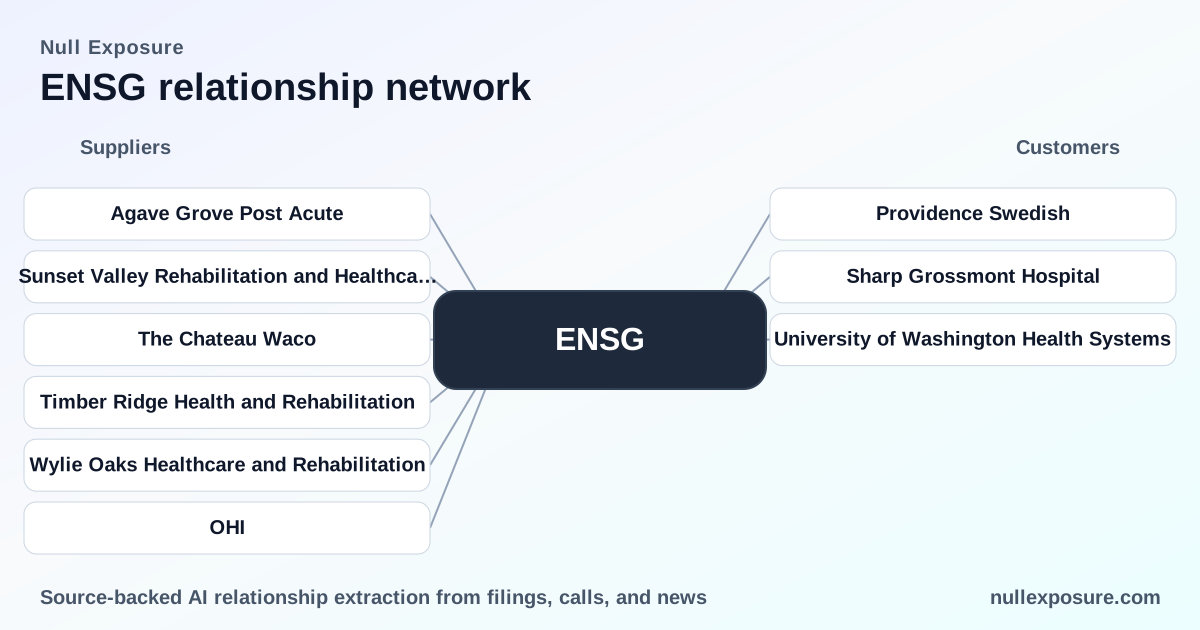
Below I cover every relationship flagged in the reporting set and what each transaction or mention means for investors and procurement teams.
Agave Grove Post Acute — expansion in Arizona
Ensign acquired operations of Agave Grove Post Acute, a 225-bed skilled nursing facility in Glendale, Arizona, consolidating operational control in that market and increasing local procurement and staffing needs. The transaction was disclosed in a company press release reported via The Globe and Mail on March 9, 2026.
Sunset Valley Rehabilitation and Healthcare Center — Littlefield, Texas acquisition
Ensign acquired the 80-bed Sunset Valley Rehabilitation and Healthcare Center in Littlefield, Texas as part of a multi-facility transaction, indicating continued roll-up activity in Texas that will expand regional purchasing volumes for clinical supplies and services. The deal is detailed in the Ensign press release covered by The Globe and Mail (Mar 9, 2026).
The Chateau Waco — real estate and operations in Waco, Texas
Ensign purchased both the real estate and operations of The Chateau Waco (123 beds), a move that brings the property onto Ensign’s balance sheet and strengthens control over capex and vendor selection for that facility. This was announced in the same March 9, 2026 press release via The Globe and Mail.
Timber Ridge Health and Rehabilitation — Stevens Point, Wisconsin
The company acquired Timber Ridge Health and Rehabilitation, a 48-bed skilled nursing facility in Stevens Point, Wisconsin, expanding its footprint in the Midwest and creating a small but strategically relevant procurement node for local vendors. The acquisition was included in Ensign’s March 9, 2026 disclosure reported by The Globe and Mail.
Wylie Oaks Healthcare and Rehabilitation — Wylie, Texas
Ensign acquired the real estate and operations of Wylie Oaks Healthcare and Rehabilitation (106 beds) in Wylie, Texas, further consolidating Texas market share and increasing medium-term capital and vendor service demand. The transaction is cited in Ensign’s March 9, 2026 press release as reported by The Globe and Mail.
Omega Healthcare REIT (OHI) — site-level collaboration on vacant land
Ensign disclosed working with Omega Healthcare REIT to utilize several acres of vacant land on a leased property—an example of Ensign collaborating with a REIT landlord to unlock development or expansion potential on an existing site. This collaboration was described during the Ensign Q4 2025 earnings call transcript published on InsiderMonkey (Q4 2025). The relationship underscores how Ensign negotiates with institutional real estate partners to extract optionality from leased assets.
What investors and operators should watch next
- Concentration in long-term leases means counterparty risk lives with landlords and REIT partners; continued acquisitions of real estate and operations suggest Ensign wants to internalize both operating and landlord cashflow, increasing supplier contract tenure and procurement centralization.
- Large periodic capex (>$190m in 2025) drives supplier dependency cycles and creates windows where vendor leverage shifts; procurement teams should expect spikes in demand around modernization programs.
- Short-term credit lines create refinancing milestones (e.g., April 2027) that could compress liquidity if market conditions change; watch covenant schedules and lender relationships.
For an investor-focused supplier risk scorecard and contract-tenure heatmap on Ensign, visit NullExposure.
Bottom line
Ensign’s operating model is real-estate intertwined with clinical operations, producing steady revenue and recurring margin streams while requiring episodic, material capital expenditure and active landlord/REIT collaboration. Suppliers and counterparties will find long-term stability in many relationships because of multi-decade leases and mortgage terms, but they should prepare for concentrated procurement periods tied to Ensign’s modernization programs and acquisition cadence. For a structured supplier audit and to monitor Ensign’s counterparty exposures in real time, go to NullExposure.