Enova International (ENVA): Supplier relationships and operational constraints investors should price in
Enova is a technology-first lender that monetizes by originating and servicing short-term and small-business loans across multiple jurisdictions, using proprietary data science and AI underwriting to drive yield and scale. The company generates revenue primarily from interest and fee income on a $1.49B trailing twelve-month revenue base and sustains healthy margins (about 20.7% profit margin), positioning it as a profitable, analytics-driven credit franchise with a market capitalization near $3.35B. For a targeted supplier-risk overview and supplier maps, visit https://nullexposure.com/.
How Enova organizes third-party capabilities — a concise read for investors
Enova’s operating model is built on a split between internal analytics and outsourced operational capabilities. The firm licenses security and authentication technologies and contracts an array of third-party service providers — from lead generators and marketing affiliates to underwriting and payment processors — to acquire customers and execute loan lifecycles. This hybrid model lets Enova concentrate investment in data science and credit models while outsourcing discrete operational and customer-acquisition tasks.
- Contracting posture: Enova uses a mix of licensing agreements (for encryption/authentication) and service-provider contracts (marketing, underwriting support, payment processing). The language in company disclosures highlights licensed security tech and multiple third-party vendors, indicating standard commercial contracts rather than captive in-house builds.
- Concentration: The company references “many other third parties” and “lead providers and marketing affiliates,” signaling a deliberately diversified vendor base rather than reliance on a single supplier for these functions.
- Criticality: Encryption/authentication providers and payment/underwriting processors are mission-critical to the lending flow — they protect customer data and enable funding and repayments — and therefore warrant heightened operational and counterparty monitoring.
- Maturity: Use of licensed security technologies and established affiliate channels indicates mature, market-standard supplier relationships that are operationally embedded rather than experimental.
Supplier relationships investors must account for
Below I cover every supplier relationship surfaced in the available results and explain the investment-relevant takeaways.
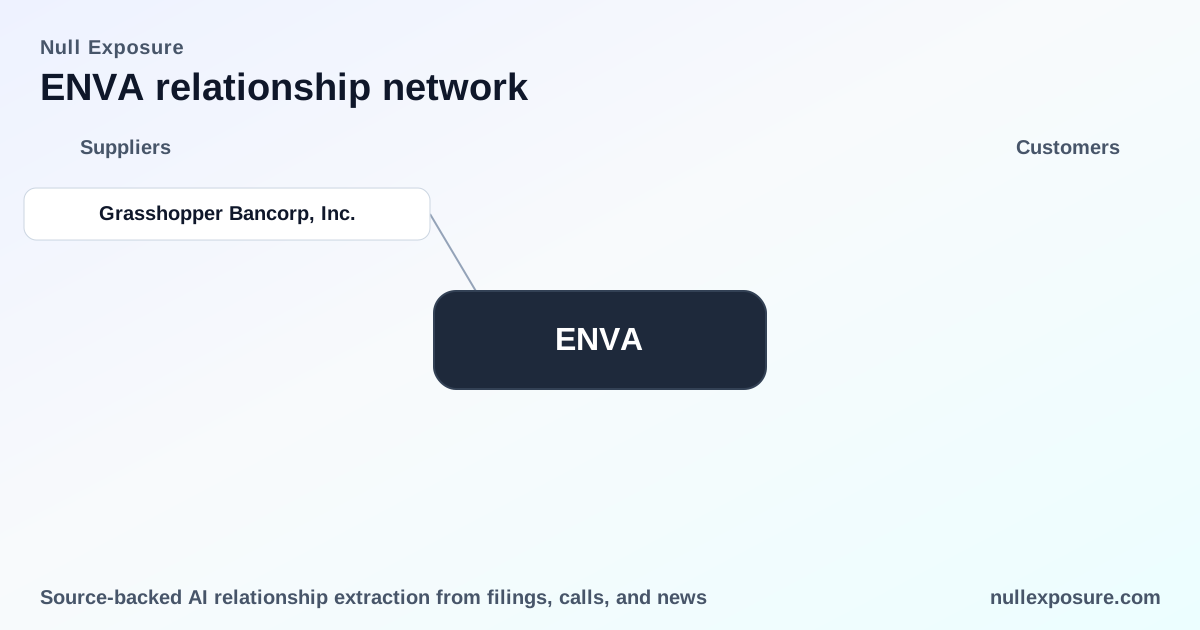
Grasshopper Bancorp, Inc. — strategic capability acquisition, not a simple vendor tie
Enova announced an expansion of its digital lending reach through acquisition of Grasshopper Bancorp, bringing a banking license, deposit base and a digital platform focused on entrepreneurs and tech-forward clients, while Enova supplies data science and AI underwriting capabilities to scale small-business and consumer lending. This transaction transforms a supplier-like banking capability into a strategic, on-balance-sheet capability that reduces dependence on third-party deposit channels. (Source: Sahm Capital news report, February 25, 2026.)
What the constraints signal about operational risk and vendor management
Enova’s constraint excerpts convey two explicit relationship roles: licensor and service provider.
- The licensor role is explicit: Enova relies on encryption and authentication technology licensed from third parties to secure transmission of confidential information, including customer bank account and personal data. This makes data-security vendors core to regulatory and operational resilience, and contract terms around updates, certification, and liability are consequential for continuity.
- The service-provider role is explicit: Enova uses lead providers and marketing affiliates for new-customer acquisition and “many other third parties” for underwriting and payment processing. This establishes a performance-driven supplier architecture where customer growth levers are partly outsourced, and payment/underwriting vendors are embedded in the credit lifecycle.
Taken together these constraints are a company-level signal: Enova is architected to keep analytics and credit decisioning in-house while outsourcing security, customer acquisition, and payments. That operating posture reduces capital and operational burden but increases the importance of vendor SLA oversight, fraud controls at integration points, and contingency planning for critical vendors.
Operational and investment implications
- Counterparty concentration risk is low by design. The language about “many other third parties” and use of affiliates indicates Enova spreads operational exposure across multiple vendors rather than relying on a single counterparty for customer acquisition or payment servicing.
- Security and payments are single points of functional criticality. Encryption/authentication vendors and payment processors are fundamental to operations; failures or contract disputes in these categories would materially interrupt origination and servicing pipelines.
- Commercial flexibility is high. Marketing affiliates and lead providers are usually performance-based, providing elastic customer acquisition but also volatility in unit economics if sourcing costs shift.
- Regulatory and reputational sensitivity is elevated. Outsourced security and payment functions escalate compliance scrutiny because third-party controls extend directly into customer data protection and payment integrity.
For a deeper supplier-risk assessment and to see how these supplier dynamics compare to peers, visit https://nullexposure.com/ where you can explore supplier maps and risk scoring.
What investors should watch next (practical signals)
- Monitor regulatory filings and investor presentations for details on the Grasshopper integration, especially how Enova intends to migrate deposit flows and whether this reduces funding cost or expands margins.
- Track vendor-related disclosures: security audits, certification renewals, and payment-processor continuity plans. Any mention of single-vendor licensing renewals or concentration clauses should be treated as material.
- Watch customer acquisition cost trends tied to lead providers and affiliates; rising sourcing costs will compress unit economics faster than improvements from analytics alone.
Bottom line
Enova operates as a high-margin, analytics-first lender that deliberately outsources non-core functions — licensed security tech and a network of service providers — while buying bank capabilities (Grasshopper) to internalize funding and distribution advantages. That structure supports scalable underwriting performance but places outsized importance on vendor selection, contractual protections, and integration execution. For a full map of supplier exposures and prioritized counterparty risks, visit https://nullexposure.com/ and see the supplier insights that institutional investors are using to quantify operational risk.