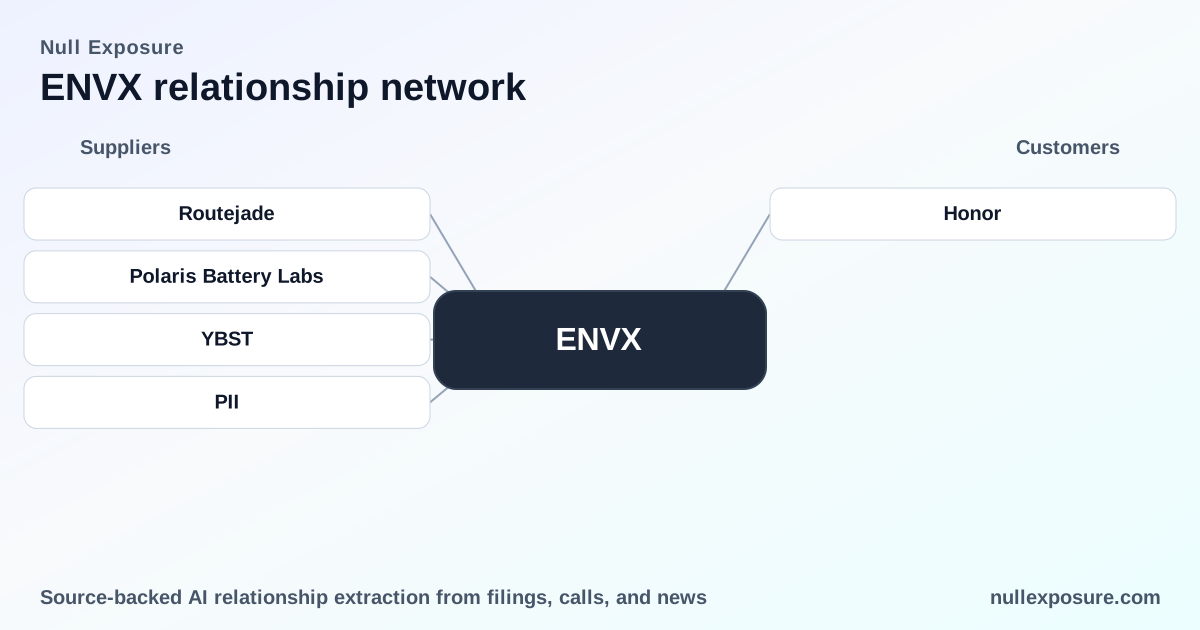
Enovix (ENVX) supplier map: what investors should know about manufacturing partners and testing relationships
Enovix operates and monetizes by designing and commercializing a proprietary 3D silicon lithium‑ion cell architecture and then scaling production through a mix of in‑house capabilities and long‑term manufacturing partnerships. Revenue comes from selling high‑density cells and modules to consumer electronics and adjacent markets, while the company accelerates customer qualification by outsourcing volume manufacturing and independent verification to specialized partners. The business model blends IP-led product development with contract manufacturing and independent test validation to convert technology leadership into commercial shipments.
Explore supplier risk profiles and relationships in one place at https://nullexposure.com/.
Why suppliers matter to Enovix investors
Enovix’s value proposition is technology-led, but the path from lab performance to recurring revenue is fundamentally dependent on third‑party manufacturing and independent testing. Execution risk is concentrated not in R&D but in supplier performance, contract tenure, geographic diversity and qualification timelines. For investors, the critical questions are whether manufacturing partners can scale, whether contracts lock in favorable terms, and whether independent validation removes barriers to customer adoption.
Key operational signals:
- Long-term manufacturing commitment: Enovix has a multi-year manufacturing agreement structure that supports scaling timelines but creates counterparty concentration risk when a single partner handles volume.
- Global supply footprint: Materials and services are sourced globally, which spreads sourcing risk but increases exposure to cross‑border logistics and regional incident disruption.
- Use of master supply agreements and second sources: The company has executed framework agreements and qualified backup suppliers for some materials, which reduces single‑point failure for critical inputs.
If you track supplier concentration or counterparty exposure, learn more about supplier intelligence at https://nullexposure.com/.
The relationships — Routejade, Polaris (Polaris Battery Labs) and YBS
This section covers every supplier and service relationship identified in public filings and news.
-
Routejade: Enovix disclosed the acquisition of Routejade, a South Korea battery manufacturer, in 2023 and the establishment of an R&D center in Hyderabad to support product and manufacturing teams. This transaction gives Enovix a degree of manufacturing control and localized technical capability in Asia. (Source: Enovix FY2024 10‑K filing, December 2024.)
-
Polaris Battery Labs (independent testing): Enovix engaged Polaris Battery Labs to conduct a side‑by‑side evaluation of the Enovix AI‑1 smartphone battery against a leading commercial smartphone battery; Polaris verified a 935 Wh/L result that Enovix publicized in January 2026, reinforcing the technology claim. (Source: GlobeNewswire press release, January 13, 2026; supporting commentary in market coverage, March 2026.)
-
YBS International Berhad (manufacturing partner): Enovix entered into a 10‑year manufacturing agreement with YBS in July 2023, under which YBS assigned its subsidiary Orifast Solution Sdn Bhd (OSSB) to manufacture lithium‑ion batteries for Enovix; the agreement includes an automatic five‑year extension clause and significant remaining term as of December 2024. (Source: Enovix FY2024 10‑K filing, December 2024.)
What each relationship means for execution and risk
Enovix’s supplier strategy mixes ownership (acquisition), long‑term contracts, and third‑party validation. That creates a set of predictable trade‑offs for investors.
-
Acquisition of Routejade reduces certain scaling risks by bringing manufacturing capability and local talent in‑house, improving control over process transfer and qualification timelines; however, integration execution becomes the gating item (Enovix FY2024 10‑K).
-
Independent verification from Polaris strengthens the technology story by providing a recognized third‑party benchmark for energy density; validation helps during customer qualification but does not remove the need to demonstrate reproducible yields at high volume (GlobeNewswire, Jan 2026; market analysis March 2026).
-
The YBS 10‑year manufacturing contract demonstrates long‑term capacity planning but increases counterparty concentration because a significant portion of volume is governed by a single manufacturing partner; the contract’s automatic extension amplifies that concentration unless Enovix secures additional qualified volume sources (Enovix FY2024 10‑K).
Constraints and company-level signals that shape supplier risk
The public record contains explicit contract excerpts and operational descriptions that reveal Enovix’s contracting posture and maturity.
-
Contracting posture — long‑term commitments with framework protections. Enovix operates with long‑dated manufacturing agreements (a 10‑year YBS Agreement with a five‑year auto‑extension) and also executes master supply agreements and qualified second sources for certain materials, indicating a hybrid model that balances locked capacity with redundancy (company 10‑K excerpts).
-
Concentration and criticality. Long tenor manufacturing agreements reduce volume uncertainty for both parties but create concentration risk if a single manufacturer underperforms; independent testing partners help de‑risk technology validation but do not substitute for manufacturing scale.
-
Geographic maturity and global sourcing. Enovix sources materials globally and maintains operations across the U.S., Malaysia, India and Korea; this gives access to diversified supply chains but also increases exposure to regional disruptions (company filings citing outages and global supply sourcing).
-
Operational roles. Public documents categorize suppliers as manufacturers (explicit for YBS/OSSB) and as service providers for hosting, applications and testing, indicating Enovix relies on a mix of production and non‑production third parties.
Collectively, these constraints show an organization moving from pure R&D toward industrialized manufacturing with formal, long‑dated contracts and selective vertical integration.
Investment implications: what to watch next
- Monitor production yields and qualification timelines from YBS/OSSB and Routejade integrations; high yields convert the Polaris-verified lab metrics into revenue.
- Track customer qualification announcements following Polaris validation; independent test results are necessary but not sufficient without demonstrated high‑volume repeatability.
- Watch for additional long‑term contracts or capacity diversification that reduce single‑partner concentration.
If you evaluate counterparty exposure or need a supplier due‑diligence baseline, start with a focused supplier map on our platform: https://nullexposure.com/.
Bottom line
Enovix has structured its supplier relationships to accelerate scale: a long‑term manufacturing anchor (YBS), an acquired manufacturer (Routejade) and independent validation (Polaris) together form a coherent path to commercialization. The trade‑off for investors is clear: these relationships materially de‑risk technology delivery but concentrate operational dependence on a few critical partners. Track manufacturing yields, contract roll‑outs, and additional capacity announcements to convert Enovix’s technology advantage into predictable revenue.
For deeper supplier analytics and monitoring tailored to investment due diligence, visit https://nullexposure.com/.