EON Resources (EONR) — supplier relationships and what they mean for investors
EON Resources operates as a small-cap independent oil and gas exploration and production company focused on the Permian Basin; it monetizes through upstream production and asset development, selling hydrocarbons and leveraging third-party engineering and vendor services to convert reserves into cash flow. With a concentrated operating footprint in the Northwest Shelf and early-stage balance sheet dynamics, EON’s commercial success depends on efficient service procurement, reserve validation, and careful capital allocation. For a quick look at related supplier intelligence, visit https://nullexposure.com/.
What EON sells, how it contracts, and why suppliers matter
EON’s core revenue driver is oil and gas production from Permian assets; the company outsources a meaningful portion of drilling, completion and reserve evaluation work to specialist firms. That contracting posture creates predictable vendor dependence: engineering firms validate reserves that underpin investor valuation, while IR and vendor arrangements influence liquidity and working capital. EON’s public filings show a modest market capitalization ($58.9M) and lean revenue run-rate ($17.3M TTM), with negative reported EBITDA and EPS — a profile consistent with a growth-through-development upstream operator that relies on external service providers to scale production.
- Concentration: operations centered on the Grayburg-Jackson field in Eddy County, New Mexico (Northwest Shelf, Permian).
- Vendor intensity: third-party services are critical to drill and produce; the company recognizes stock-based compensation to vendors as part of vendor settlements.
- Size and maturity: small-cap operator with active derivative arrangements tied to its lender; procurement and counterparty selection materially affect capital efficiency.
Explore supplier risk and counterparty mapping at https://nullexposure.com/.
Supplier relationships identified in public disclosures
Below I summarize each supplier relationship surfaced in recent filings and press releases. Each entry is concise, sourced, and focused on investor-relevant facts.
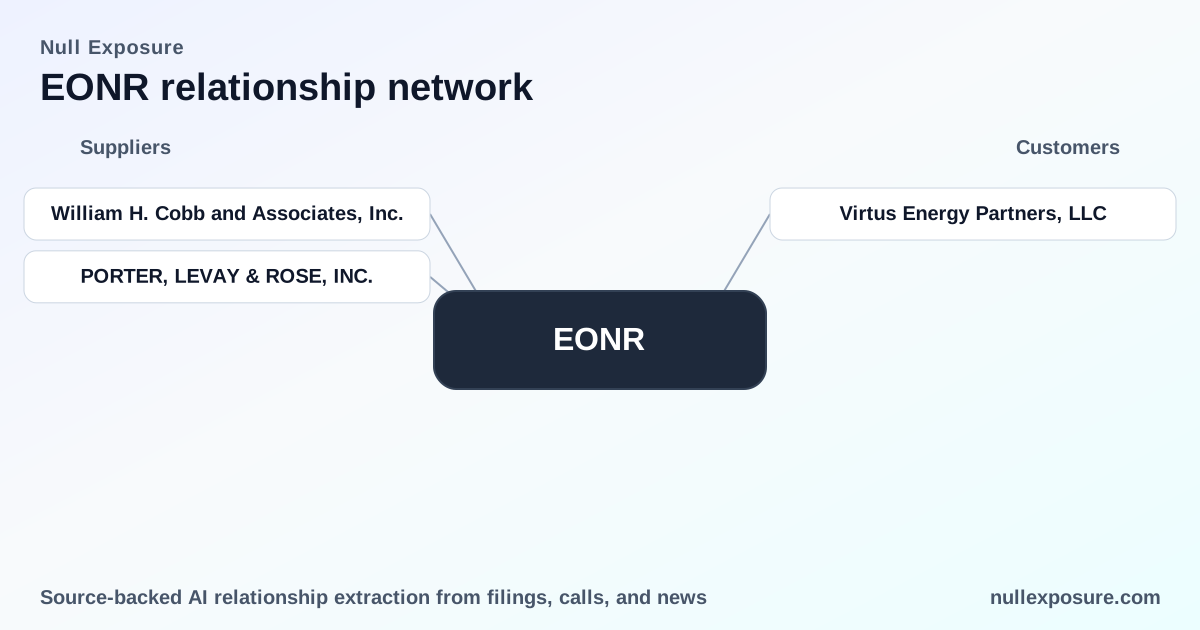
William H. Cobb and Associates, Inc.
- The company’s December 2023 reserve report from third-party engineer William H. Cobb and Associates assigns LHO proven reserves of approximately 15.4 million barrels of oil and 3.5 billion cubic feet of natural gas, a key input for reserve-backed valuation and production planning. Source: AccessNewswire press release (March 9, 2026) describing the December 2023 reserve report (https://www.accessnewswire.com/newsroom/en/oil-gas-and-energy/hnr-acquisition-corp-announces-change-of-name-to-eon-resources-inc.-and-change-of-909698).
- A companion release repeats the same reserve figures in the company’s rebranding announcement; the engineering report functions as the technical foundation for investor communications. Source: AccessNewswire press release (March 9, 2026) (https://www.accessnewswire.com/newsroom/en/oil-gas-and-energy/hnr-acquisition-corp-is-now-eon-resources-inc.-919333).
PORTER, LEVAY & ROSE, INC.
- Porter, Levay & Rose is listed as the company’s investor relations contact, with Michael J. Porter named as President and the firm’s contact details provided in the company announcement; that establishes an outsourced IR relationship for capital markets outreach. Source: AccessNewswire press releases (March 9, 2026) (https://www.accessnewswire.com/newsroom/en/oil-gas-and-energy/hnr-acquisition-corp-announces-change-of-name-to-eon-resources-inc.-and-change-of-909698 and https://www.accessnewswire.com/newsroom/en/oil-gas-and-energy/hnr-acquisition-corp-is-now-eon-resources-inc.-919333).
Constraints and what they tell investors about the operating model
EON’s disclosures present a coherent set of operating and sourcing signals that inform supplier risk, contract posture, and spending behavior.
- Geographic focus is narrow and operationally specific. The company explicitly centers activity on the Northwest Shelf of the Permian Basin and the Grayburg-Jackson field in Eddy County, New Mexico, which concentrates operational risk but simplifies supplier logistics and local supplier selection.
- Service-provider dependence is structural. Filings state EON relies on multiple third-party service providers for development and production activities; drilling of new wells is conducted by independent contractors under customary industry practice. This creates operational criticality for vendors that supply drilling, completions, and field services.
- Vendor economics include equity-linked settlements. The company issued 1,200,000 common stock warrants to a vendor to settle payables, with an estimated fair value recognized as stock-based compensation of $981,826 during the year ended December 31, 2024 — a clear indicator that EON uses equity incentives to manage working capital and vendor relationships.
- Active counterparties and financial arrangements. EON reports active derivative activities with one counterparty secured by its bank credit facility, which is evidence of ongoing hedging or financial-risk management via counterparties tied into its lending structure.
- Typical single-supplier spend band is modestly material. The warrant-based settlement and the recorded stock-based compensation point to vendor engagements that fall in the $100k–$1M range, signifying meaningful but not outsized single-vendor exposure.
These characteristics position EON as a capital-constrained, vendor-reliant upstream operator that compensates service providers with a mix of cash and equity-linked instruments — a profile investors must model into liquidity and dilution scenarios.
Investment implications and risk checklist
EON’s supplier map and financial profile produce a compact set of investment considerations:
- Reserve validation drives valuation. Third-party engineering reports (William H. Cobb) materially affect perceived asset value and future financing capacity.
- Vendor relationships impact production ramp and cash flow. Outsourced drilling and completion services are operationally critical; any supplier disruption would delay wells and cash generation.
- Equity-linked vendor settlements dilute shareholders. The issuance of warrants to settle payables signals constrained cash liquidity and a willingness to trade future equity for near-term operational stability.
- Concentration amplifies execution risk. Single-basin focus (Grayburg-Jackson) reduces geographic diversification and ties performance to local operational success.
Key actions for operators and investors: monitor reserve updates, vendor payment terms, warrant exercises/dilution, and derivative counterparty exposures. For deeper supplier due diligence and visibility into vendor contracts, consult https://nullexposure.com/.
Final read: what to watch next
EON is a narrow, service-dependent E&P with reserve-backed upside but constrained liquidity dynamics. The company’s use of third-party engineering for reserve certification and outsourced investor relations are positive signs of professionalization, yet the use of warrants to settle vendor payables and negative EBITDA are reminders that execution and working capital management remain the primary near-term risks.
For operators evaluating partnerships or for investors sizing exposure, prioritize verification of reserve economics, contract terms with drilling/completion vendors, and the timetable for converting reserve estimates into producing wells. For a broader supplier risk view and to map counterparties across small-cap E&P firms, visit https://nullexposure.com/.
Bold takeaways:
- Third-party reserve engineering validates the asset base.
- Service-provider reliance is operationally critical.
- Equity-linked vendor settlements create dilution and signal liquidity constraints.
To review supplier relationships across E&P small-caps and benchmark vendor exposures, go to https://nullexposure.com/.