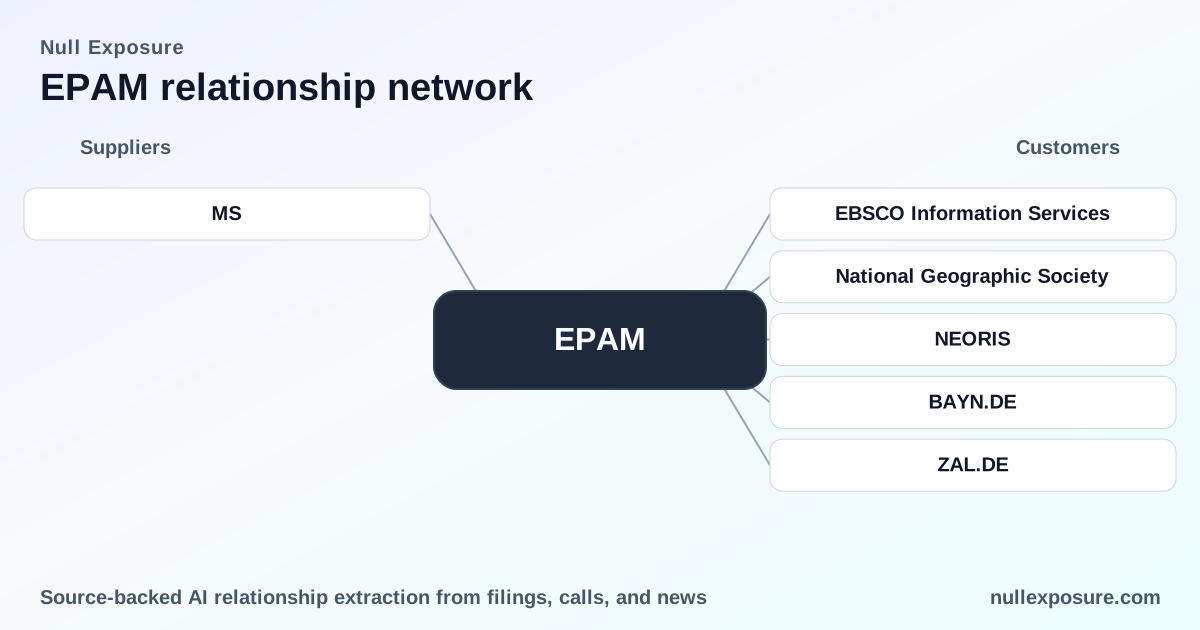
EPAM Systems — how supplier commitments and capital moves reshape the investment case
EPAM Systems monetizes by selling digital engineering, software development and platform services to enterprise clients worldwide, leveraging a global delivery footprint and long-term contracts to generate recurring services revenue and high incremental margins. The company converts skilled labor and cloud consumption into predictable revenue, then returns excess capital to shareholders through buybacks, while managing multi-year supplier commitments that affect both cost structure and liquidity. This note focuses on EPAM’s supplier and counterparty signals in public reporting and newsflow and what they mean for investors and operators.
Explore deeper supplier intelligence at https://nullexposure.com/.
The headline: $300 million accelerated repurchase with Morgan Stanley is a capital-allocation statement
EPAM announced an accelerated share repurchase (ASR) to repurchase $300 million of common stock under an existing $1.0 billion authorization. This transaction is a clear, near-term commitment to reduce share count and return capital, which raises earnings per share and signals confidence in free cash generation.
- According to PR Newswire on March 9, 2026, EPAM entered an ASR with Morgan Stanley & Co. LLC to repurchase $300 million of its common stock. This is a formal, bank-facilitated buyback structure. (PR Newswire, Mar 9, 2026)
- TradingView carried the same firm-market read on March 9, 2026, noting the ASR was executed as a fixed-dollar agreement under EPAM’s $1.0 billion authorization. (TradingView, Mar 9, 2026)
- Financial headlines aggregated by Finviz also reported the ASR with Morgan Stanley, reinforcing that multiple outlets covered the same counterparty trade. (Finviz, Mar 9, 2026)
Each of these items confirms the same commercial relationship with Morgan Stanley as the ASR counterparty; taken together they indicate a single, material capital-markets engagement rather than an operational supplier contract.
Supplier commitments that matter to operations and margins
EPAM’s operating model relies on vendor-supplied cloud services and third-party platforms to deliver products and managed services. Public disclosures show multi-year supplier commitments and deferred consideration obligations that sit squarely in the company’s near-term liquidity profile.
- EPAM disclosed a five-year cloud services agreement signed March 31, 2023, with a committed spend of $75.0 million over the term and $62.2 million still to be spent as of December 31, 2024. This is an active, multi-year commitment that establishes predictable infrastructure cost exposure. (Company filing disclosures, through Dec 31, 2024)
- The company also reported approximately $35.0 million of undiscounted deferred consideration expected to be paid $17.0 million in 2025 and $18.0 million in 2026, which creates a measured near-term cash outflow schedule. (Company filing disclosures, through Dec 31, 2024)
These items are company-level signals of contracting posture (multi-year, committed), spend band ($10m–$100m), and maturity (active commitments with remaining spend). They are not assigned to any specific supplier in the public excerpt, but they materially affect how EPAM plans procurement and capital allocation.
Why the ASR and supplier commitments interact for investors
EPAM reported trailing revenue of approximately $5.46 billion and EBITDA around $707 million (TTM). A $300 million ASR is economically meaningful relative to EBITDA and reduces corporate liquidity that would otherwise be available to fund supplier commitments or acquisitions. At the same time, committed cloud spend and deferred consideration create scheduled cash demands that compress optionality if operating cash flow softens.
- Capital allocation takeaway: The ASR prioritizes shareholder returns over setting aside excess liquidity for opportunistic M&A or larger strategic supplier investments.
- Operational takeaway: Multi-year cloud commitments are likely essential to service delivery; they create recurring cash draws but also enable scalable margins by offloading infrastructure.
If you evaluate enterprise suppliers or counterparty credit, this mix—active cloud commitments plus aggressive buybacks—changes the risk-reward profile for counterparties and investors. Learn more about counterparty signals at https://nullexposure.com/.
Relationship-by-relationship ledger (complete): what our sources show
-
PR Newswire / Morgan Stanley & Co. LLC — EPAM entered an accelerated share repurchase agreement to repurchase $300 million of common stock, executed March 9, 2026; the counterparty is Morgan Stanley & Co. LLC and the transaction reduces outstanding equity under an existing $1.0 billion program. (PR Newswire, Mar 9, 2026)
-
TradingView / Morgan Stanley — The same ASR was reported as a fixed-dollar accelerated share repurchase executed with Morgan Stanley on March 9, 2026, confirming the structure and dollar value within EPAM’s buyback authorization. (TradingView, Mar 9, 2026)
-
Finviz / Morgan Stanley & Co. LLC — Market news aggregation also captured the March 9, 2026 ASR with Morgan Stanley, reinforcing that multiple outlets publicly recorded the counterparty and transaction amount. (Finviz, Mar 9, 2026)
Each line above documents the same counterparty engagement from different outlets; include these in operational reviews to verify market execution and counterparty selection.
Risks and monitoring checklist for investors and operators
- Liquidity strain from buybacks. The $300 million ASR reduces available cash; monitor operating cash flow and covenant headroom if present.
- Committed cloud spend ($75M total; $62.2M remaining) is a fixed cost anchor for delivery; deviations in utilization or pricing can compress margins.
- Deferred consideration obligations (~$35M) create a defined near-term cash schedule into 2026.
- Geopolitical and delivery footprint: EPAM’s global delivery network includes exposure to several jurisdictions; continuity risk in any key region would amplify supplier and resourcing pressures.
Track quarterly cash flow statements and supplier contract amendments to see how management balances buybacks with supplier spend and liquidity preservation.
Final assessment and next steps
EPAM’s public signals show a company that is simultaneously investing in core cloud infrastructure through multi-year commitments and signalling confidence in free cash flow via a sizable ASR. For investors, that combination is a trade-off between return of capital and operational flexibility; for operators and suppliers, it signals a stable but committed buyer with predictable cloud demand.
For a deeper read on EPAM’s supplier posture and counterparty exposures, visit https://nullexposure.com/. If you manage supplier risk or evaluate vendor concentration, our platform consolidates these relationship signals into actionable insight — start your assessment at https://nullexposure.com/.