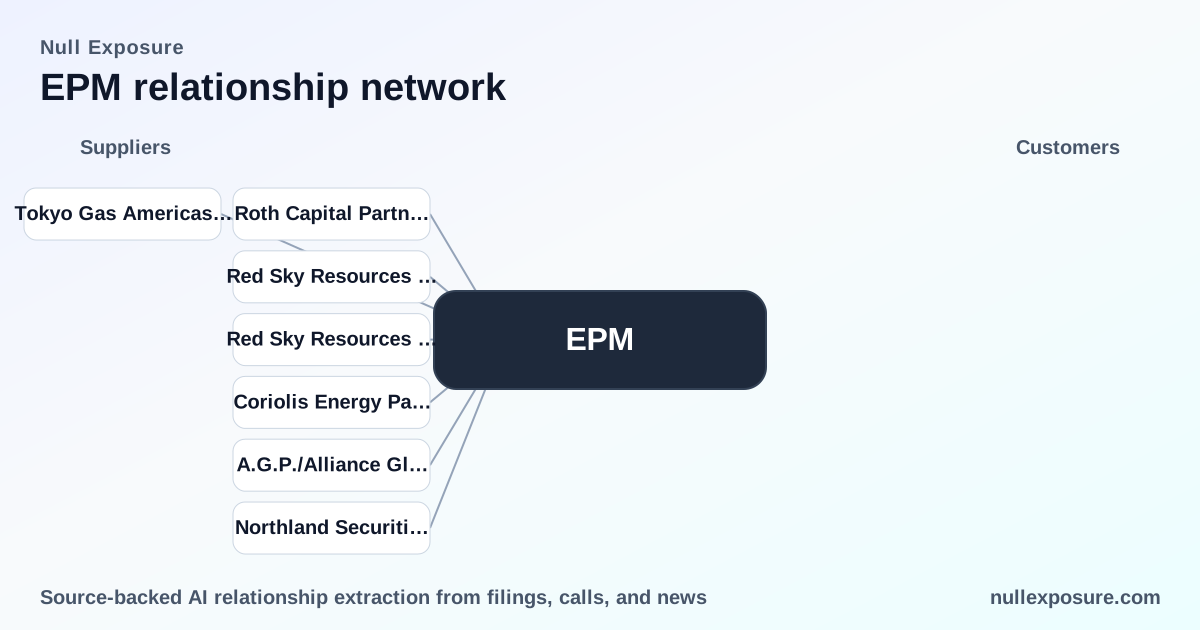
Evolution Petroleum (EPM): supplier relationships, capital posture, and what counterparties reveal
Evolution Petroleum operates as a small-cap oil & gas E&P company that acquires and manages non-operated working interests in U.S. producing assets and monetizes through cash flow from production, opportunistic asset buys and disposals, and equity and debt financings. The company’s economics are driven by production volumes on acquired interests, the cost and structure of third‑party operator relationships, and periodic capital raises—most recently an at‑the‑market equity program and continuing use of a senior secured credit facility. For a concise mapping of counterparties and supplier relationships, see Null Exposure’s research hub: https://nullexposure.com/.
How Evolution runs the business and turns assets into cash
Evolution owns interests in oil and gas wells but does not operate its properties directly; it relies on third‑party operators for drilling, completion, and production reporting. This non‑operated model lowers operating overhead and capital intensity for Evolution but increases reliance on the competence and execution of operator partners for near‑term production and reservoir management. Evolution collects revenue proportional to its working interests and supplements cash flow with targeted M&A — typically in the $10–100 million spend band—and with financing tools such as secured credit and equity programs.
- Capital structure and scale: Market capitalization is modest and liquidity constrained relative to large E&Ps; trailing revenue and EBITDA indicate a small but profitable operating base.
- Operating leverage: Because the company is a non‑operator, counterparty selection (operators and joint‑venture sellers) is a primary determinant of realized returns and delivery risk.
Explore further counterparty mappings and supplier diligence tools at Null Exposure: https://nullexposure.com/.
Capital moves and the financing narrative
Evolution’s recent financing and acquisition activity demonstrates a dual approach: preserve optionality with a secured credit facility while tapping equity markets selectively. On February 11, 2026, the company executed a Sales Agreement with Roth Capital Partners as lead agent, joined by Northland Securities and A.G.P./Alliance Global Partners, to sell up to $30 million of common stock through at‑the‑market transactions; this is a clear path to shore up liquidity without a single block placement. According to company filings and the press release reported on The Globe and Mail, that ATM program is in place for opportunistic issuance in FY2026.
At the same time, Evolution carries a Senior Secured Credit Facility that matures on June 30, 2028, and management has previously used borrowings under that facility to fund acquisitions. As of June 30, 2025, the company reported approximately $37.5 million of indebtedness outstanding and availability of $27.5 million, which places its near‑term leverage and purchasing power squarely in the $10–100 million transaction band. These elements create a financing posture that is flexible but dependent on capital markets access and lender terms.
Mapping counterparties: who Evolution is transacting with (and why it matters)
Below are the named counterparties reported in public sources and what each relationship contributes to Evolution’s operating and financial picture.
Roth Capital Partners
Evolution engaged Roth Capital Partners as the lead agent in a Sales Agreement to offer and sell up to $30 million of common stock in at‑the‑market transactions, establishing an equity liquidity mechanism. This arrangement was disclosed in a press release reported on The Globe and Mail on February 11, 2026.
Northland Securities
Northland Securities is named alongside Roth Capital and A.G.P./Alliance Global Partners as a participating broker‑dealer for the same ATM equity offering, providing distribution capacity for incremental share issuance under the Sales Agreement (Globe and Mail, Feb 11, 2026).
A.G.P./Alliance Global Partners
A.G.P./Alliance Global Partners joined the syndicate on the February 11, 2026 Sales Agreement as another distribution partner for the up to $30 million at‑the‑market program, broadening Evolution’s options for equity placement (Globe and Mail, Feb 11, 2026).
Red Sky Resources III LLC & Red Sky Resources IV LLC
Evolution entered definitive agreements to acquire non‑operated oil and gas assets in the SCOOP and STACK plays from Red Sky Resources III LLC and Red Sky Resources IV LLC. These transactions expanded Evolution’s footprint in central Oklahoma and represent asset purchases of material but not transformational scale, described in a January 11, 2024 report from Gas Compression Magazine.
Coriolis Energy Partners I LLC
Coriolis Energy Partners I LLC was also a seller in the same SCOOP/STACK transactions, providing Evolution with additional non‑operated producing interests as reported by Gas Compression Magazine on January 11, 2024. These purchases illustrate Evolution’s strategy of buying third‑party interests to grow production without operating the wells.
Tokyo Gas Americas Ltd.
Evolution acquired a significant acreage position—23,000 net acres in the Barnett Shale—from Tokyo Gas Americas Ltd., giving the company entry into North Texas production exposure; this transaction was reported in Natural Gas Intelligence in FY2021. The Tokyo Gas deal underscores Evolution’s use of strategic asset purchases to diversify geographic exposure.
What the relationships and constraints disclose about operating risk
Collectively, these counterparties and the documented constraints paint a coherent operating profile:
- Contracting posture: Evolution relies on long‑term secured lending and market access to equity (ATM program) rather than large single equity raises, as evidenced by the senior secured facility maturing in 2028 and the $30 million ATM arrangement. That mix favors flexibility but increases sensitivity to short‑term market sentiment.
- Concentration and criticality: The company’s non‑operated model is a structural concentration risk: production and near‑term drilling execution are dependent on third‑party operators and JV partners rather than in‑house teams. This reduces fixed costs but raises counterparty execution and information risk.
- Transaction scale and maturity: Publicly disclosed asset purchases fall in the $10–100 million range, consistent with a buyer role that targets bolt‑on, long‑life assets to incrementally grow cash flow. The senior secured facility maturity (June 30, 2028) establishes a medium‑dated refinancing timeline that investors must monitor.
- Liquidity and leverage balance: Reported indebtedness and available credit indicate material but manageable leverage for a company of this scale; however, access to additional capital is facilitated by the ATM arrangement and the group of dealer partners named.
Investment implications and next steps for relationship diligence
For investors and operators evaluating Evolution as a counterparty or portfolio holding, the principal considerations are operator selection, financing execution risk, and the impact of incremental equity issuance on per‑share economics. Monitor operator performance on the acquired SCOOP/STACK and Barnett interests, the utilization of the credit facility and covenant status through 2028, and the pace of ATM offering sales that could dilute near‑term EPS.
For a practical supplier and counterparty diligence workflow—mapping counterparties, tracking financing programs, and monitoring operator performance—see Null Exposure’s platform and reports at https://nullexposure.com/.
Actionable next step: review the February 2026 Sales Agreement disclosure and the asset purchase notices in Oklahoma and Texas to prioritize due diligence on operator competence and reserve reconciliation. For ongoing monitoring and supplier mapping tools, visit https://nullexposure.com/.