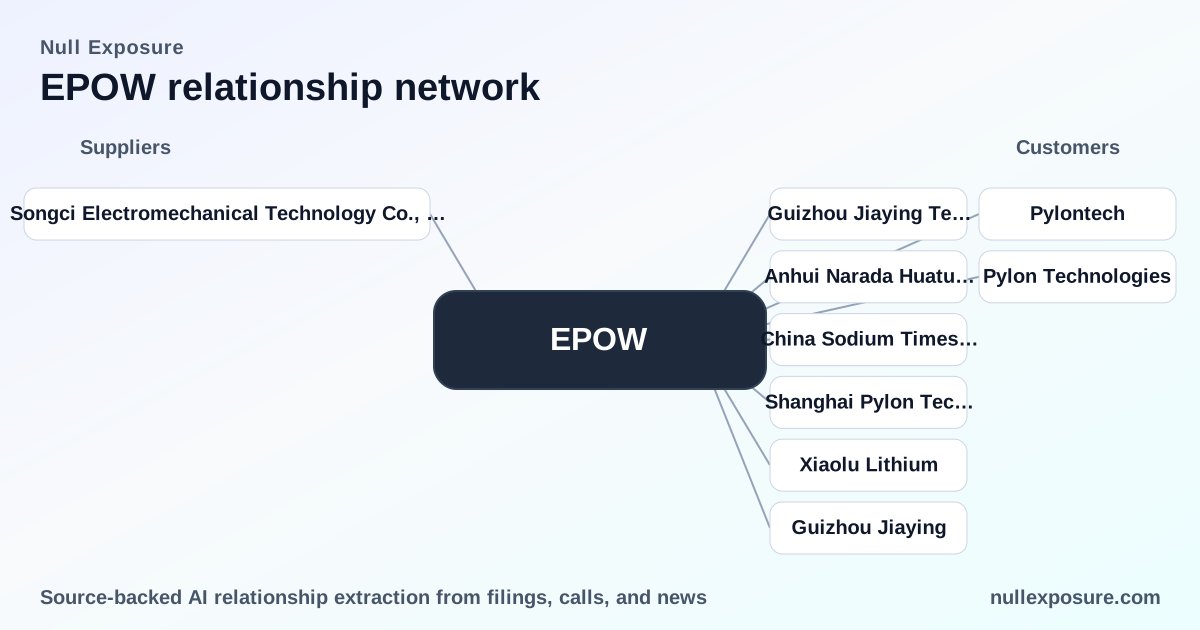
Sunrise New Energy (EPOW) — supplier relationships and strategic signals investors should price now
Sunrise New Energy manufactures and sells graphite anode materials used in lithium‑ion batteries for electric vehicles and related applications, monetizing through product sales to battery makers and downstream OEMs. The company’s value proposition rests on technology-driven anode chemistry and production scale; however, negative gross profit and EBITDA alongside a sub-$30M market cap indicate a cash-constrained, early‑stage supplier with execution risk that investors and operators must weigh against any technology partnerships. Learn more about supplier intelligence and relationship risk at https://nullexposure.com/.
How Sunrise actually operates and how that shapes deal economics
Sunrise is a China‑headquartered manufacturer focused on graphite and silicon‑carbon anode materials. Revenue TTM is $70.7M, but the company reports negative gross profit (‑$2.1M) and EBITDA (‑$6.5M), signaling an operating model still burning cash to scale output. Key balance and market metrics: market cap ≈ $27.1M; book value per share (‑$0.406); shares outstanding ~32.16M; insiders ~20.5% and institutions ~22.5% ownership.
Those numbers translate into clear commercial characteristics: Sunrise functions as a supplier that must balance commodity cost control with product differentiation driven by process technology. Contracts will tilt toward commercial supply agreements rather than long‑dated, high‑credit anchoring offtakes until profitability stabilizes. The firm’s small capitalization and negative margins indicate high execution sensitivity to feedstock and equipment efficiency, making supplier and equipment relationships strategically material. For more supplier intelligence and sourcing diligence, visit https://nullexposure.com/.
Relationship evidence: what the Songci collaboration reveals
Sunrise announced a co‑development with Songci Electromechanical Technology Co., Ltd. to deliver an industry‑leading CVD fluidized bed system for silicon‑carbon anodes. The collaboration positions Sunrise to integrate specialized deposition equipment into its anode production process and signals deliberate investment in advanced manufacturing capability rather than pure commodity graphite production (QuiverQuant news, March 9, 2026: https://www.quiverquant.com/news/Sunrise+New+Energy+Co.%2C+Ltd.+and+Songci+Electromechanical+Technology+Co.%2C+Ltd.+Announce+Breakthrough+in+CVD+Fluidized+Bed+System+for+Silicon-Carbon+Anodes).
Songci is described as a holding subsidiary of AUTEWEI Technology Co., Ltd., a recognized equipment maker in photovoltaic and semiconductor manufacturing; that pedigree strengthens the technical relevance of the collaboration and suggests Sunrise is pursuing manufacturing differentiation through equipment co‑development rather than only raw material supply (QuiverQuant news, March 9, 2026).
Every supplier relationship the record shows
Songci Electromechanical Technology Co., Ltd. — Sunrise co‑developed a CVD fluidized bed system for silicon‑carbon anodes with Songci, indicating an upstream equipment partnership that supports higher‑value anode production; the announcement was published March 9, 2026 (QuiverQuant news, March 9, 2026: https://www.quiverquant.com/news/Sunrise+New+Energy+Co.%2C+Ltd.+and+Songci+Electromechanical+Technology+Co.%2C+Ltd.+Announce+Breakthrough+in+CVD+Fluidized+Bed+System+for+Silicon-Carbon+Anodes).
Constraints, contracting posture, concentration and maturity — company-level signals
No supplier constraints were explicitly flagged in the provided intelligence set; as a company‑level signal, that absence means public records in this batch do not show formal supply covenants, exclusivity clauses, or named long‑term offtake anchors. Combine that with the financial profile and you derive these operating characteristics:
- Contracting posture: Sunrise currently looks like a transactional supplier with a strategic tilt—product sales dominate monetization, while the Songci partnership shows a selective move toward technology agreements and equipment co‑development that can justify premium pricing when executed.
- Concentration and counterparty risk: With modest revenue and market cap, Sunrise faces high customer and execution concentration risk until it secures diversified, creditworthy offtakes; no public long‑term customer list is provided in the record.
- Criticality: Anode materials are critical inputs in EV and energy storage supply chains; Sunrise’s technology investments into silicon‑carbon anodes increase its potential strategic importance to battery makers seeking higher energy density.
- Maturity: Financials and capitalization identify Sunrise as an early‑stage, scale‑constrained manufacturer—the company is investing in manufacturing capability but requires margin improvement and working capital to de‑risk large commercial contracts.
These signals inform how counterparties should price contract terms: more conservative payment terms, staged capacity ramp milestones, and equipment or technology validation gates are justified for a supplier with this profile.
Operational risks and upside drivers investors should track
The Songci co‑development is the clearest upside driver in the relationship map: successful integration of a CVD fluidized bed system for silicon‑carbon anodes can materially improve anode performance and gross margins if throughput and yield targets hold. Operational and financial risks that constrain that upside include:
- Yield and scale risk — advanced deposition systems require time to stabilize yields; early production runs can erode margins.
- Capital intensity and funding gap — negative EBITDA and small market cap indicate limited internal funding to scale equipment rollouts without external capital or partner investment.
- Customer concentration — absence of public long‑term offtakes implies revenues remain exposed to a small set of customers and spot market conditions.
- Supply chain exposure — specialized equipment dependence increases vendor concentration risk for critical capital goods.
Investors should watch production yield metrics, any announced offtake agreements tied to the new silicon‑carbon process, and capex financing to understand whether the Songci partnership converts into durable commercial advantage.
Practical recommendations for investors and operators
- Prioritize validation milestones in any commercial contract: require production yield and cycle time targets before escalating committed volumes or price concessions.
- Treat the Songci tie‑up as technology risk transfer: structure payments or discounts contingent on equipment performance and scale economics rather than unconditional volume commitments.
- Monitor cash runway and capital structure: Sunrise’s negative EBITDA and low market cap create refinancing risk that directly impacts supplier reliability.
- For operators evaluating Sunrise as a supplier, insist on capacity and quality evidence (sample lots, lab reports, and line‑time commitments) before integrating devices that depend on the new silicon‑carbon anode chemistry.
For a deeper look at supplier relationships and to subscribe to ongoing monitoring, visit https://nullexposure.com/.
Bottom line
Sunrise New Energy is a technology‑oriented anode supplier in early commercial innings. The Songci co‑development is a clear strategic signal that the company is targeting differentiated silicon‑carbon anode production via advanced equipment partnerships; however, negative margins, limited market capitalization, and limited public contract visibility create execution and counterparty risk that should shape contracting, pricing and due diligence. Institutional and operator counterparties must convert the Songci announcement into documented performance milestones before extending capital or large‑volume offtakes. Learn more about supplier risk and relationship monitoring at https://nullexposure.com/.