EPR Properties: where landlords and operators drive cash flow
EPR Properties is an experiential net-lease REIT that acquires destination assets—theme parks, water parks, ski resorts, entertainment venues and specialty real estate—and monetizes them through long-term leases and sale-leaseback transactions with experienced operators. EPR’s economics depend on durable contractual rent streams, operator execution at visitor-facing assets, and active portfolio rotation financed through long-dated debt. For a deeper look at how EPR sources and structures these supplier relationships, visit https://nullexposure.com/.
The business model in plain language: asset ownership, operator dependency, and financing posture
EPR owns specialized real estate that requires external operators to run day-to-day activities; the company’s returns come from lease income and selective capital appreciation on those assets. Key model characteristics are long-term contracting, concentrated counterparty exposure to leisure operators, and material leverage with scheduled principal maturities—an operating posture that favors stability in rent collection but creates dependence on operator performance and liquidity.
- The company’s financing schedule shows multi-year principal obligations, which signals a maturity ladder that investors must underwrite when assessing covenant and refinancing risk.
- Lease and management agreements require tenant/operators to carry insurance and maintain property-level protections, signaling structured risk transfer to service providers rather than operational in-house control.
Those company-level signals reflect how EPR contracts with suppliers and operators; they are as material to underwriting as tenant credit and park attendance trends. If you want to map counterparty exposure in more depth, start at https://nullexposure.com/.
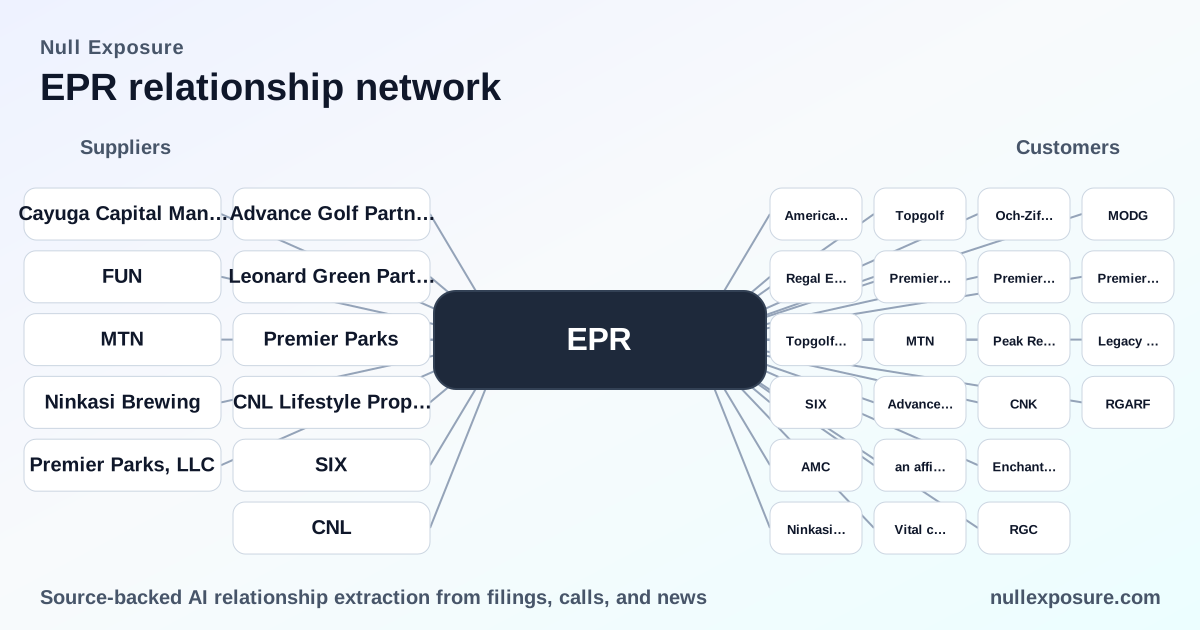
Who supplies EPR’s portfolio — operator, sponsor and seller relationships
Below are every relationship surfaced in public filings and reporting. Each entry includes a plain-English summary and the cited source.
Advance Golf Partners
EPR disclosed that certain golf-course properties will be leased and operated by Advance Golf Partners, indicating a typical operator-as-service-provider lease structure. This detail was noted in EPR’s 2025 Q4 earnings call (March 2026).
Leonard Green Partners
EPR referenced the private-equity transaction in which Leonard Green Partners acquired a 60% interest in Topgolf, a tenant-relevant ownership change that affects the operator landscape for EPR’s related properties; cited in the company’s 2025 Q4 earnings call.
Premier Parks
EPR stated Ocean Breeze will be leased and operated by an affiliate of Premier Parks, signaling a strategic operating partner for waterpark and amusement assets; source: EPR 2025 Q4 earnings call (March 2026).
CNL Lifestyle Properties (Federal Way / Wild Waves)
Local reporting documents that EPR acquired Wild Waves and other parks from CNL Lifestyle Properties in 2016, marking an earlier phase of portfolio build-out by buying operating parks from a third-party owner; cited in Federal Way Mirror (2016).
Six Flags (News-Leader report)
A March 2026 news release reported that Six Flags agreed to sell seven parks to EPR for roughly $331 million, a sizeable, multi-park acquisition that increases operator counterparty complexity; source: The News‑Leader (March 6, 2026).
CNL (Och‑Ziff & portfolio sale)
Trade reporting covers the 2017 transaction in which Och‑Ziff, EPR and CNL completed an $830 million sale of ski and attractions portfolios, illustrating EPR’s role as an acquirer in pooled portfolio deals; source: SAMInfo (2017).
Cayuga Capital Management
Real estate records show an entity tied to Cayuga Capital sold a Williamsburg warehouse (home to Vital Climbing Gym) to EPR for $43.3 million, reflecting EPR’s acquisition of specialty urban leisure property in 2023; source: The Real Deal (March 20, 2023).
Six Flags Entertainment Corporation (ABC7 Chicago)
Regional media noted Six Flags’ announcement that it would divest seven locations to EPR as part of portfolio sharpening and liquidity actions, underscoring the strategic seller/operator relationship between Six Flags and EPR (March 2026); source: ABC7 Chicago (March 2026).
Six Flags Entertainment (Fox Business)
National business press reported that Six Flags will sell seven amusement parks in the U.S. and Canada to EPR, reiterating the same portfolio shift and confirming transaction scale in public markets coverage (March 2026); source: Fox Business (March 2026).
Six Flags (MyNBC5)
Local news highlighted the sale of Great Escape and La Ronde as part of a $342 million transaction with EPR, adding granular confirmation of which parks are changing hands and the deal magnitude (March 2026); source: MyNBC5 (March 2026).
Vail Resorts
Reporting notes that Mount Snow is owned by EPR but managed by Vail Resorts, a classic REIT/operator split where the landlord collects rent while a major leisure operator runs guest services; source: MyNBC5 (March 2026).
CNL Lifestyle Properties (Democrat & Chronicle)
Coverage of EPR’s 2016 purchase cited that Darien Lake and multiple parks were bought from CNL as part of a reported $456 million deal, showing EPR’s multi-asset acquisitions from CNL during that cycle; source: Democrat & Chronicle (2016).
Ninkasi Brewing
Industry reporting documents the sale of Ninkasi Brewing’s properties to EPR concurrent with an ownership change in the brewery, illustrating EPR’s purchase of production/industrial real estate tied to a consumer business (2019); source: NewSchoolBeer (2019).
Premier Parks, LLC (Calypso‑Valcartier)
A 2022 trade piece describes EPR acquiring Calypso‑Valcartier and naming Premier Parks, LLC as the new manager/operator, signaling repeat partnerships with Premier Parks entities for regional leisure assets; source: Stay Magazine (2022).
What the relationship map means for investors: concentration, control and refinancing points
EPR’s portfolio is operator-dependent and financing-levered. Long-term lease economics support predictable cash flows, but operator credit and execution—especially for theme parks and resorts—drive real cash collection. The company’s principal payments schedule highlights near- and medium-term refinancing points that investors must stress-test against cyclical visitation and operator liquidity. Separately, lease terms that require operators to carry insurance externalize operational risk but do not eliminate counterparty concentration when a small set of management firms or brands run a large share of assets.
- Concentration risk: Multiple park acquisitions from Six Flags and CNL show portfolio growth through sizable, single-seller transactions, which increases dependency on a shrinking universe of specialty operators.
- Operational leverage: Management relationships (e.g., Vail Resorts, Premier Parks) mean EPR’s asset-level performance is tied to external operators’ guest experience and capital spending programs.
- Refinancing cadence: Public disclosures of scheduled principal maturities indicate a material debt maturity profile investors must triangulate with covenant and liquidity assumptions.
If you are modeling EPR’s landlord cash flows or stress-testing counterparty default scenarios, examine operator contracts and the debt maturity ladder at https://nullexposure.com/.
Bottom line: underwriting EPR requires both landlord and operator diligence
EPR offers a differentiated real-estate exposure to experiential venues with stable contractual rent upside but concentrated counterparty and refinancing risk. For investors and operators evaluating supplier relationships, the right diligence combines lease/legal review, operator credit analysis, and an assessment of near-term debt maturities. For an organized view of these supplier relationships and structured signals, visit https://nullexposure.com/ for additional supplier intelligence and reporting.
Actionable conclusion: treat EPR as a landlord whose cash flow stability is only as strong as its operators’ performance and its access to capital markets; monitor operator credit events and upcoming principal payments closely before increasing exposure.