EPR Properties 5.75% Series C: Income-first preferred with operational exposure to experiential real estate
EPR Properties’ 5.75% Series C cumulative convertible preferred shares deliver a fixed-income profile backed by a specialty REIT concentrated in entertainment, recreation and leisure real estate; holders collect a steady dividend stream and retain optional upside through conversion into common equity if the issuer’s experiential assets appreciate. The security monetizes through contractual dividend obligations and conversion economics tied to EPR’s operating performance, so supplier and asset-level partnerships that affect operating costs, sustainability, and customer experience are relevant to preferred investors assessing credit and optionality. For in-depth supplier relationship analysis and monitoring, visit https://nullexposure.com/.
How EPR’s capital stack and operations translate into value for preferred holders
EPR Properties operates as an experiential REIT: it leases, manages and invests in theatres, entertainment complexes, family entertainment centers and related venues that generate customer-facing revenue streams. The Series C preferred instrument is a hybrid positioned above common equity for cash flow priority but below secured debt; income reliability depends on EPR’s ability to maintain occupancy, manage operating costs, and preserve cash available for dividends. Conversion optionality provides asymmetric upside if the underlying common shares appreciate, but the preferred’s primary attractor for institutional buyers is the fixed 5.75% coupon.
Why supplier relationships matter for a preferred investor
Supplier partnerships for EPR are not peripheral — they influence operating margins, capital expenditure timing and reputational risk around guest experience. Energy, facilities services and redevelopment contractors directly affect property-level profitability and dividend coverage, particularly for rooftop and large-footprint entertainment centers. Monitor supplier counterparties as potential credit amplifiers: a reliable contractor reduces variability in operating cash flow, while concentrated or bespoke supplier exposure increases counterparty risk.
Visit https://nullexposure.com/ to see supplier-level signals and contextualized relationship summaries for investors.
Supplier relationships on record (plain-English summaries)
EPR’s publicly reported supplier relationships in the recent coverage are limited but strategically telling.
-
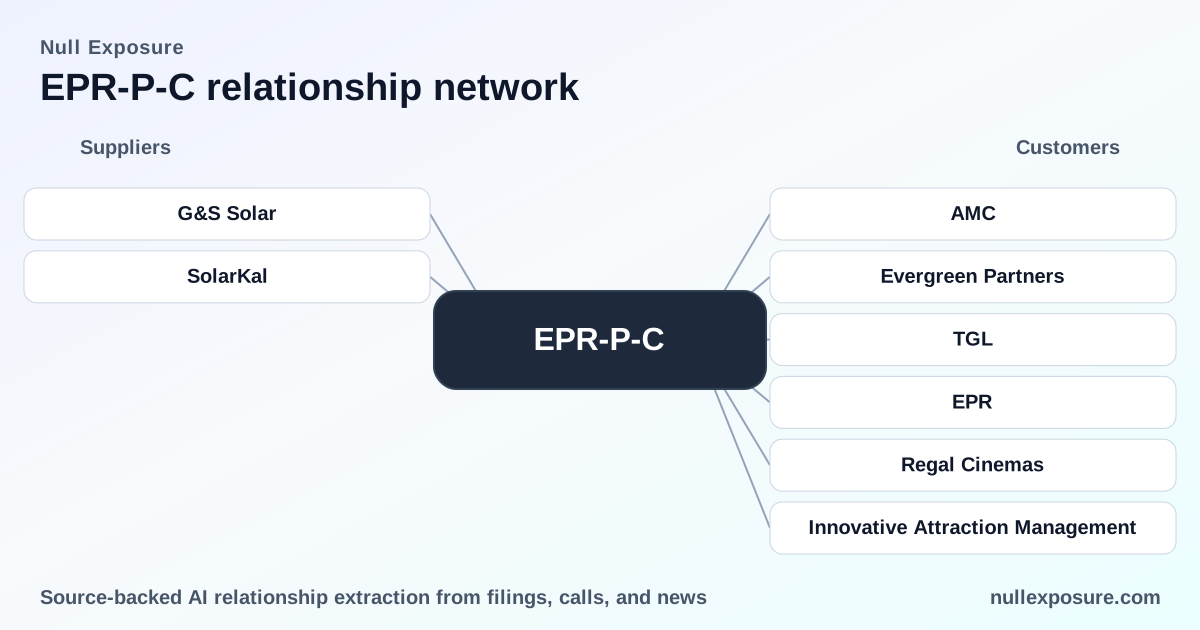
G&S Solar — EPR engaged G&S Solar as the selected developer to construct a community-scale rooftop solar array at the New Roc City entertainment complex in New Rochelle after a competitive procurement process. This relationship signals project-level outsourcing of renewable energy installation and a preference for local-market solar developers. Source: Solar Power World, May 2025 — https://www.solarpowerworldonline.com/2025/05/solarkal-gs-solar-bring-community-solar-array-to-rooftop-near-nyc/.
-
SolarKal — EPR worked with SolarKal, a commercial solar advisory firm, to evaluate portfolio feasibility for community solar and to facilitate an RFP that identified New Roc City as a prime rooftop candidate. SolarKal’s role is advisory and origination-focused, indicating EPR’s use of external energy consultants to scope and structure sustainability projects rather than building that capability in-house. Source: Patch New Rochelle, March 2026 — https://patch.com/new-york/newrochelle/new-roc-city-community-solar-farm-grows-above-entertainment-venue; and Solar Power World, May 2025 — https://www.solarpowerworldonline.com/2025/05/solarkal-gs-solar-bring-community-solar-array-to-rooftop-near-nyc/.
What these supplier ties imply about EPR’s operating model
Several company-level signals emerge from the supplier disclosures:
-
Contracting posture — project-based and outsourced. EPR leverages third-party advisors and local developers for renewable energy projects rather than internalizing that capability, which is consistent with a capital-efficient REIT model that outsources specialist work to control capex and execution risk.
-
Concentration — low supplier concentration at the portfolio level (signal). The evidence shows discrete, site-specific engagements (a rooftop solar on New Roc City) rather than single-vendor domination; this points to a diversified, opportunistic supplier approach rather than a high concentration dependency.
-
Criticality — medium. Energy and sustainability partnerships improve operating expense profiles and ESG positioning, both of which support cash flow durability and stakeholder access to capital, but suppliers for these projects are not the sole determinant of dividend coverage.
-
Maturity — selective, programmatic rollouts. The solar collaboration reflects a strategic but still incremental adoption of renewables across the portfolio, not a fully scaled internal program. That implies execution risk tied to project rollout cadence and third-party delivery.
These are company-level signals derived from the available supplier disclosures rather than relationship-specific constraints.
Investment implications and risk checklist for EPR-P-C holders
- Income stability: The fixed 5.75% coupon is supported if EPR’s cash flows remain steady; supplier-managed projects that reduce operating costs (like rooftop solar) support dividend coverage over time.
- Operational execution risk: Outsourcing to advisors and local developers reduces capital commitments but concentrates execution risk in third parties; monitor project timelines and completion notices.
- ESG and capital access: Visible sustainability projects can improve financing spreads and tenant relations, indirectly supporting preferred-holders’ downside via preserved liquidity.
- Counterparty monitoring: Track the financial and reputational standing of specialty vendors used across projects; while current evidence points to low concentration, new strategic suppliers could change that profile.
Mid-term action: validate project completion and expected operating-cost savings from supplier engagements through facility-level reporting and local filings. For curated monitoring tools that map these linkages in investor-friendly format, see https://nullexposure.com/.
Bottom line and recommended next steps
EPR Properties’ Series C preferred is an income-oriented instrument whose downside and upside are both influenced by property-level operational execution. Supplier relationships disclosed to date — advisory roles and selected local developers for rooftop solar at New Roc City — indicate a pragmatic outsourcing model that reduces capital intensity while introducing execution dependence on third parties. For preferred investors, the key ongoing questions are execution delivery, realized cost savings from these projects, and whether EPR scales similar partnerships across its experiential portfolio.
If you evaluate REIT preferreds on the basis of operational counterparties and project execution, start with supplier-level relationship mapping and active monitoring at https://nullexposure.com/. For bespoke intelligence and periodic alerts on counterparties that affect dividend coverage, subscribe at https://nullexposure.com/.