Essential Properties Realty Trust (EPRT): what the bank syndicate tells investors about capital, control, and operational posture
Essential Properties Realty Trust (EPRT) acquires, owns and manages single-tenant commercial properties across the U.S., generating cash flow through long‑term leases and monetizing through disciplined portfolio growth and occasional equity raises. The company funds acquisitions and capital needs through a mix of operating cash flow and public markets activity, using large investment banks as execution partners for equity offerings — a structure that directly links funding cost, dilution, and liquidity to the quality of its capital markets relationships. Learn more about supplier relationship intelligence at https://nullexposure.com/.
Recent capital markets move: a coordinated underwriting strategy
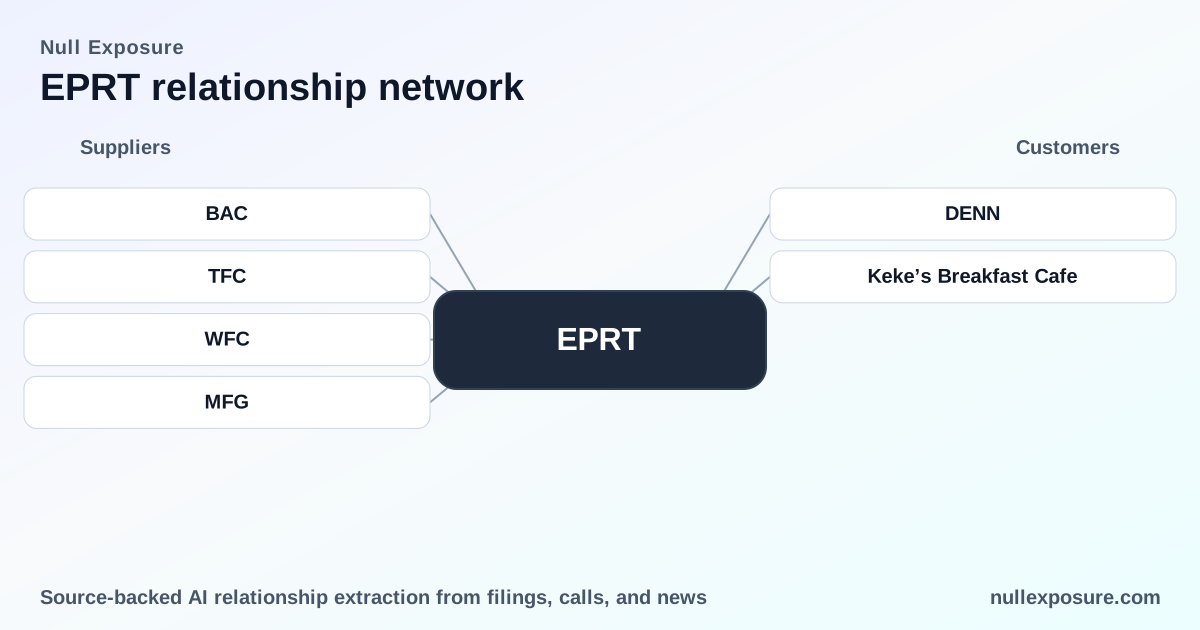
On March 9, 2026, EPRT announced a public offering of common stock with BofA Securities, Mizuho, Truist Securities and Wells Fargo Securities acting as joint book‑running managers. This is a conventional REIT capital raise: using a multi‑bank syndicate spreads underwriting risk, preserves distribution channels to institutional investors, and supports execution speed for accretive acquisitions or balance‑sheet management.
The practical implications are straightforward: EPRT is actively tapping equity markets rather than relying solely on debt, which impacts leverage, share count, and the timing of portfolio growth. For investors and operating partners, the transaction confirms access to top‑tier distribution but also increases scrutiny on dilution and capital allocation priorities.
Who EPRT is working with — the full list
-
BofA Securities (Bank of America). BofA is named as one of the joint book‑running managers for EPRT’s public offering, providing distribution and underwriting capability for the equity raise. According to TradingView (news item published March 9, 2026), BofA joined the syndicate for the offering.
-
Truist Securities. Truist is participating as a joint book‑running manager, adding regional institutional reach and syndicate capacity to the transaction. TradingView reported the bank’s role in the March 9, 2026 announcement.
-
Wells Fargo Securities. Wells Fargo Securities is listed among the joint book‑running managers, contributing capital markets execution and investor coverage to the deal. TradingView covered Wells Fargo’s participation in the March 9, 2026 notice.
-
Mizuho. Mizuho is serving as a joint book‑running manager alongside the U.S. bulge bracket and regional banks, supplementing syndicate liquidity and distribution. TradingView’s March 9, 2026 publication lists Mizuho in the syndicate.
Each relationship above is disclosed in connection with the same equity offering announcement; the participation of four separate underwriters indicates a syndication strategy designed to balance execution, pricing, and investor reach.
What the relationship map signals about EPRT’s operating model
EPRT’s supplier relationships and governance language in filings reveal several company‑level characteristics that shape risk and opportunity:
-
Contracting posture: structured and conservative. The company restricts certain financial arrangements to counterparties with high credit ratings and established institutional relationships, indicating a preference for counterparties that reduce execution and counterparty risk.
-
Counterparty concentration: diversified within capital markets. Using multiple book‑running managers reduces single‑counterparty concentration for equity issuance, but the company still depends on a relatively small group of major financial institutions for capital markets access.
-
Criticality: capital markets relationships are mission‑critical for growth. Underwriting partners are central to funding acquisitions and managing leverage; interruptions in these relationships would materially affect growth pacing and financing cost.
-
Maturity and controls: active and governed. Filings describe active vendor/service relationships subject to security risk assessments at engagement, renewal and elevated risk — a governance posture that supports ongoing vendor monitoring and indicates mature vendor management practices.
-
Service orientation: external providers as operational enablers. The company classifies some counterparties as service providers and has implemented controls to identify and mitigate cybersecurity and operational threats tied to third parties.
These are company‑level signals derived from the firm’s disclosures and should be used to frame diligence on both financial and operational dependencies.
Learn how marketplace intelligence transforms sourcing decisions at https://nullexposure.com/.
Investment implications for allocators and operators
-
Access to capital: The syndicate composition of BofA, Mizuho, Truist and Wells Fargo confirms EPRT’s ability to access broad institutional demand — a positive for growth potential and liquidity management. But monitor issuance cadence and dilution.
-
Execution risk and cost: Multiple underwriters reduce execution risk but increase underwriting fees; investors should weigh growth funded by equity against yields on existing assets and distribution policy.
-
Operational resilience: The company’s vendor governance and security controls are a positive operational signal, reducing third‑party risk for critical service providers and counterparties.
-
Concentration monitoring: Although capital markets partners are diversified across four banks for this transaction, ongoing dependence on major institutions for derivatives and other financial instruments creates a concentration risk that warrants oversight.
Actionable steps for investors and operating partners:
- Track future offerings and bookrunner repeats to detect shifts in capital access.
- Review dilution impacts against projected acquisition returns.
- Confirm vendor security posture and contract renewal timing as part of counterparty risk reviews.
Bottom line: execution capacity with predictable dependencies
EPRT is executing a classic REIT growth playbook: acquire yield‑producing single‑tenant properties while tapping public equity through established banking partners. The March 2026 offering—underwritten by BofA Securities, Mizuho, Truist Securities and Wells Fargo Securities—demonstrates strong capital markets access, disciplined counterparty selection, and active vendor governance. For investors, that combination supports continued portfolio growth but requires active monitoring of dilution, underwriting fees, and counterparty concentration. The participation of these four banks was reported by TradingView on March 9, 2026.
For deeper supplier and counterparty insights, visit https://nullexposure.com/ and see how relationship intelligence sharpens capital and operational decisions.