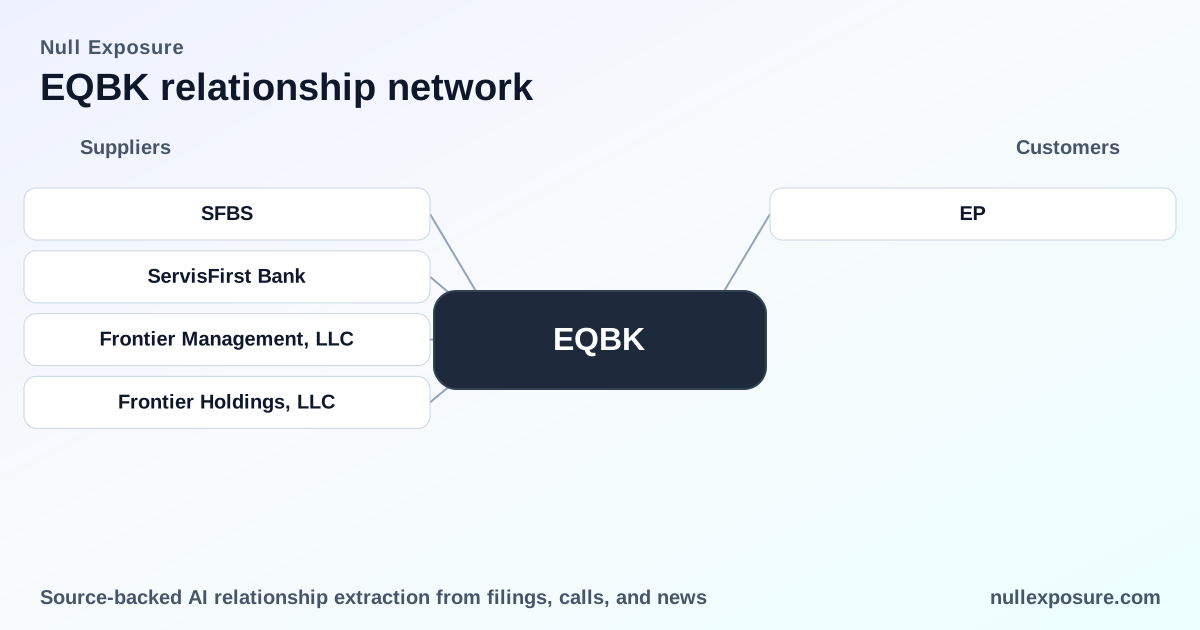
Equity Bancshares (EQBK) — supplier relationships and what they mean for investors
Equity Bancshares is a regional bank holding company that earns interest spread on loans and securities, collects fee and mortgage banking income, and grows via targeted acquisitions. Its supplier relationships reflect ordinary banking counterparties (credit and funding providers) and transactional vendors tied to operations and occasional acquisitions; these relationships influence capital flexibility, operational continuity, and deal execution. For deeper sourcing and relationship monitoring, visit https://nullexposure.com/.
How to read the supplier picture quickly
Equity Bank’s supplier footprint is not exotic: credit counterparties and transactional vendors dominate, and occasional M&A counterparties appear when the company acquires local businesses. That posture implies a mixture of long-dated contractual obligations (leases, note maturities, unfunded credit commitments) and short-term vendor arrangements that are cancellable on demand. Investors should treat the supplier list as a proxy for funding, operational resilience, and deal execution capability rather than as a technology or outsourcing dependency profile. Learn more about how this analysis is compiled at https://nullexposure.com/.
What the public record lists — relationship by relationship
ServisFirst Bank (SFBS)
Equity Bancshares executed the Ninth Amendment to its Loan and Security Agreement with ServisFirst Bank, signaling an active, continuing credit relationship between the two banks in FY2025 and continuing into FY2026 reporting. This amendment shows ServisFirst is a material lending or credit counterparty for Equity Bancshares. Source: MarketScreener coverage of Equity Bancshares’ filings and earnings commentary, including the FY2025/FY2026 notices — https://www.marketscreener.com/news/equity-bancshares-posts-q3-net-loss-of-29-7-mln-ce7d5adedb8cf32c and related items (March 2026).
Frontier Management, LLC
Equity Bancshares reported an acquisition activity tied to Frontier Management, LLC in FY2025; the company acquired an entity controlled or related to Frontier Management as part of its branch/market expansion strategy. This indicates Frontier Management acted as a seller or transaction counterparty in the deal that closed in the reported period. Source: MarketScreener reporting on Equity Bancshares’ FY2025 results and M&A disclosures — https://www.marketscreener.com/news/equity-bancshares-q3-swings-to-loss-revenue-declines-ce7d5adedb8ff324 (March 2026).
Frontier Holdings, LLC
Equity Bancshares acquired Frontier Holdings, LLC from Frontier Management, LLC, demonstrating a bilateral relationship where Frontier Holdings was the acquired operating entity and thus a one-off supplier/target in the company’s growth-by-acquisition strategy. This transaction is relevant to integration risk and localized operational continuity following the acquisition. Source: MarketScreener reporting on the FY2025 statement of acquisitions — https://www.marketscreener.com/news/equity-bancshares-q3-swings-to-loss-revenue-declines-ce7d5adedb8ff324 (March 2026).
(Note: multiple MarketScreener entries reference the same ServisFirst amendment across FY2025 and FY2026 reporting; those items collectively document the continuing credit arrangement — see the MarketScreener links above and the FY2026 earnings flash item at https://www.marketscreener.com/news/earnings-flash-eqbk-equity-bancshares-posts-q4-eps-1-16-vs-factset-est-of-1-14-ce7e58d2da8ff521.)
Company-level constraints and what they imply for suppliers and investors
The public disclosures include a set of contractual and counterparty signals that shape Equity Bancshares’ supplier posture:
- Long-term commitments are material. The company reports significant unfunded commitments it expects to fulfill through 2039, notes maturing in 2030, and multi-year operating leases. This demonstrates a maturity ladder with long-dated obligations that constrain liquidity and require forward funding.
- Short-term arrangements coexist with long-term contracts. Some agreements are explicitly day‑to‑day and terminable on demand, indicating operational flexibility for certain vendors but also exposure to vendor churn for mission-critical services.
- Government and municipal securities are a meaningful part of the portfolio. The securities portfolio includes state and political subdivision bonds with a majority rated A or better, and a large share of general obligation bonds — underscoring the bank’s credit exposure to public-sector credit cycles.
- Dependent on external service providers. The company acknowledges reliance on third parties for processing and records handling and engages related-party contractors for construction services, signaling operational concentration risk and modest related-party governance considerations.
These constraints collectively show a company balancing long-term funding commitments and acquisitions with day-to-day vendor flexibility; they are company-level signals that inform counterparty concentration, contract criticality, and negotiation leverage.
What investors and operators should watch next
- Monitor loan amendments and credit counterparties. The Ninth Amendment with ServisFirst is a live indicator of funding and covenant conditions; track future amendments or replacements to assess refinancing risk and covenant stress.
- Assess integration risk from acquisitions. The Frontier Holdings acquisition is small-scale but operationally relevant; integration execution will affect branch-level deposit retention and local loan origination.
- Watch the maturity profile closely. Notes maturing in 2030 and unfunded commitments through 2039 make the company sensitive to medium-term funding markets and deposit stability. Stress test liquidity under adverse deposit runoff and rising funding costs.
- Operational continuity depends on third-party relationships. Day-to-day cancellable contracts reduce locked-in costs but heighten operational fragility if key processors or contractors are lost.
For ongoing monitoring and supplier relationship intelligence, visit https://nullexposure.com/ for consolidated sourcing and alerts.
Bottom line — investment implications
Equity Bancshares runs a classical regional bank supplier posture: credit relationships (like ServisFirst) and deal counterparties (Frontier Management/Frontier Holdings) drive financing and growth execution, while long-term commitments and reliance on third-party processing shape liquidity and operational risk. Investors should value the company’s earnings and book metrics against the maturity mismatch and acquisition integration exposure disclosed in filings.
For a practical next step, review covenants and amendment language in the ServisFirst facility and track deposit retention metrics post-acquisition of Frontier Holdings; both are immediate, actionable indicators of counterparty and execution risk. Learn more or subscribe to ongoing supplier relationship coverage at https://nullexposure.com/.
Bold takeaway: Equity Bancshares’ supplier footprint is conventional for a regional bank but materially affects funding flexibility and operational continuity — treat lender amendments and acquisition integrations as primary risk drivers.