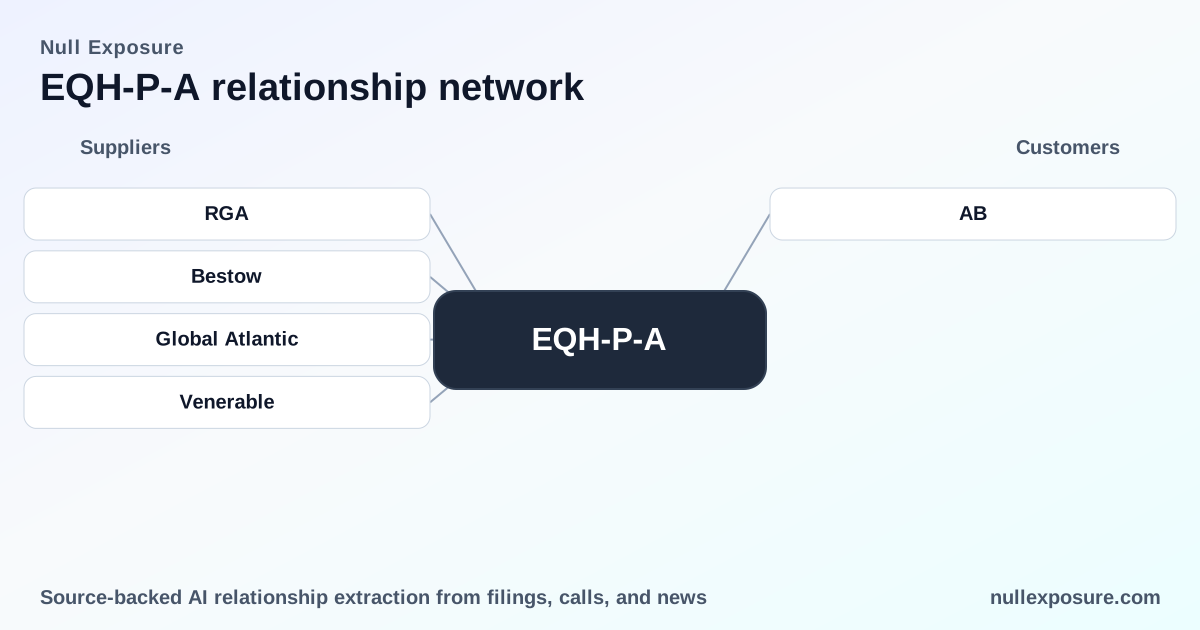
EQH-P-A (Equitable Holdings Preferred): Supplier relationships that reshape capital and distribution
Equitable Holdings operates as a diversified financial services franchise, monetizing through insurance premium flows, investment spread on general account assets, and fee income from asset management and retirement services. The company actively manages capital through reinsurance and ceding strategies while extending distribution reach via technology and partnership-driven products. For investors and operators, the supplier set is less a roster of vendors than a playbook for capital optimization, mortality risk transfer, and modernized distribution. If you want ongoing supplier intelligence and relationship impact analysis, visit https://nullexposure.com/ for curated coverage.
Why these partner moves matter to holders of EQH-P-A
Equitable’s preferred securities valuation is sensitive to capital adequacy, mortality volatility and fee revenue stability. Recent transactions and partnerships directly influence regulatory capital, mortality exposure and distribution economics. Capital-releasing reinsurance and third-party distribution platforms both reduce balance-sheet risk and create optionality in earnings, which is particularly relevant for preferred investors focused on dividend coverage and the issuer’s capital management flexibility.
What the headline relationships are telling the market
Below I cover every supplier relationship surfaced in recent public reporting and media, explain the strategic role each partner plays, and cite the original source for each item.
RGA — large-scale life reinsurance executed in 3Q 2025
Equitable closed an Individual Life reinsurance transaction with RGA in the third quarter of 2025 that freed over $2 billion of capital and reduced mortality exposure by 75%, materially reshaping the company’s risk profile and capital requirements. According to Equitable’s FY2026 reporting published on Yahoo Finance in March 2026, management emphasized the transaction’s capital-release and risk-reduction effects; the Q4 2025 earnings call transcript also referenced the RGA transaction as evidence of value-creating capital actions. (Source: Equitable FY2026 earnings release on Yahoo Finance, March 2026; Q4 2025 earnings call transcript on InsiderMonkey)
Bestow — digital distribution platform powering a term offering (FY2021)
Equitable partnered with Bestow to launch a digital term life insurance product distributed through Equitable’s financial professional network, leveraging Bestow’s life insurance platform to reach customers with streamlined underwriting and digital processing. The collaboration was announced in 2021 and framed as a distribution and product innovation play rather than a balance-sheet transfer. (Source: Life & Health published report on Equitable–Bestow partnership, FY2021)
Global Atlantic — account value ceded to reduce liability and capital exposure
Equitable’s FY2026 disclosures note that certain Separate Account and General Account assets were ceded to Global Atlantic—$3.0 billion of Separate Account and $7.2 billion of General Account AUM at year-end 2025, reflecting use of external capacity to manage liability and capital dynamics. This cession provides scale to reallocate risk off Equitable’s books and optimize regulatory capital. (Source: Equitable FY2026 filings reported on Yahoo Finance, March 2026)
Venerable — ceded account value for product and capital management
Equitable’s FY2026 reporting also shows ceded business to Venerable, with $8.2 billion of Separate Account and smaller General Account amounts noted at year-end 2025, underscoring a multi-counterparty approach to reinsurance and runoff management across different blocks of business. This diversification of counterparties helps manage counterparty concentration while achieving capital relief. (Source: Equitable FY2026 disclosures summarized on Yahoo Finance, March 2026)
How these relationships map to the operating model constraints investors must watch
Equitable’s supplier posture, as revealed by the relationships above, gives several company-level signals investors should treat as structural characteristics of their underwriting and capital strategy:
- Contracting posture — proactive and transactional. Equitable is executing large reinsurance and cessions as deliberate capital-management transactions rather than ad hoc outsourcing. This indicates an active capital management program driven by financial objectives rather than operational necessity.
- Concentration — intentional diversification across reinsurers and platforms. The use of RGA, Global Atlantic and Venerable together reflects a conscious effort to avoid single-counterparty concentration for ceded liabilities, while Bestow addresses distribution concentration through platform partnerships.
- Criticality — high for capital and risk transfer, moderate for distribution. Reinsurance and cession counterparties are critical to managing regulatory capital and mortality volatility; digital distribution partners are strategically important for growth and cost efficiency but less critical to solvency.
- Maturity — moving from legacy blocks to modernized arrangements. The scale and timing of transactions (notably the large 2025 reinsurance) show maturation of Equitable’s approach to transferring legacy risks and monetizing distribution through third-party platforms.
These signals are company-level observations based on disclosed deals and cessions; they are not tied to undocumented constraints or vendor-specific caveats.
Investment implications and risk factors to watch
- Capital release lowers near-term solvency pressure, which can support preferred dividend coverage and reduce tail volatility in book value per share. The RGA transaction’s reported $2 billion release is the most consequential single action for preferred creditors.
- Counterparty risk now shifts from direct underwriting to reinsurer credit. Diversifying cedants reduces concentration but increases reliance on reinsurer asset quality and claims-paying ability; monitor counterparty ratings and collateral arrangements.
- Distribution innovation reduces cost-to-serve and can grow fee income, but it exposes Equitable to technology and partner attrition risks; watch retention and conversion metrics from Bestow-enabled products.
- Regulatory and accounting treatment will remain key. The exact capital and GAAP impacts of cessions dictate how quickly benefits flow to holders of preferred securities; follow subsequent filings for modeled benefit realization.
If you want deeper tracking of counterparty exposure, collateral mechanics and credit implications, our platform provides ongoing updates and context at https://nullexposure.com/.
Final takeaways and next steps for investors and operators
Equitable’s 2025–2026 supplier strategy is explicitly capital-focused and distribution-aware. Large reinsurance with RGA materially reduces mortality exposure and frees capital; cessions to Global Atlantic and Venerable demonstrate deliberate diversification of credit and risk transfer; Bestow partnership modernizes distribution without materially shifting near-term capital needs.
For portfolio managers, preferred security analysts and operational leaders, the critical next steps are straightforward: monitor reinsurer credit and collateral, track realized capital benefits in successive filings, and assess distribution product economics over the next 12–24 months. For ongoing updates and relationship-level detail, subscribe at https://nullexposure.com/.
Bold, decisive actions by Equitable have already altered the company’s risk profile; the market’s job now is to monitor execution and the durability of those capital benefits.