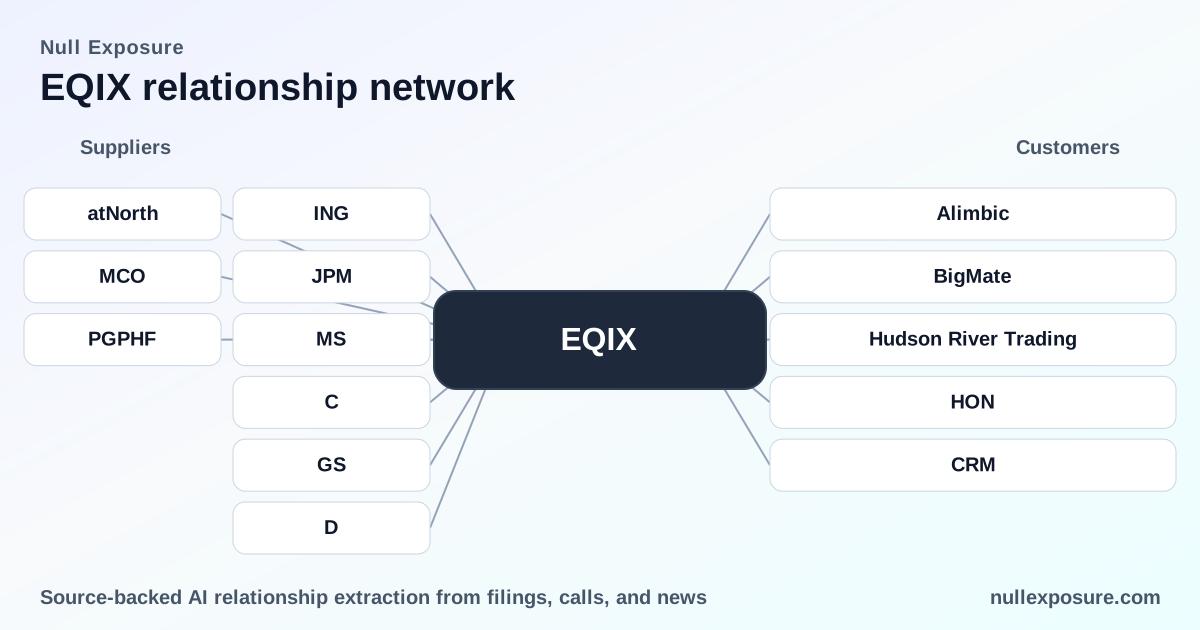
Equinix (EQIX) — Counterparty Map and What It Means for Investors
Equinix operates and monetizes a global platform of interconnected data centers: it leases colocation space and cross-connects, charges recurring rent and interconnection fees, and captures premium margins from network effects and dense customer ecosystems. The company funds growth through capital markets activity and strategic M&A while locking long-term supply for critical inputs such as power and construction. For investors evaluating supplier relationships, the latest disclosures show Equinix leaning on global banks for debt underwriting, relying on energy suppliers and long-term power contracts, and executing acquisition-led expansion that broadens supplier exposure. Learn more about supplier risk and counterparty concentration at https://nullexposure.com/.
The picture in plain language: banks, ratings, energy and one strategic buyout
Recent public filings and press releases reveal a tightly clustered set of counterparties playing three roles for Equinix in early 2026: debt underwriters, a ratings agency, and strategic counterparties tied to energy and M&A. Debt-market relationships dominate the near-term signal set, while energy procurement and acquisition partners inform operational continuity and integration risk. Below I map each named relationship, then synthesize what this implies for contracting posture, criticality, and concentration.
How I read the bank engagements and rating action
Equinix completed a $1.5 billion senior notes offering in March 2026 with a syndicate of major global banks acting as underwriters and lead managers; those banks will be the primary distribution and underwriting counterparties for Equinix’s immediate debt funding. Moody’s upgraded Equinix’s senior unsecured rating to Baa1, supporting lower funding cost and confirming the market’s view of balance-sheet resilience. These are capital-structure level supplier relationships with direct influence on cost of capital and liquidity.
Mapped relationships (each name from the results, one-per-entry)
Citigroup
Citigroup acted as a book-running manager and underwriter on Equinix’s March 2026 senior notes offerings, placing it squarely in the group that executed the $1.5 billion debt transaction. According to PR Newswire in March 2026, Citigroup was listed among the joint book-running managers for the 2033 notes offering.
Goldman Sachs
Goldman Sachs appears across the coverage as a joint lead manager and underwriter for the notes issuance, supporting distribution and pricing of Equinix’s senior notes in March 2026. National and trade releases in March 2026 list Goldman Sachs among the underwriting syndicate.
Goldman Sachs (Singapore) Pte.
Goldman Sachs (Singapore) Pte. served as a joint lead manager on the 2031 notes, reflecting Equinix’s use of regional Goldman units for international debt placement. A March 2026 press release reported the Singapore arm’s role on the 2031 offering.
Goldman Sachs & Co. LLC
Goldman Sachs & Co. LLC is named as a joint book-running manager on the 2033 notes offering, confirming the firm’s participation across multiple legal entities in Equinix’s debt syndication activity, as noted in March 2026 filings.
J.P. Morgan
J.P. Morgan acted as a joint lead manager and syndicate underwriter for the March 2026 senior notes, playing a primary role in market placement and underwriting for Equinix’s debt issuance, per PR Newswire and companion coverage in March 2026.
Morgan Stanley
Morgan Stanley participated as a joint lead manager and underwriter on both the 2031 and 2033 notes, forming part of the core bank syndicate that supported Equinix’s $1.5 billion financing in early March 2026, according to PR Newswire and associated reports.
ING
ING served as a book-running manager in the March 2026 senior notes transaction and was listed among the banks handling the offering’s placement, according to multiple March 2026 press reports.
Moody’s
Moody’s upgraded Equinix’s senior unsecured rating to Baa1, a material credit signal that underpins the successful pricing and market reception of the debt placement; this upgrade was cited in March 2026 coverage and company comments on the offering’s close.
Dominion Energy
Dominion Energy is referenced as a power supplier to large tech customers including Equinix, indicating a supplier relationship where utility-scale generation and distribution underpin data center uptime and energy cost exposure; this linkage was noted in a March 2026 industry note on utilities and large customers.
atNorth
atNorth is the Nordic data center operator that Equinix agreed to acquire as part of a transatlantic expansion push; coverage in early 2026 described the $4 billion acquisition as a strategic move to consolidate capacity in Scandinavia and immediately expand Equinix’s footprint.
Partners Group
Partners Group is the seller in the atNorth transaction: Equinix and the Canada Pension Plan Investment Board confirmed the joint acquisition of atNorth from Partners Group, a March 2026 market note framed the deal as a decisive consolidation move.
(Each relationship summary above is drawn from press coverage and filings in March 2026, including PR Newswire, National Today, Aijourn, Tikr, and industry news summaries.)
What the supplier constraints tell us about Equinix’s operating model
Two company-level signals in recent disclosures shape the supplier risk profile:
- Long-term contracting for power: Equinix discloses a portfolio of 29 PPAs across 12 countries, totaling 1,472 MW of new wind and solar capacity and additional fixed-price power contracts in numerous jurisdictions. This is a deliberate, long-term procurement posture that reduces spot-price exposure and prioritizes energy continuity.
- Construction and service outsourcing: Equinix contracts substantially all construction and expansion work to independent contractors and relies on third-party utilities and infrastructure providers for power and site-level services. That represents a service-provider contracting posture where operational criticality is outsourced but tightly managed through long-term agreements.
These constraints combine into a supplier profile that is capital intensive, concentrated in a few critical categories (debt syndication, utilities, construction), and procedurally mature—Equinix substitutes operational control with contractual durability.
Investment implications and risk checklist
- Funding and liquidity: The concentration of global banks in recent underwriting syndicates signals easy access to capital markets for the near term and better pricing enabled by the Moody’s upgrade. That lowers refinancing risk for the immediate pipeline.
- Operational continuity: Long-term PPAs and reliance on third-party construction contractors reduce short-term operating cost volatility but create dependency on counterparties for physical delivery and timelines—due diligence on counterparty credit and project timelines is essential.
- M&A integration: The atNorth acquisition increases geographic diversification but elevates integration risk with new regional suppliers and regulatory regimes; tracking contract transfers and local utility arrangements is material to run-rate realization.
For detailed counterparty scoring, contractual expiry visibility, and concentration dashboards, visit https://nullexposure.com/ to see how supplier maps change around events like this.
Bottom line and next moves
Equinix’s March 2026 activity shows a company financing expansion through syndicated debt while locking long-term energy supply and executing targeted acquisitions to scale. For investors and operators, the key exposures are to a small set of global banks for near-term finance, to utilities and PPA counterparties for energy continuity, and to integration risk from recent acquisitions. Monitor Moody’s public commentary, syndicate roll rates, and PPA handbacks as the next immediate indicators of credit and operational health.
If you need a bespoke counterparty analysis or an audit of supplier concentration for a portfolio that includes EQIX, explore subscription tools and reports at https://nullexposure.com/.