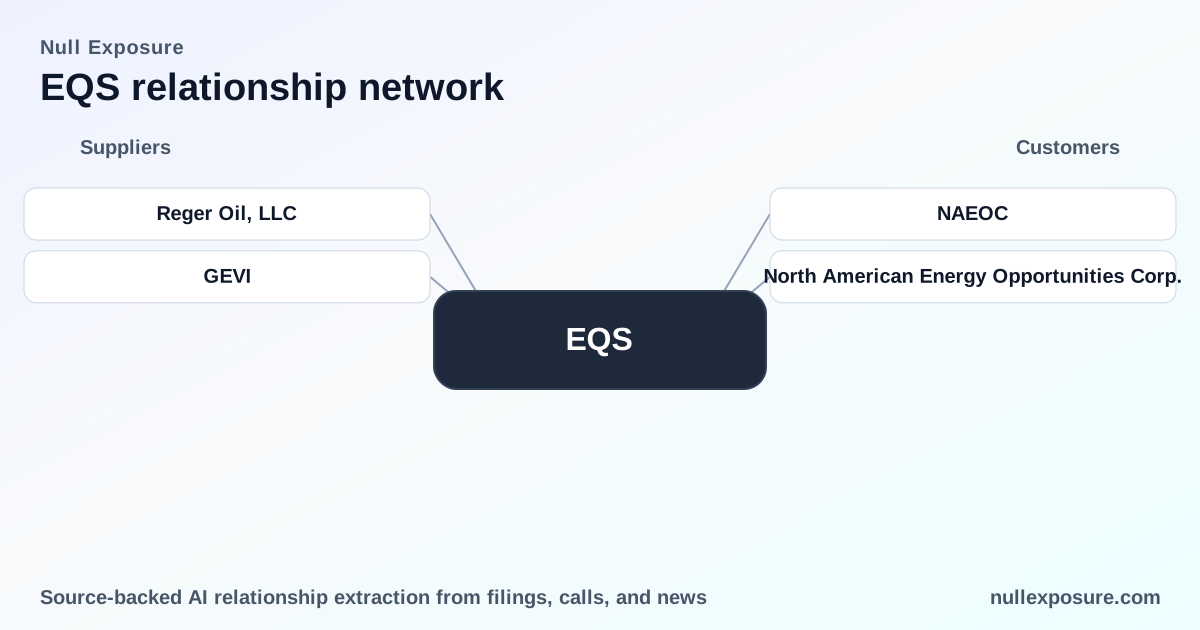
Equus Total Return (EQS): A concentrated, opportunistic closed‑end fund with tactical counterparties
Equus Total Return Closed Fund (EQS) operates as a closed‑end investment company that monetizes by originating and acquiring debt and equity instruments in distressed, small‑ and mid‑market companies, then harvesting returns through interest income, convertible securities upside and periodic exits. The fund uses a mix of short‑dated secured notes and longer‑dated loans, supplemented by operational partnerships through subsidiaries such as Morgan E&P, to convert asset recovery and turnaround expertise into realized gains. For a quick look at how we source and track these supplier and counterparty relationships, visit https://nullexposure.com/.
How Equus actually makes money — the operating thesis in plain language
Equus targets companies that are not broadly covered by large institutional capital — small and middle market issuers — and structures investments to capture current income with upside optionality. That includes purchasing one‑year senior convertible promissory notes at fixed double‑digit coupons, making multi‑year loans with fixed or floating rates and taking equity stakes where turnarounds are credible. The fund then relies on active portfolio management, sometimes through wholly‑owned subsidiaries, to accelerate recoveries and enhance exit valuations. Revenue comes from coupon/interest receipts, realized gains on equity or convertibles, and occasional fee income tied to operations.
Operating model and risk posture — constraints that shape supplier relationships
Several company‑level signals define EQS’s contracting posture and concentration risk:
- Mix of short‑ and long‑term instruments. The fund uses both one‑year senior convertible notes yielding high fixed interest and loans with three‑to‑seven year terms; that combination gives the portfolio both near‑term cash yield and multi‑year recovery optionality.
- Counterparty focus on small and mid‑market issuers. Equus explicitly targets firms with enterprise values roughly between $5 million and $75 million, signaling higher operational involvement and credit selection intensity than a passive lender would require.
- Geography concentrated in the U.S. market. Eligible portfolio companies are domestic, which simplifies legal/regulatory control but concentrates macroeconomic exposure to North America.
- High asset concentration in a single sector. The Energy segment accounted for 93.1% of NAV and 91.9% of total assets as of December 31, 2024, making the portfolio critically exposed to energy markets rather than broadly diversified.
- Active valuation governance and service providers. Equus engages independent valuation firms for larger holdings, indicating formal third‑party controls over fair value determination.
- Spend and deal sizing consistent with mid‑market allocations. Target deal sizes and enterprise value ranges indicate per‑counterparty exposure commonly in the $1M–$100M band, reflecting a middle market sponsor posture.
Together these constraints show a manager that writes concentrated, active positions, mixes short‑dated yield instruments with longer credit exposure, and relies on third‑party valuation and operational partners to extract value.
Direct supplier and counterparty relationships you need to know
Below are the counterparties identified in public filings and press releases. Each description includes a plain‑English summary and a source citation.
Reger Oil, LLC — field operations and consultancy in Williston Basin
Equus’s wholly‑owned subsidiary Morgan E&P engaged Michael Reger and Reger Oil, LLC under a consulting agreement to lead operations in the Williston Basin, signaling a hands‑on operational partnership rather than a passive financing relationship. According to a GlobeNewswire release dated August 6, 2025, Morgan E&P formally retained Reger Oil to manage basin activities and operational execution. (GlobeNewswire, Aug 6, 2025)
A parallel notice carrying similar language also appeared via Yahoo Finance in March 2026 describing the consulting arrangement between Morgan E&P and Reger Oil. (Yahoo Finance, Mar 2026)
Why this matters: the relationship turns the subsidiary into an operating sponsor rather than just a capital provider, increasing the fund’s operational control over energy assets and concentrating execution risk in a named service provider.
General Enterprise Ventures, Inc. (GEVI) — short‑dated convertible financing
On February 10, 2025, Equus purchased a 1‑year senior convertible promissory note from General Enterprise Ventures, Inc. for $1.5 million carrying a 10% annual interest payment, reflecting EQS’s use of short‑term, high‑coupon convertible instruments to generate current income and optional equity upside. This transaction is disclosed in Equus’s FY2025 net asset value filings and was reported through Reuters/TradingView on April 11, 2025. (Reuters/TradingView, Apr 11, 2025)
The same GEVI note transaction is reiterated in Equus’s subsequent NAV press releases published later in 2025. (GlobeNewswire, Nov 24, 2025)
Why this matters: the GEVI position exemplifies EQS’s strategy of using short‑term convertibles to lock in double‑digit yield while retaining conversion upside, but it also concentrates near‑term liquidity and credit risk into specific small‑cap issuers.
Portfolio implications and what investors should watch
- Concentration risk is the dominant theme. With Energy representing over 90% of NAV, any investor or operator evaluating supplier relationships must treat energy service providers and operators as critical single points of failure for value realization.
- Short maturities increase refinancing and timing risk. The mix of one‑year convertible notes and longer loans produces lumpy cash flows that require active portfolio management if counterparties cannot meet obligations or market exits stall.
- Operational partnerships are strategic. By contracting Reger Oil to lead basin operations, Equus shifts value capture to an operational model — that reduces reliance on market liquidity for exits but increases dependency on service providers’ performance.
- Independent valuations and formal governance reduce model risk. Engagement of third‑party valuation firms for larger holdings is a corporate control strength that improves transparency on fair value when positions are illiquid.
If you are evaluating counterparty risk or operational continuity, focus on: service provider contracts in the Williston Basin, timing and covenants on the GEVI convertible, and the fund’s plan to de‑risk energy concentration.
For a deeper supplier mapping and to track new counterparties as they are announced, go to https://nullexposure.com/.
Final recommendation for investors and operators
Equus executes a clear, active playbook: target mid‑market credits, use short‑dated high‑coupon convertibles for yield, and deploy operational partnerships to protect and realize value. The portfolio’s upside is meaningful if energy markets normalize and operational partners perform, but investors must underwrite high sector concentration and near‑term refinancing risk.
If your mandate includes allocating to managers that combine credit engineering with operational control, Equus warrants continued monitoring — particularly the performance of Morgan E&P’s agreements and the repayment/conversion outcomes of short‑term notes like GEVI. Learn more about monitoring supplier relationships and concentration risk at https://nullexposure.com/.
Bold, active positioning in small and mid‑market credits can outperform when execution is flawless; Equus’s public disclosures make execution and counterparty performance the central risks and the central opportunity.