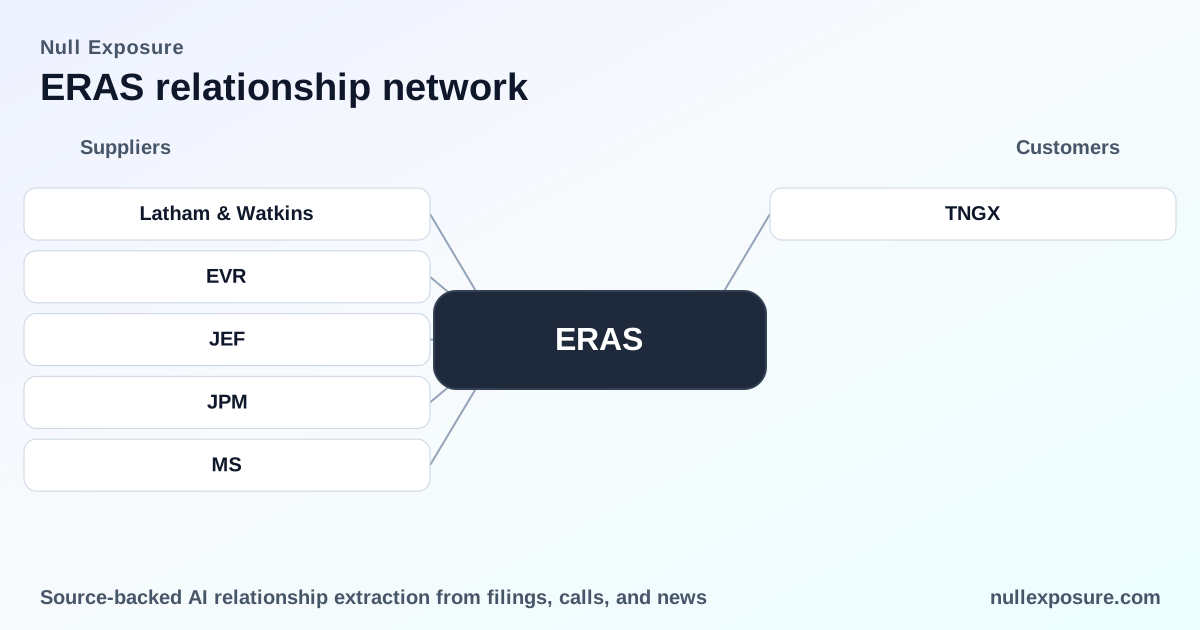
ERAS: Where the capital and IP relationships sit ahead of clinical inflection
Erasca Inc. operates as a clinical-stage oncology biotech that earns value by discovering and developing targeted small-molecule therapies through in‑licensing and third‑party manufacturing, then monetizes progress by advancing assets to clinical milestones and tapping the public markets for capital. The company’s model is built on exclusive licenses for core programs, outsourced manufacturing and development services, and episodic equity offerings to fund trials — a structure that concentrates operational criticality in a small set of external partners while preserving balance-sheet optionality through access to top-tier underwriters. Learn more at https://nullexposure.com/.
The short thesis for investors and operators
Erasca’s path to value is binary but conventional: clinical progress converts expensive R&D burn into high-value commercial optionality, and capital markets access functions as the short-to-medium-term liquidity engine. The company is non‑revenue and loss-making, so partner relationships for IP, CRO, and contract manufacturing are operationally critical, and bank-led equity placements materially influence near-term financing risk and dilution.
- Balance‑sheet driver: episodic public offerings executed with large investment banks.
- Operational driver: in‑licensed proprietary IP and outsourced manufacturing/clinical services.
- Key risk: concentration of critical capabilities outside the company and long-term lease obligations that commit capital.
If you evaluate supplier counterparty risk or partnership exposure for carriers, investors, or counterparties, a concise counterparty map is essential — more on that below. Visit https://nullexposure.com/ for supplier intelligence and relationship context.
How Erasca actually contracts and where the risk concentrates
Erasca’s operating model combines long-term IP licenses and physical-asset leases with largely cancelable service contracts for research and manufacturing. That mix creates three practical constraints investors and procurement teams must understand:
- Contracting posture — durable head-office footprint and durable IP rights. Erasca leases substantial lab and office space under agreements running through 2032, and it holds multiple exclusive license agreements for core programs. Those are fixed-duration commitments and directly affect liquidity planning.
- Concentration and criticality — third parties run the manufacturing and a material portion of development execution. Erasca does not own manufacturing capacity and depends on CROs, CMOs, and academic investigators to deliver clinical data; those relationships are critical to timelines and regulatory filings.
- Maturity and spend profile — clinical-stage company with mid‑double‑digit to low‑triple‑digit millions in long‑term commitments. Lease commitments alone create a mid‑tens of millions liability profile that sits on top of variable trial spend.
These are company-level signals drawn from public disclosures; they describe how the business is structured rather than attributing risk to any single supplier unless the contract language explicitly does so.
The bankers and counsel on the FY2026 equity work — who did what
Below is a relationship-by-relationship review of the counterparties disclosed in coverage of Erasca’s 2026 equity offering and related announcements. Each entry is a plain-English summary with a sourcing note.
-
Latham & Watkins — Latham & Watkins served as Erasca’s legal counsel on the upsized offering, with a San Diego‑based corporate team leading the representation. This is documented in a Latham & Watkins client announcement in January 2026 describing the firm’s role on the deal. (Latham & Watkins press release, Jan 2026: https://www.lw.com/en/news/2026/01/latham-watkins-advises-erasca-in-upsized-offering-of-common-stock)
-
J.P. Morgan — J.P. Morgan acted as a joint book‑running manager on Erasca’s proposed and priced public offering, a lead-bank role that anchors distribution and pricing for the transaction. This role is reported in press distributions tied to the offering in January 2026. (GlobeNewswire distribution reported via Manila Times, Jan 22–24, 2026)
-
Morgan Stanley — Morgan Stanley served as a joint book‑running manager alongside J.P. Morgan and others, supporting syndicate formation and placement for the offering. The bank’s position in the book‑runner group is recorded in the same offering announcements. (GlobeNewswire distribution reported via Manila Times, Jan 22–24, 2026)
-
Jefferies — Jefferies joined as a joint book‑running manager on the offering, contributing to institutional placement and aftermarket coverage responsibilities. That participation is cited in the public offering notices distributed in January 2026. (Quiver Quant press summary and GlobeNewswire distribution, Jan 2026)
-
Evercore ISI — Evercore ISI is listed as a joint book‑running manager on the offering, handling placement and investor outreach alongside the other banks. The firm’s role is documented in the offering press materials distributed in January 2026. (Quiver Quant press summary and GlobeNewswire distribution, Jan 2026)
Each of these counterparty statements is derived from the offering communications and press distributions around the January 2026 equity transaction (see sources above). For deal execution watchers, the syndicate composition underscores strong sell‑side distribution and interest from top-tier banks, which reduces immediate financing execution risk but signals increased exposure to capital‑markets conditions.
What the supplier constraints tell operators and risk teams
Translate the constraint excerpts into actionable supplier intelligence:
- Long‑term leases (through 2032) indicate a fixed-cost runway that reduces near-term facility risk but raises leverage on future capital raises if clinical progress stalls. (Company lease disclosure through Dec 31, 2024)
- Multiple exclusive in‑licenses (NiKang, Medshine, Novartis, Katmai, Joyo) demonstrate an IP‑centric sourcing model: Erasca is effectively a consolidator of targeted assets rather than an internal discovery engine. These licenses are the company’s principal operating assets and are central to valuation. (License agreement disclosures, 2020–2024)
- Outsourced manufacturing and CRO reliance is explicit: Erasca lacks internal scale manufacturing and relies on third parties for clinical and commercial production, making supplier continuity and quality oversight mission-critical for timelines and approvals. (Manufacturing/CRO disclosures)
- Global vendor exposure and foreign‑currency invoices introduce FX and global supply‑chain considerations that procurement teams should monitor. (Vendor geography disclosure)
- Spend band signal (~$10–100m) from lease commitments indicates nontrivial fixed obligations independent of trial variability. (Lease commitments as of Dec 31, 2024)
These constraints collectively describe a company that is capital‑intensive, IP‑driven, and operationally dependent on external manufacturers and service providers — a profile that dictates a risk management posture focused on supplier redundancy, contract enforceability, and monitoring of bank syndicate engagement.
What investors and procurement teams should do next
- For capital allocators: stress‑test models for additional equity issuance given the company’s history of using underwriters and the January 2026 offering; factor lease obligations into cash‑runway scenarios.
- For counterparty risk teams: prioritize CMO/CRO continuity checks and license covenant reviews, and insist on performance metrics tied to clinical milestones.
- For business development and operations: align IP diligence with the specific license terms (field of use and territory carve‑outs) to quantify commercialization scope.
If you want a structured supplier-risk brief or an analyst deck that maps these relationships to financial and operational thresholds, explore our service offering at https://nullexposure.com/.
Final read — the investment and operational takeaways
Erasca is a textbook clinical‑stage biotech: no product revenue, significant R&D burn, and externalized manufacturing and IP. The company secures capital through top-tier underwriters and secures its programs through exclusive licenses — a combination that supports upside if clinical readouts succeed but concentrates downside in third‑party execution and capital markets access. Monitor upcoming trial milestones, counterparty continuity for CMOs/CROs, and any future equity placement language; those variables will determine whether Erasca’s external relationships are a catalytic advantage or a structural constraint.
For a deeper supplier map and tailored counterparty monitoring, visit https://nullexposure.com/ — we synthesize filings, press coverage, and contract excerpts into operationally usable intelligence.