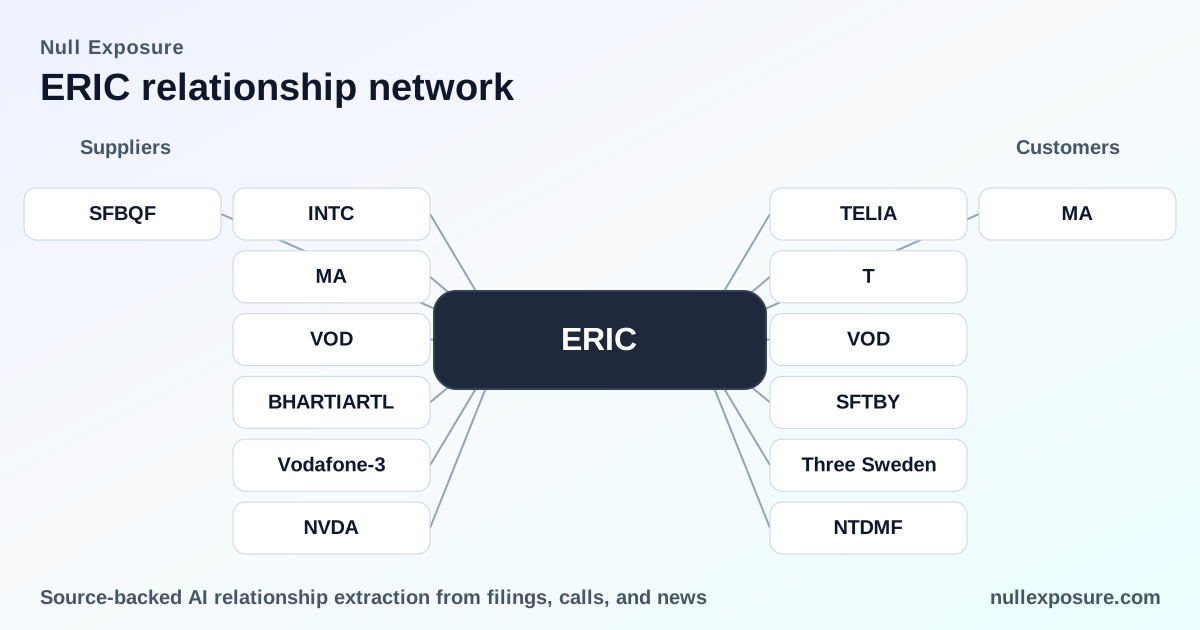
Ericsson (ERIC) — supplier relationships that shape the next decade of telecom infrastructure
Telefonaktiebolaget LM Ericsson generates cash by selling communications hardware, network software, and managed services to global carriers and enterprises — and by licensing software and platform capabilities (including emerging fintech and AI-enabled network software). Revenue mixes across equipment, software subscriptions, and long-term service contracts create predictable annuity-like cash flows while preserving upside from 5G/6G upgrades and cloud-native network transitions. For investors and procurement officers, Ericsson’s external relationships signal how the company converts technology partnerships into differentiated product roadmaps and go-to-market access.
Explore full supplier profile on NullExposure
Why the partner roll-call matters to investors
Ericsson’s partner list reads like a strategic blueprint: chip and data-center alliances for AI and Cloud RAN, fintech tie-ups to monetize platform software, and multi-year carrier contracts that lock in deployment and services revenue. Each relationship either extends Ericsson’s addressable market (fintech, cloud) or protects its core revenue base (carrier contracts). The combinations of long-duration operator agreements and technology alliances reduce go-to-market risk while concentrating execution risk into a smaller set of strategic suppliers and customers.
Review supplier signals and monitoring at NullExposure
Relationship roll-call — what investors need to know now
Intel: pushing Ericsson into AI-native silicon and Cloud RAN
Ericsson expanded its collaboration with Intel to accelerate AI-native 6G development, with future Ericsson silicon planned to leverage Intel’s advanced process nodes and Intel Xeon-powered Cloud RAN solutions. This positions Ericsson to couple its software stack tightly to a leading datacenter and silicon supplier for performance-optimized RAN workloads (Finviz, March 9, 2026).
Source: https://finviz.com/news/333120/ericsson-eric-intel-intc-expand-partnership-to-accelerate-ai-native-6g-development
Mastercard: turning network platforms into payments infrastructure
Ericsson and Mastercard announced a collaboration to integrate Ericsson’s Fintech Platform with Mastercard’s money-movement rails, targeting telecom operators, banks, and fintechs — with a stated focus on unbanked and underbanked communities. This extends Ericsson’s software monetization beyond connectivity into transaction flows and platform services (Intellectia.ai, March 9, 2026).
Source: https://intellectia.ai/news/stock/ericsson-and-mastercard-collaborate-to-reshape-global-money-movement
Vodafone: multi-year programmable-network deal preserves core revenue
Ericsson disclosed a five-year strategic agreement with Vodafone in Europe for programmable networks and confirmed its status as a primary vendor with a stable market share, reinforcing a predictable service and equipment revenue stream in the region (InsiderMonkey, Q3 2025 earnings transcript).
Source: https://www.insidermonkey.com/blog/telefonaktiebolaget-lm-ericsson-publ-nasdaqeric-q3-2025-earnings-call-transcript-1628259/
Vodafone-3 (U.K.): dominant mobile and core network win with long tenure
Management reported an eight-year partnership in the U.K. with Vodafone-3, where Ericsson will supply a significant majority of mobile networks and the entire core network — a long-term commitment that locks in both product delivery and managed services revenue for the contract period (InsiderMonkey, Q3 2025 earnings transcript).
Source: https://www.insidermonkey.com/blog/telefonaktiebolaget-lm-ericsson-publ-nasdaqeric-q3-2025-earnings-call-transcript-1628259/
Bharti Airtel: expanding fixed wireless access with core network integration
Ericsson announced a contract with Bharti Airtel to support their fixed wireless access rollout using Ericsson’s core network portfolio, strengthening Ericsson’s position in the Indian market and expanding equipment plus software revenue from a major emerging-market carrier (InsiderMonkey, Q3 2025 earnings transcript).
Source: https://www.insidermonkey.com/blog/telefonaktiebolaget-lm-ericsson-publ-nasdaqeric-q3-2025-earnings-call-transcript-1628259/
NVIDIA: AI infrastructure questions and potential strategic relevance
Reporting on Ericsson’s cost and competitiveness moves raised questions about the role of NVIDIA’s AI infrastructure in Ericsson’s AI RAN software, signaling investor and press interest in whether NVIDIA will be a material hardware/software partner as Ericsson scales AI-enabled network functions (Intellectia.ai, March 9, 2026). This is currently a point of market focus rather than a disclosed contractual commitment.
Source: https://intellectia.ai/news/stock/ericsson-proposes-1600-job-cuts-in-sweden-to-enhance-competitiveness
SoftBank: share gains in Japan through 5G SA enhancements
Ericsson reported new agreements in Japan that include enhancements to SoftBank’s 5G standalone network, where management stated an increased market share — a commercially important regional win that supports both short-term revenue and long-term installed base services (InsiderMonkey, Q3 2025 earnings transcript).
Source: https://www.insidermonkey.com/blog/telefonaktiebolaget-lm-ericsson-publ-nasdaqeric-q3-2025-earnings-call-transcript-1628259/
Operating model and company-level constraints investors should factor in
There are no formal constraint entries in the supplier-relationship record provided here; as a result, observations below are company-level signals derived from Ericsson’s public disclosures and partner activity:
- Contracting posture: Ericsson operates with a mix of long-term, multi-year carrier contracts and technology alliances, which drive predictable service revenue and provide runway for software subscription uptake.
- Concentration: Carrier customers are geographically diversified across Europe, Asia, and emerging markets, which reduces single-customer revenue concentration but concentrates execution risk in a few large operator wins that are material to regional performance.
- Criticality: Ericsson’s core network and RAN products are mission-critical for operator service delivery, increasing switching costs and enhancing revenue visibility once contracts are live.
- Maturity: The market is mature in core hardware but in active transition for cloud-native network software and AI-enabled RAN — margins and growth will be determined by software monetization and successful silicon/cloud partnerships rather than pure hardware volume.
Investment implications — what drives upside and what to watch
- Upside drivers: Successful integration with cloud/AI partners (Intel, potential NVIDIA involvement), and revenue expansion from platform plays such as fintech with Mastercard. These relationships accelerate higher-margin software and services adoption.
- Primary risks: Execution on multi-year carrier rollouts, supplier concentration for advanced silicon or datacenter compute, and the transitional cost of repositioning R&D and headcount (management flagged workforce changes). Large operator contracts are a double-edged sword — they provide revenue visibility but concentrate operational delivery risk.
- Valuation context: Ericsson trades with moderate multiples relative to its sector peers and shows strong return on equity metrics; investors should weigh near-term execution risk against structural upside from software and AI-native network architectures.
Monitor supplier and counterparty risk on NullExposure
Final read — what investors and operators should act on now
Ericsson’s public partner set demonstrates a strategic shift from pure hardware supplier to platform orchestrator: long-duration carrier contracts secure recurring revenue while partnerships with Intel, Mastercard, and potential AI infrastructure providers expand serviceable markets. For investors, the key tasks are tracking (1) the conversion of multi-year deals into recurring software revenue, (2) the depth of technical integration with Intel/NVIDIA for AI RAN, and (3) commercial traction for fintech and platform services. For operators and procurement teams, the takeaway is the same: Ericsson offers an integrated stack that reduces vendor sprawl but raises dependency on its chosen silicon and cloud partners.
To review Ericsson’s supplier profile and get ongoing alerts on relationship changes, visit NullExposure: https://nullexposure.com/.