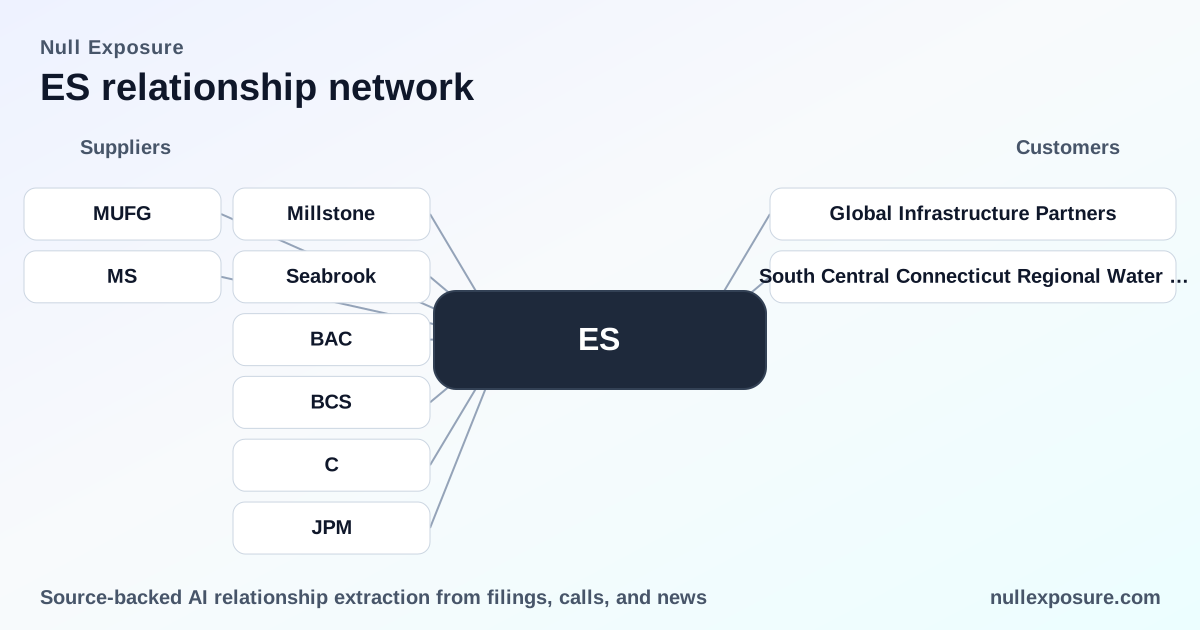
Eversource Energy (ES): Supplier relationships, contractual posture, and what investors should price in
Eversource Energy operates as a regulated electric utility that procures energy and capacity for its standard-service (SS) and supplier-of-last-resort (LRS) customers, while earning returns on regulated transmission and distribution assets. The company monetizes through regulated rates and tariffed pass-throughs for purchased power, supplemented by capital returns on its rate base; procurement is therefore a line-item exposure that feeds directly into customer rates and regulatory reviews. For a focused supplier-risk view and continuous monitoring, visit https://nullexposure.com/.
Quick investor takeaways up front
- Eversource is a purchaser, not a merchant generator: procurement obligations—both long-term and short-term—drive commercial exposure and regulatory scrutiny.
- Material, multi-year payments exist for renewables and capacity, while some standard-service supply is procured on sub‑annual cycles; this creates a mixed maturity profile that investors must balance in forecasts.
- Capital markets access is strong: major banks acted as bookrunners on a recent debt sale, underlining liquidity channels for financing rate-base growth and working capital.
Who Eversource contracts with — the full roster from available records
Millstone
Eversource’s filing states that CL&P is required by regulation to purchase generation from Millstone under PURA‑approved power purchase agreements executed in 2019, embedding nuclear supply into the utility’s procurement obligations. According to Eversource’s FY2024 Form 10‑K, these PPAs are regulatory requirements for CL&P.
Seabrook
CL&P is likewise obligated under PURA‑approved PPAs entered in 2019 to purchase generation from Seabrook, creating a contracted nuclear supply relationship that feeds standard-service obligations. The FY2024 Form 10‑K records this regulatory purchasing requirement.
Bank of America Corp. (BAC)
A Boston Globe report covering Eversource’s debt activity noted that Bank of America was a bookrunner on a recent hybrid debt sale, signaling institutional underwriting support for Eversource’s capital plans. The Boston Globe article dated February 23, 2026 lists Bank of America among the bookrunners.
Barclays Plc (BCS)
Barclays served as a bookrunner on Eversource’s debt offering, demonstrating consistent access to global investment‑banking distribution for financing needs. This role is documented in the Boston Globe coverage of the February 2026 transaction.
Citigroup Inc. (C)
Citigroup acted as a bookrunner for the hybrid bond transaction, contributing to the underwriting syndicate that placed the debt into the market. The Boston Globe’s February 23, 2026 article names Citigroup among the arrangers.
JPMorgan Chase & Co. (JPM)
JPMorgan is listed as a bookrunner on the same debt sale, indicating relationship banking and underwriting capacity supportive of Eversource’s financing program. The Boston Globe report (Feb 23, 2026) records JPMorgan’s participation.
Morgan Stanley (MS)
Morgan Stanley participated as a bookrunner on the hybrid bonds, reinforcing the syndicate depth behind Eversource’s capital issuance. This participation is cited in the Boston Globe coverage of the transaction.
Mitsubishi UFJ Financial Group Inc. (MUFG)
MUFG completed the underwriting syndicate as a bookrunner on Eversource’s debt sale, showing involvement from global bank balance sheets in the company’s funding activities. The Boston Globe article from February 23, 2026 lists MUFG among the bookrunners.
What the company-level constraints reveal about operating posture and risk
Eversource’s public disclosures and extracted contract evidence paint a clear operating profile:
- Contracting posture — mixed tenors. Company filings show long‑term commitments: capacity contracts that extend through 2026 and renewable purchase contracts that extend through 2046 (CL&P) and 2045 (NSTAR Electric). Simultaneously, CL&P enters short‑term full‑requirements contracts for SS loads up to one year, creating a layered exposure to both long-lived fixed commitments and rolling short-term markets.
- Buyer role and pass-through economics. The company functions primarily as a buyer of energy, capacity, and Renewable Energy Certificates (RECs), procuring supply for customers and passing costs through under regulated SS/LRS frameworks. This buyer posture focuses counterparty and market-price risk on procurement lines rather than merchant generation returns.
- Concentration and spend scale. Procurement line items flagged in disclosures—natural gas procurement ($2,990.7) and renewable energy purchases ($10,550.3)—constitute material spend buckets, indicating that procurement decisions have direct balance‑sheet and rate case implications.
- Criticality and maturity. Long-dated renewable PPAs and capacity commitments are critical to regulatory compliance and resource adequacy, while short-term supply contracts introduce exposure to near-term price volatility that is typically managed through regulatory pass-throughs.
Together, these signals imply stable, regulated earnings tempered by procurement exposure: investors should treat Eversource as a regulated utility with sizable, sometimes long-dated contractual commitments that affect cash flow timing and regulatory narratives.
For a deeper supplier-risk framework and to see how these relationships track against peer utilities, visit https://nullexposure.com/.
How these supplier and banking relationships affect investment risk
- Rate-case sensitivity: Long-term PPAs and large renewable purchase commitments will feature prominently in future rate reviews; regulators will evaluate prudence and cost recovery.
- Market-price transmission: Short-term SS procurement places Eversource’s customers—and indirectly the company—exposed to near-term energy-price swings that pass through rates, creating volatility in regulatory filings.
- Counterparty and concentration risk: The regulatory obligation to purchase from named nuclear generators concentrates certain supply risks; mitigation comes through regulatory frameworks that mandate cost recovery but not elimination of execution risk.
- Financing and liquidity: The bank syndicate that underwrote the hybrid debt sale demonstrates current capital-market access, which reduces financing risk for scheduled capital programs and obligational timing. The Boston Globe reported the syndicate on February 23, 2026.
Final investor actions and recommended focus
- Monitor forthcoming rate cases and PPA disclosures for how regulators allocate costs from long‑term renewable and nuclear PPAs into customer tariffs. These proceedings will determine earnings viscosity.
- Track short‑term procurement flows during stress periods to understand how pass‑through mechanics protect or expose cash flows in volatile markets.
- Watch capital markets activity and bank syndicate composition for signs of cost of capital shifts; the recent hybrid issuance bookrunners signal active underwriting relationships that support funding flexibility.
For ongoing coverage and supplier‑relationship scoring tailored to utilities and regulated procurement exposure, explore https://nullexposure.com/.
Bold, contractual commitments and fiscal backing from major banks define Eversource’s risk profile: regulated, procurement‑intensive, and capital‑market enabled. Investors should underwrite both the steady regulatory franchise and the procurement-driven cash‑flow dynamics when valuing ES.