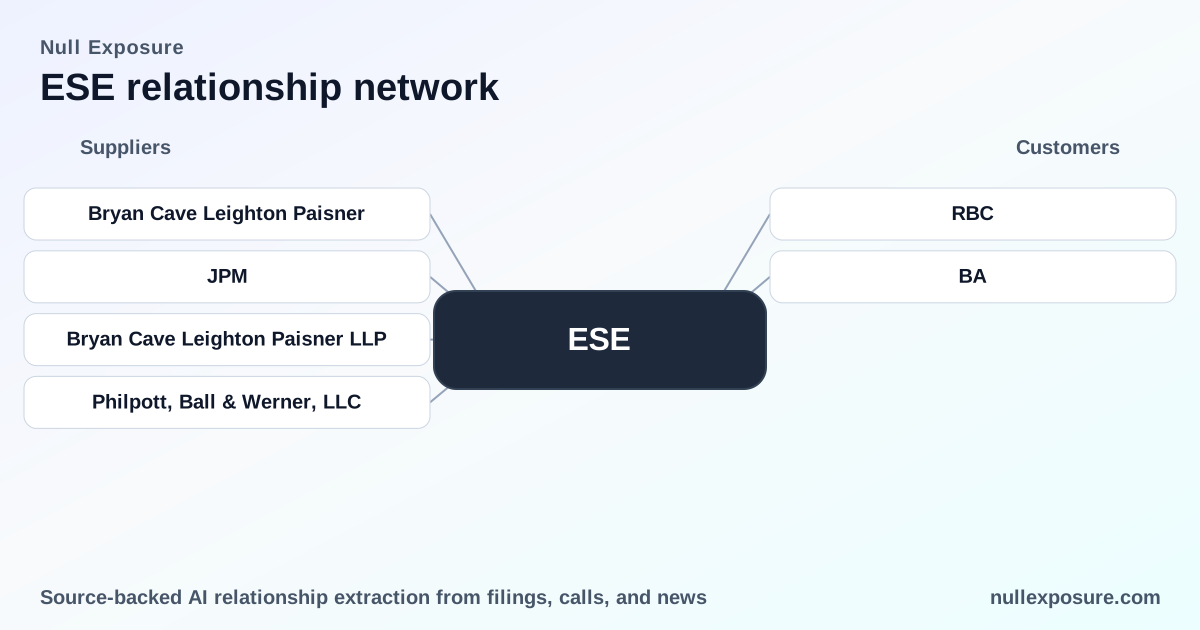
ESCO Technologies (ESE): supplier relationships, manufacturing posture, and investor implications
ESCO Technologies designs and supplies specialized instrumentation and systems to industrial and commercial customers and monetizes through product sales, engineered systems contracts, and recurring aftermarket services across multiple segments. The company's economics combine high-margin engineered solutions with cyclical industrial exposure; outsized valuation multiples reflect durable margins and profitable divestiture activity rather than commodity manufacturing. For investors evaluating ESCO as a supplier partner or counterparty, the focus is on manufacturing outsourcing under long-term contracts, strategic legal and financial advisors used in M&A, and execution risk around portfolio reshaping. Learn how this supplier picture maps to commercial risk and opportunity at https://nullexposure.com/.
How ESCO makes money and why supplier relationships matter
ESCO’s revenue mix is built from engineered products and systems, supported by aftermarket services that drive strong gross margins (gross profit TTM reported at $490.6M on $1.170B revenue). The company outsources production through regional contract manufacturers under long-term contracts, which lowers fixed manufacturing exposure but transfers operational concentration risk to third-party manufacturers. That contracting posture reduces in-house capital intensity while increasing dependence on stable, experienced partners to meet quality and delivery expectations for mission-critical industrial customers.
Because ESCO’s business integrates engineered design with outsourced manufacturing, supplier reliability becomes a meaningful driver of margin stability and delivery cadence, and adviser relationships during M&A events impact strategic capital allocation and shareholder returns. For further context and comparable supplier intelligence, visit https://nullexposure.com/.
Operating model signals investors should read as constraints
ESCO’s public disclosures and recent reporting produce clear company-level signals about supplier posture and operating constraints:
- Long-term contracting posture: ESCO explicitly states its USG segment manufactures through a network of regional contract manufacturers under long-term contracts. That structure indicates predictable sourcing but creates multi-year dependency on select manufacturers for critical components and assemblies.
- Manufacturer relationship role: The same disclosure frames those third parties as manufacturers rather than simple vendors, implying higher integration in quality, lead times, and engineering collaboration.
- Maturity and concentration: Long-term contracts suggest mature supplier relationships with negotiated service levels; however, concentration risk increases if a small number of contract manufacturers supply complex instrumentation.
- Criticality: Given ESCO’s engineered product set and aftermarket service economics, disruptions at contracted manufacturers would have outsized consequences for delivery and margin capture.
These constraints point to high operational leverage to supplier performance while retaining benefits of lower fixed manufacturing costs. Institutional ownership (reported at 99.55%) and a market capitalization near $6.9B indicate investor expectations priced for continued execution and low operational surprises.
The relationships that matter — what the filings and press report
Below are the specific third-party relationships cited in recent press reporting and what each relationship implies for investors and operators.
Bryan Cave Leighton Paisner
ESCO retained Bryan Cave Leighton Paisner as legal counsel in a significant transaction, acting alongside J.P. Morgan as financial advisor. This legal advisory role indicates ESCO uses established corporate law firms for deal structuring and compliance. According to GovConWire reporting on March 9, 2026, Bryan Cave acted as legal counsel in ESCO’s $550M transaction. (GovConWire, 2026-03-09)
J.P. Morgan Securities (JPM)
J.P. Morgan Securities served as exclusive financial adviser to ESCO on a major disposition, signaling that ESCO selects top-tier investment banks for strategic transactions and capital markets execution. That engagement demonstrates ESCO’s intent to extract disciplined value from divestitures and indicates access to broad buyer networks. (GovConWire, 2026-03-09)
Bryan Cave Leighton Paisner LLP (transaction counsel on VACCO sale)
In a separate transaction—ESCO’s divestiture of VACCO Industries—Bryan Cave Leighton Paisner LLP again provided legal advisory services, underscoring a recurring legal advisory relationship used for portfolio reshaping and M&A execution. Quiver Quant’s coverage of the VACCO sale in March 2026 lists Bryan Cave Leighton Paisner LLP as legal advisor. (Quiver Quant / market report, 2026-03-09)
Philpott, Ball & Werner, LLC
Philpott, Ball & Werner, LLC acted as exclusive financial advisor to ESCO for the VACCO Industries divestiture, indicating ESCO will engage boutique or specialized advisors for certain strategic sales alongside national banks. That combination suggests a pragmatic advisor mix tailored to deal complexity and buyer appetite. (Quiver Quant / transaction announcement, 2026-03-09)
What these relationships collectively reveal
Together, the advisory and legal relationships highlight an active corporate development program: ESCO uses both global banks (J.P. Morgan) and specialized advisory boutiques (Philpott, Ball & Werner) while relying on repeat legal counsel for transaction execution. That mix signals disciplined deal execution and a willingness to monetize non-core assets, which supports the company’s cash generation profile and can improve capital allocation efficiency.
Operationally, the company-level constraint that ESCO outsources manufacturing under long-term contracts frames supplier risk as execution and concentration risk rather than short-term procurement volatility. Investors should treat the supplier base as strategically important to delivery and service economics rather than fungible commodity suppliers.
Investment implications and risk checklist
- Upside drivers: Portfolio optimization through disciplined divestitures can re-rate the business toward higher-margin segments; access to top-tier financial advisers supports market-efficient outcomes. ESCO’s reported gross margins and aftermarket revenues provide durable cash generation to support reinvestment or buybacks.
- Key risks: Long-term outsourced manufacturing relationships create concentration and operational risk—a major supplier disruption would affect delivery schedules and margin capture. Legal and advisory relationships reduce transaction execution risk but do not eliminate integration or market receptivity risk for divestitures.
- Valuation context: ESCO trades at premium multiples (trailing P/E around 55x, forward P/E near 25x), reflecting growth and margin expectations; operational dependence on contract manufacturers should be a monitoring item for downside scenarios.
If you need a consolidated view of supplier concentration and legal/financial advisory linkages across the industrial supply chain, explore more at https://nullexposure.com/.
How operators and procurement teams should act
Procurement and operations teams evaluating ESCO as a supplier or partner should verify contract term lengths, exit clauses, quality performance metrics, and backup manufacturer capacity—these are the levers that translate ESCO’s long-term outsourcing posture into reliable supply outcomes. For investors, diligence should include reviewing recent transaction agreements and counsel/adviser roll calls as indicators of strategic focus and execution capability.
Conclusion — where to go from here
ESCO’s supplier picture is clear: long-term manufacturing contracts plus seasoned legal and financial advisers support a capital-efficient operating model that transfers certain manufacturing risks to external partners while preserving engineered-margin upside. Monitor supplier concentration metrics and the cadence of portfolio transactions as leading indicators of operational stability and capital allocation discipline.
For a deeper supplier-risk assessment and transaction relationship map, visit https://nullexposure.com/ to see how these dynamics affect counterparties and investment theses.