Euroseas (ESEA): Supplier relationships, operational posture, and what investors should price in
Euroseas operates and monetizes a global containership and multipurpose shipping business by chartering vessels into short- and multi-year contracts and capturing the spread between charter revenues and vessel operating cost. Revenue comes from time/period charters and recurrent operating cash flow; operating execution is outsourced under an affiliated ship-management model and investor communications are managed through established maritime IR channels. This structure produces high operating margins and recurring dividends, while concentrating operational counterparty and information flows — factors that directly affect counterparty risk and valuation. For a deeper read on supplier mapping and counterparty exposure, see https://nullexposure.com/.
Why management and chartering structure matters to counterparties
Euroseas runs a fleet whose commercial and technical day-to-day operations are arranged through an external manager rather than being fully insourced. That operating posture turns the ship manager into a high‑leverage supplier: operational continuity, regulatory compliance and vessel uptime depend on a small set of management arrangements. For counterparties and operators evaluating credit exposure, the key lenses are contracting posture (affiliated management), concentration (tight ownership and a compact supplier set), and operational maturity (documented certifications and recurring forward-charter activity).
Operational outcomes show up in the company’s financials: Euroseas reports robust margins and cash generation—2025 revenue of approximately $228 million and EBITDA of $156 million with a profit margin above 60%—which fund a notable dividend yield and reinforce the importance of uninterrupted vessel operations to preserve those cash flows.
Supplier map: the relationships disclosed in press releases and IR notes
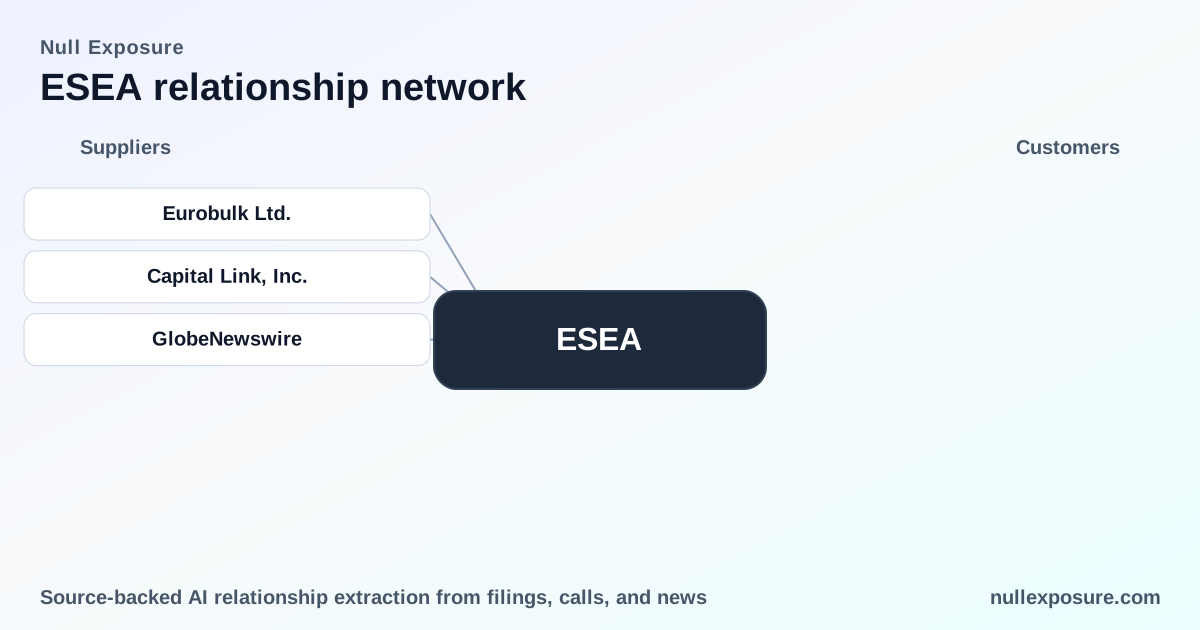
Below I cover every relationship called out in the releases and media coverage assembled for ESEA.
-
Eurobulk Ltd.
Eurobulk is identified repeatedly as the affiliated ship management company responsible for the day-to-day commercial and technical management and operations of Euroseas’ vessels; press announcements list Eurobulk’s ISO 9001 and ISO 14001 certifications as evidence of established operational controls. According to Euroseas press releases distributed via GlobeNewswire in December 2025 and February 2026, Eurobulk handles vessel operations and charter execution for the fleet (GlobeNewswire, Dec 9, 2025; GlobeNewswire, Feb 25, 2026). -
Capital Link, Inc.
Capital Link is the investor relations and financial media contact used by Euroseas in its public filings and release distribution. Multiple company notices list Capital Link personnel and contact details for investor queries, reflecting a centralized IR outsourcing relationship that channels investor communications (GlobeNewswire press releases, Nov–Feb 2025–2026). -
GlobeNewswire
GlobeNewswire functions as the distribution platform Euroseas uses to publish regulatory and commercial announcements. Coverage aggregated through third-party services notes these releases as the primary public source for charter and operational notices; one aggregator explicitly flagged an AI-produced summary of a GlobeNewswire release in March 2026 (QuiverQuant referencing GlobeNewswire / AI disclaimer, Mar 2026).
Each of the items above is directly cited in Euroseas’ recent public releases and in aggregator coverage from late 2025 into early 2026 (see GlobeNewswire press releases Nov–Dec 2025 and Feb 2026 and QuiverQuant reporting in March 2026).
How those relationships translate into constraints investors should model
Treat these operating characteristics as company-level signals to incorporate into risk and valuation models:
-
Contracting posture: Euroseas delegates daily vessel management to a single affiliated management provider. This structure centralizes operational control and creates a single-point operational dependency that drives both service reliability and vendor concentration risk.
-
Concentration: Insider ownership and a compact supplier/IR footprint compress negotiation leverage and information asymmetry. Euroseas reports insiders controlling roughly 59% of shares, which amplifies the influence of a small group on strategic decisions and counterparty selection.
-
Criticality: Vessel management and chartering are mission-critical suppliers—disruption to the management chain or to forward charters has a direct, immediate impact on revenue and cash flow.
-
Operational maturity: Public notices reference ISO certifications and repeated forward-charter announcements, signaling a mature operating playbook that supports long-term charters and repeat contracts.
Modeling implications: value volatility will be driven less by fleet composition alone and more by the resilience and continuity of management and chartering relationships; stress scenarios should include manager disruption, concentrated counterparty default, and IR/communications breakdowns that amplify market reaction.
Mid‑analysis recommendation
If your investment or operational decision hinges on counterparty continuity, prioritize primary-source verification of management contracts and charter-back schedules, and track investor communications issued through Capital Link and GlobeNewswire for real-time signals. For further supplier mapping and to run counterparty exposure scenarios, visit https://nullexposure.com/.
Investment takeaways and next steps
-
Operational control is outsourced and concentrated. Euroseas’ fleet performance depends on a small set of management and IR relationships; that increases operational leverage but also concentrates risk.
-
Cash generation is strong and visible. With 2025 revenue and EBITDA supporting a high profit margin and a material dividend yield, the business converts charter revenues to cash effectively; operational continuity is therefore a first-order determinant of sustainable returns (Company filings, FY2025 results).
-
Public information flows are centralized. Investor communications channeled through Capital Link and distributed via GlobeNewswire create predictable disclosure cadence, which is helpful for monitoring but also creates a single vector for market-moving announcements.
Practical next steps for investors and operators: obtain copies of the ship-management agreements and a roll-forward of forward charters; confirm insurance and maintenance obligations under the management arrangement; and set up automated monitoring of GlobeNewswire releases and Capital Link advisories for Euroseas filings.
For a direct toolset to run those counterparty checks and see the relationship graph for ESEA, start here: https://nullexposure.com/.
Final judgment
Euroseas offers an attractive cash-generating shipping exposure with clear revenue mechanics driven by forward charters and tight operational execution. The company’s supplier map shows mature, repeatable arrangements but also concentration risk around an affiliated ship manager and centralized investor communications, which should be priced into downside and liquidity scenarios. For tailored counterparty analysis and exposure modeling on Euroseas, consult https://nullexposure.com/ for the supplier-centric workflows that sophisticated investors use.