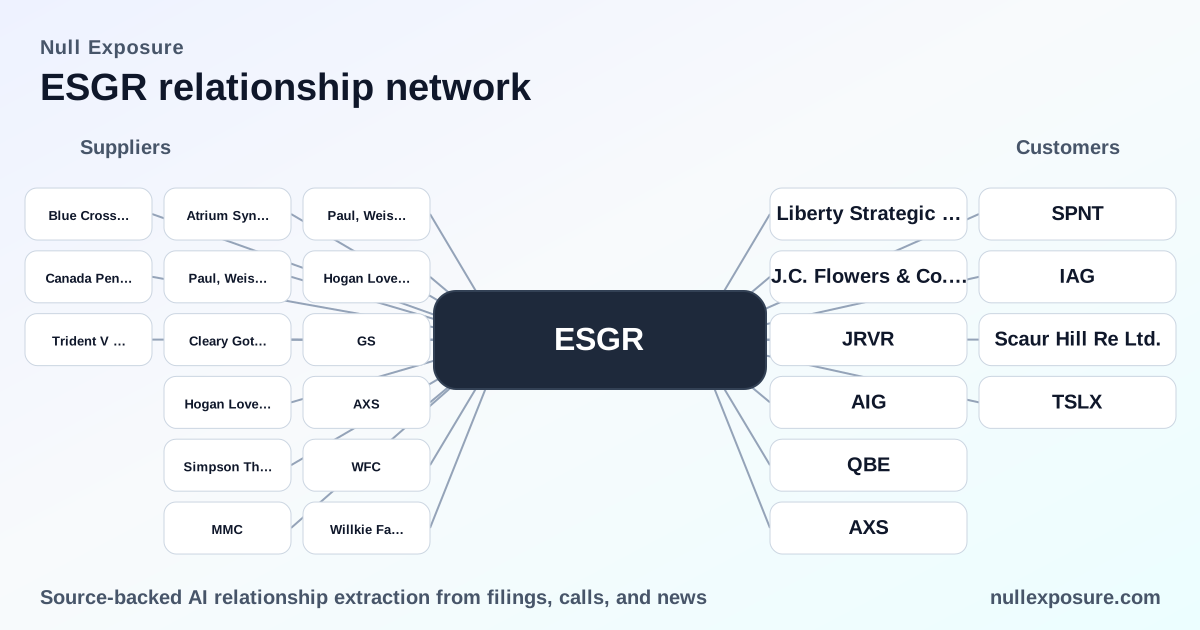
Enstar Group (ESGR) — Supplier Relationships and Operational Implications
Enstar is a specialty insurance consolidator that acquires run‑off portfolios and operating insurance businesses, manages liabilities through capital and reinsurance arrangements, and monetizes value via underwriting recoveries, reserve optimization and strategic disposals. The firm relies on a small ecosystem of elite financial advisers, global law firms, reinsurance counterparties and cedants to execute transactions and manage run‑off transfers—relationships that are operationally critical for deal execution and capital deployment.
If you are evaluating counterparty or supplier risk for underwriting, M&A or capital allocation decisions, the supplier roster and its composition are essential inputs. Learn more at https://nullexposure.com/.
What the supplier roster tells investors about Enstar’s operating model
Enstar’s disclosed suppliers are concentrated in the top tier of investment banks, global law firms and reinsurance intermediaries, which signals a high‑touch, transaction‑driven contracting posture. This roster supports a model that depends on specialist advisory services for acquisitions, structured reinsurance for reserve transfers and selective buy/sell relationships with institutional investors.
- Concentration: The supplier list is small and repeatable—Goldman Sachs, major law firms, Guy Carpenter and leading reinsurers occur repeatedly—indicating low supplier breadth but high supplier quality.
- Criticality: Legal and financial advisers are mission‑critical during M&A and portfolio transfers; counterparties such as AXIS and Atrium are critical to reserve management and loss‑portfolio transfers.
- Maturity: Engagement of global firms like Simpson Thacher, Cleary Gottlieb, Hogan Lovells and Goldman Sachs indicates sophisticated contracting and documentation practices appropriate to large insurance transactions.
- Counterparty risk focus: Reinsurance retrocession and portfolio transfers concentrate risk if a small number of counterparties承担 material reserves or capital support.
For a deeper read on how these supplier signals influence portfolio and counterparty due diligence, visit https://nullexposure.com/.
Vendor and adviser roster — who did what (each relationship documented)
Goldman Sachs & Co. LLC / Goldman Sachs Co. LLC (GS)
Goldman Sachs acted as Enstar’s lead financial adviser on multiple transactions, including the Sixth Street acquisition process and the AF Group acquisition announced in February 2026. According to GlobeNewswire and Sixth Street announcements in 2025–2026, Goldman provided sell‑side advisory and outreach to potential bidders during “go‑shop” periods. (GlobeNewswire, Jul 2, 2025; SixthStreet announcement, 2024–2026)
Paul, Weiss, Rifkind, Wharton & Garrison LLP
Paul Weiss served as legal adviser to Enstar on acquisition activity noted in the Sixth Street announcement; the firm participated alongside other top law firms on transaction documentation. (SixthStreet announcement, referenced Jul 2025 filings)
Hogan Lovells US LLP / Hogan Lovells
Hogan Lovells acted as a legal adviser on multiple Enstar transactions, including the Sixth Street process and the AF Group acquisition, highlighting repeated engagement for cross‑border transactional counsel. (SixthStreet announcement; GlobeNewswire, Feb 13, 2026)
AXIS Capital (AXS)
AXIS is a reinsurance counterparty referenced in a loss‑portfolio retrocession where AXIS retroceded approximately US$2.3 billion of reinsurance reserves; the transfer relates to casualty portfolios and underscores material reserve reallocation across market participants. (Insurance Business Magazine, transaction reporting FY2025)
Wells Fargo (WFC)
Wells Fargo appeared among the financial advisers to Enstar on the AF Group acquisition, serving alongside Goldman Sachs and Guy Carpenter for the February 2026 transaction. (GlobeNewswire, Feb 13, 2026)
Guy Carpenter Capital & Advisory (MMC)
Guy Carpenter, a division of MMC Securities LLC, served as a financial adviser to Enstar on the AF Group acquisition, providing capital markets and reinsurance advisory support. (GlobeNewswire, Feb 13, 2026)
Willkie Farr & Gallagher LLP
Willkie Farr served as legal adviser on the AF Group acquisition, one of several elite law firms advising Enstar on the February 2026 deal. (GlobeNewswire, Feb 13, 2026)
Cleary Gottlieb Steen & Hamilton LLP
Cleary Gottlieb was listed among legal advisers on the AF Group transaction, demonstrating Enstar’s use of multiple global law firms for large, cross‑jurisdictional deals. (GlobeNewswire, Feb 13, 2026)
Simpson Thacher & Bartlett LLP
Simpson Thacher was engaged as legal counsel on the AF Group acquisition, again indicating layered legal counsel for complex corporate and regulatory matters. (GlobeNewswire, Feb 13, 2026)
Atrium Syndicate 609
Atrium Syndicate 609 transferred approximately US$196 million in net loss reserves to Enstar’s Syndicate 2008 under a loss‑portfolio transfer agreement, illustrating how Enstar acquires and manages loss corridors from syndicated market participants. (Insurance Business Magazine, FY2025 reporting)
Blue Cross Blue Shield of Michigan
Blue Cross Blue Shield of Michigan was the seller of Accident Fund Holdings, Inc. (AF Group) in a definitive stock purchase agreement with Enstar, representing a strategic acquisition of a workers’ compensation platform. (GlobeNewswire, Feb 13, 2026)
Canada Pension Plan Investment Board (CPPIB)
CPPIB was a counterparty to an Enstar share repurchase: Enstar repurchased ordinary shares from CPPIB as part of a secondary liquidity transaction, signaling institutional ownership adjustments. (The Royal Gazette, FY2023 reporting)
Trident V funds managed by Stone Point Capital LLC
Trident V funds (Stone Point) sold a block of Enstar ordinary shares to the company under the same repurchase program, demonstrating active secondary trading with private equity investors. (The Royal Gazette, FY2023 reporting)
How these suppliers shape operational risk and execution capacity
Enstar’s supplier mix communicates a deal‑centric operating model: repeated engagement of top investment banks and law firms supports aggressive M&A and complex portfolio transfers, while reinsurers and syndicates execute the actual movement of reserves. That structure produces several investor‑relevant implications:
- Execution reliability: Engagement of elite advisers reduces procedural execution risk on large transactions and regulatory filings. This is an operational strength for Enstar.
- Concentration risk: A narrow set of counterparties handles large reserve transfers; counterparty failure or disputes would be material to certain lines of business.
- Liquidity and capital flexibility: Institutional share repurchases from CPPIB and Stone Point indicate active capital management and available liquidity channels for shareholders.
- Legal and documentation complexity: Multiple major law firms on a single transaction suggest complex cross‑jurisdictional liabilities that require sophisticated contract management.
Constraints and what’s not on record
The supplier‑scope constraints returned for ESGR are empty; there are no explicit supplier constraints recorded in the available material. As a company‑level signal, this absence indicates that no standardized supplier restrictions, termination clauses or concentration limits were disclosed in the scraped relationship results—investors should supplement this with targeted contract review where counterparty concentration or material retrocession exposures exist.
Bottom line and next steps for investors
Enstar’s supplier relationships are strategically concentrated, highly professionalized and tightly linked to its acquisition and run‑off strategy. For investors assessing counterparty, operational or M&A execution risk, the key takeaways are:
- High execution capability due to blue‑chip advisers.
- Material counterparty concentration in reinsurance and portfolio transfers.
- Active capital management through share repurchases with institutional sellers.
If you need an integrated supplier risk profile or want to monitor relationship changes across future transactions, start with a targeted supplier diligence engagement and track any shifts in reinsurance counterparties and adviser panels. For tools and reports that map these supplier dynamics directly to balance‑sheet exposures, visit https://nullexposure.com/.
Explore supplier risk mapping and transaction exposure services at https://nullexposure.com/ for tailored diligence and monitoring.