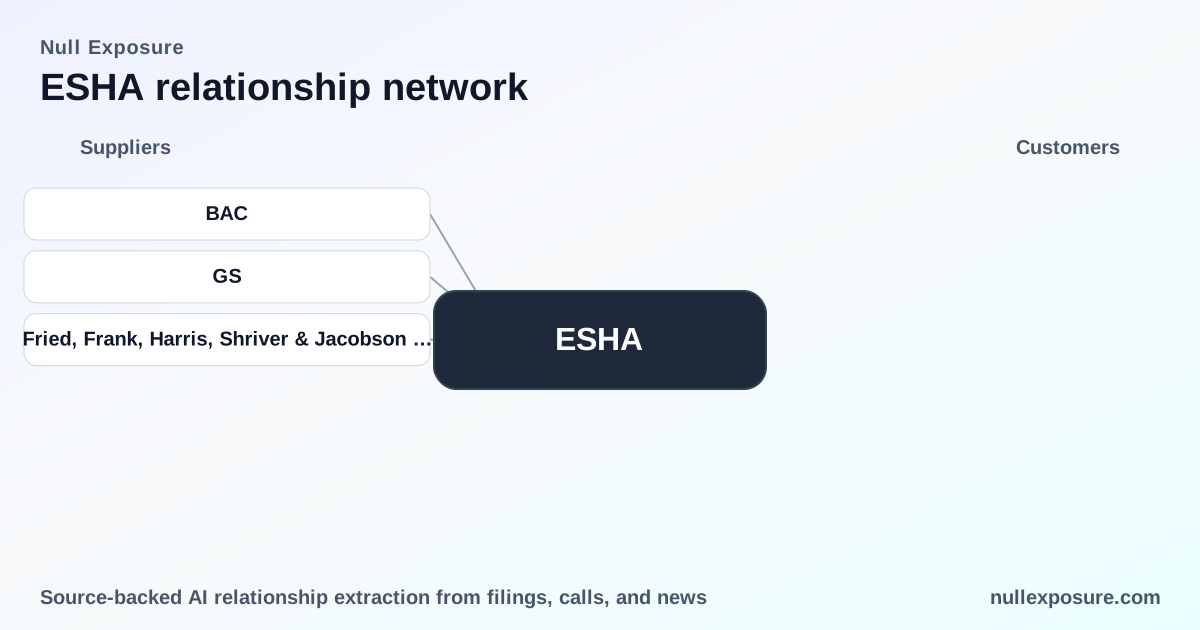
ESHA (ESH Acquisition Corp): A supplier-risk and relationship briefing for investors
ESH Acquisition Corp (ESHA) is a special purpose acquisition company (SPAC) that monetizes investor capital through an IPO trust and by executing a business combination with a target company; its operational costs and service contracts are the primary near-term cash drains until a merger is completed. The company carries no operating revenues, relies on short-term service arrangements and marketing agreements to effect a business combination, and holds concentrated insider ownership that amplifies governance and liquidity risk. For a supplier-risk view and actionable relationship signals, read on — or explore broader supplier intelligence at https://nullexposure.com/.
Investment thesis — how ESHA operates and where value is created
ESHA raises capital from public investors, maintains the cash trust while sourcing an acquisition target, and incurs predictable operating expenses (office, administrative and advisory fees) until a business combination closes. Value is created at the close of a qualifying merger: management realizes returns by delivering a target that trades publicly, while third-party advisers (investment banks, legal counsel, brokers) are often compensated through fixed marketing fees and deal contingency payments. Public filings through the quarter ended 2025-09-30 confirm no revenue, negative EPS and a small market capitalization, underscoring that investment returns are contingent on deal execution rather than ongoing operations.
The supplier relationships you need to know
Below I cover every supplier relationship surfaced in the available results. Each is summarized in plain language with a concise source reference.
-
BofA Securities: BofA served as a financial advisor in the Extended Stay America transaction referenced in coverage of related private-equity activity, signaling its role as a deal advisor in transactions tied to the SPAC ecosystem. Source: Hotel Business coverage of the Blackstone/Starwood transaction (March 2026).
-
Goldman Sachs & Co. LLC: Goldman Sachs is listed as the lead financial advisor in the same transaction report, demonstrating the firm’s continued market presence as a lead adviser on sizable hospitality deals that inform comparable SPAC deal dynamics. Source: Hotel Business coverage of the Blackstone/Starwood transaction (March 2026).
-
Fried, Frank, Harris, Shriver & Jacobson LLP: Fried Frank is cited as legal counsel in the Hotel Business article, indicating use of established transactional law firms for complex M&A work that SPACs like ESHA will require at deal close. Source: Hotel Business coverage of the Blackstone/Starwood transaction (March 2026).
Collectively these mentions are drawn from the same external news article that documents advisors on a major hospitality acquisition; they show the profiles of advisers active in the deal environment ESHA targets. Source: Hotel Business, March 9, 2026.
Contracting posture and spend profile — what the constraints reveal
ESHA’s disclosed supplier constraints provide a clear picture of operating posture and near-term liquidity exposure:
-
Short-term contracting posture: ESHA maintains a month-to-month office and administrative services arrangement at $5,000 per month until the earlier of a completed business combination or liquidation. This indicates a deliberately flexible, low-duration approach to certain overheads.
-
Concentrated governance and thin institutional float: Public data show 85% insider ownership and ~2% institutional ownership, pointing to highly concentrated control and limited free float — a material governance and liquidity characteristic for counterparties and investors to weight.
-
Service-provider dependence for deal execution: Disclosures show ESHA has engaged investment bankers and marketing advisors (referred to as I-Bankers and Dawson James) and will pay marketing fees totaling in the low single-digit millions upon consummation of a business combination. The company classifies these relationships as active and essential to completing a transaction.
-
Spend bands split between small operating costs and meaningful deal fees: ESHA’s recurring office spend is sub-$100k annually while marketing and deal-related fees total $1m–$10m (excerpts state aggregate marketing fees of ~$3.5M–$4.03M). This creates a two-tier exposure: routine low-dollar operating expense versus concentrated, contingent transaction expenditures.
-
Infrastructure and software reliance: Filings state dependence on third-party digital technologies, cloud services and information systems, underscoring operational reliance on external infrastructure providers for administrative and compliance functions during the SPAC lifecycle.
These are company-level signals drawn from ESHA’s disclosures; they are not assigned to any specific adviser unless named in the excerpt.
What this means for investors and counterparties
-
Execution risk is the primary investment risk. ESHA’s business model delivers value only when a qualifying business combination closes; absent a transaction, the company will consume cash on short-term contracts and risk liquidation. The presence of multi-million-dollar marketing arrangements concentrates financial exposure around the deal-close event.
-
Counterparty credit and negotiation leverage are asymmetric. Short-duration office contracts and contingent marketing fees give ESHA flexibility in routine procurement, but the large, discrete marketing payments create a concentrated spend obligation that a small SPAC balance sheet must cover only upon closing — this translates into high counterparty reliance on successful deal execution.
-
Governance and liquidity risks are elevated. High insider ownership (85%) and minimal institutional ownership (2%) increase the probability that insider decisions govern deal timing and partner selection, and reduce secondary-market liquidity that counterparties consider when accepting share-based or contingent compensation.
-
Operational criticality is modest but non-zero. Dependence on third-party infrastructure and legal/financial advisers is typical for SPACs; however, with no ongoing revenue, those service relationships are critical to completing a business combination and converting the SPAC’s latent value into tradable equity.
For deeper supplier risk monitoring and to map how these adviser relationships could impact deal outcomes, explore our platform at https://nullexposure.com/.
Risk checklist — investor-focused takeaways
- Primary risk: failure to complete a business combination before mandated deadlines, converting contingent fees and short-term overhead into net cash losses.
- Financial exposure: meaningful contingent marketing fees ($3.5M–$4.03M) versus limited operating cash burn ($5k/month office).
- Governance: concentrated insider control creates execution dependency on a small group of decision-makers.
- Operational reliance: third-party infrastructure and legal/financial advisers are essential to closing a transaction.
Bottom line and next steps
ESH Acquisition Corp is a classic SPAC: no operating revenues, concentrated ownership, active adviser relationships, and a two-tier spend profile where small ongoing costs coexist with material contingent fees tied directly to deal execution. For investors or operators evaluating supplier relationships, the critical questions are execution certainty, adviser alignment on economics, and whether contingent fees are proportionate to the transaction size.
If you want structured supplier intelligence tied to ESHA’s adviser network and to monitor changes in real time, visit https://nullexposure.com/ for more detailed coverage and alerting options.
For follow-up, I can produce a short due-diligence checklist tailored to counterparty negotiations with ESHA or model the cash impact of its disclosed marketing fees on post-close shareholder value.