ESHAR Supplier Relationships: Who’s Paid, Who Advises, and What Investors Should Know
ESH Acquisition Corp. Right (ESHAR) is a special-purpose acquisition company that sources and closes business combinations in technology and innovation sectors, monetizing through the traditional SPAC pathway: raising capital via an IPO, charging transaction and advisory fees, and capturing sponsor/deal economics upon completion of a business combination. The company’s supplier footprint today is focused on underwriting and advisory partners plus a small set of operational service providers—relationships that are commercial, fee-driven, and intentionally low-volume. For a deeper look at how those supplier ties translate into execution risk and cost exposure, visit https://nullexposure.com/.
Who underwrote the IPO and who will get paid on closing
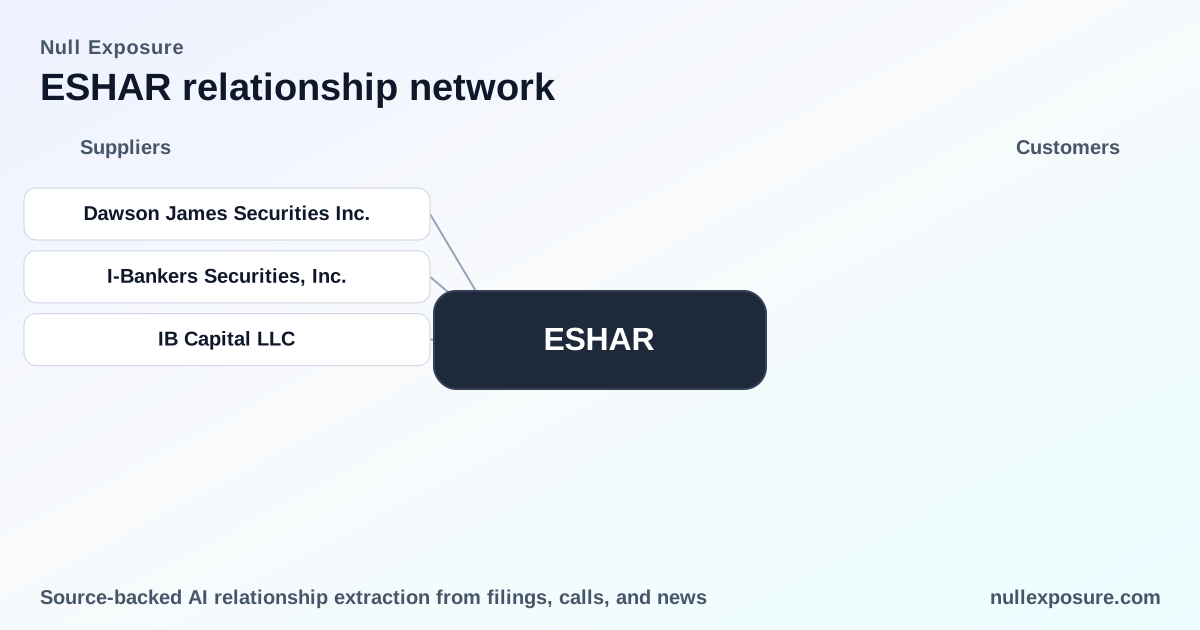
Three counterparties are documented in press coverage as underwriting or managing ESHAR’s IPO and early distribution activity. Each plays a distinct role in underwriting, distribution and marketing of the SPAC offering.
Dawson James Securities Inc.
Dawson James acted as a co-manager on the offering and is named in ESHAR’s marketing fee structure as a recipient of the post-combination marketing fee. This makes Dawson James both a distribution partner in the IPO and a compensated advisor on closing. (Source: Music Business Worldwide, March 2026; company filings describing marketing fee arrangements.)
I‑Bankers Securities, Inc.
I‑Bankers Securities is listed as a joint book‑runner/manager for the offering and is contractually entitled to a marketing fee equal to 3.5% of gross IPO proceeds alongside Dawson James, per firm disclosures. I‑Bankers functions as a primary underwriter and compensated advisor—its economics are directly tied to deal proceeds and closing activity. (Source: Music Business Worldwide, March 2026; company filing language on marketing fee.)
IB Capital LLC
IB Capital LLC is cited as a joint book‑runner/manager for the IPO, placing it in the underwriting cohort responsible for book building and distribution. IB Capital is an underwriting partner without an explicitly separate marketing‑fee carve‑out referenced in the disclosed excerpts. (Source: Music Business Worldwide, March 2026.)
What the contractual and spend signals tell investors
Several constraints drawn from ESHAR’s disclosures illuminate how the company contracts and where operational risk concentrates. These are company-level signals unless the disclosure explicitly names a counterparty.
-
Low‑touch, subscription-style operating costs. ESHAR agreed to pay $5,000 per month for office space, utilities and administrative support effective June 13, 2023; this indicates a modest, predictable fixed-cost base consistent with early-stage SPAC operating models rather than heavy infrastructure investment. (Company filing references to June 13, 2023.)
-
Related‑party office support. Executive offices are provided by an affiliate of one of ESHAR’s officers; this related-party arrangement reduces cash outlay and increases operational flexibility but raises standard related-party governance considerations. (Company filing language on executive offices.)
-
Advisory and distribution fees are explicitly structured. The company will pay a marketing fee equal to 3.5% of IPO gross proceeds to I‑Bankers and Dawson James collectively, with a specified portion payable to an additional FINRA‑member advisor. This links advisor compensation directly to deal economics and makes underwriting partners materially incentivized to consummate a business combination. (Company filing language describing marketing fee.)
-
Active, but limited, vendor spend to date. For the year ended December 31, 2024, ESHAR incurred and paid $60,000 in fees for these services, placing supplier spend in a sub‑$100k band; the relationship stage is described as active. The current spend profile supports an operating posture of targeted, transactional engagements rather than broad vendor dependency. (Company filing disclosures for 2024.)
-
Buyer posture in transaction execution. ESHAR will deploy cash from its IPO proceeds, private placement warrants, forward purchase agreements, debt or equity issuances to effectuate an Initial Business Combination—this is the classic SPAC buyer role and central to supplier economics and counterparty incentives. (Company filing language on use of proceeds.)
Mid‑read note: if you want a consolidated view of counterparty exposure across SPACs and their fee structures, start your research at https://nullexposure.com/.
What this means for investor risk and operational readiness
-
Concentration and incentive alignment: Underwriting and marketing economics are concentrated in a small set of partners (I‑Bankers, Dawson James, IB Capital). That concentration magnifies execution risk but also aligns advisors’ incentives to close a deal quickly.
-
Low fixed-cost runway, higher transaction dependency: The modest office subscription and low annual vendor spend signal a lean operating model; the company’s viability depends heavily on completing a business combination rather than running a standalone operating business.
-
Related‑party arrangements require oversight: The affiliate‑provided office space reduces cash burn but introduces governance and disclosure scrutiny that investors should monitor, particularly around fees, service terms, and any preferential treatment.
-
Fee structure ties advisor economics to deal success: The 3.5% marketing fee payable to I‑Bankers and Dawson James is substantial relative to current spend levels and is structured to activate only upon closing—this creates a clear event-driven cost profile that investors should model into transaction IRR calculations.
Quick takeaways for analysts and operators
- Underwriters: I‑Bankers, Dawson James, and IB Capital are the principal named partners on the IPO and distribution effort, with I‑Bankers and Dawson James contractually positioned to receive marketing fees tied to closing. (Music Business Worldwide, March 2026; company filings.)
- Operating cost posture: lean and subscription-based, with $5,000/month office provisions and $60k of fees paid in 2024—this indicates limited operating commitments ahead of a business combination. (Company filings for June 2023 and FY2024 disclosures.)
- Related-party accommodations exist for executive office space and should be evaluated for governance implications alongside traditional counterparty risk metrics. (Company filing language.)
Before you finalize exposure models or counterparty scorecards, validate fee triggers and timing in the company’s definitive proxy or S‑4 filing; for a concise supplier-risk comparator across similar issuers visit https://nullexposure.com/.
Bottom line
ESHAR’s supplier relationships reflect a classic SPAC structure: small, controlled operating spend combined with concentrated underwriting relationships that are compensated on transaction success. That design minimizes pre‑deal burn but places execution and counterparty governance at the center of value creation. Operators and investors should prioritize monitoring advisor fee mechanics, related‑party arrangements, and underwriting concentration as the company progresses toward an Initial Business Combination. For a broader cross‑SPAC comparison and vendor-risk benchmarking, see https://nullexposure.com/.