Estrella Immunopharma (ESLA) — supplier relationships and what they mean for investors
Estrella Immunopharma operates as a preclinical-to-early-clinical biotechnology company that develops ARTEMIS®-based T‑cell therapies (lead program EB103) by licensing core platform technology from Eureka and outsourcing clinical and development work under milestone-driven contracts. The company monetizes value primarily through clinical advancement of product candidates and recurring capital markets activity (registered direct offerings and private placements) to fund development until commercialization or partner transactions. For a concise vendor-risk and counterparty map, visit https://nullexposure.com/.
How Estrella sources capabilities and funds the science
Estrella’s operating model is deliberately lean: intellectual property and platform provenance come from a parent/licensor, Eureka, while execution — manufacturing, clinical services, and technical assistance — is outsourced under defined Statements of Work. Capital is supplied through equity transactions executed with placement agents and supported by legal counsel, meaning counterparty relationships are both operationally and financially material.
- Contracting posture: a mix of long-term, exclusive licensing for platform IP and shorter-term, high-dollar services/SOW contracts payable on milestones and defined schedules.
- Concentration and criticality: Eureka is a central counterparty — licensor, service provider, and manufacturer — representing both IP control and execution capacity.
- Spend profile and maturity: commitments include a $33 million SOW tied to the Phase I/II STARLIGHT‑1 trial and a separate $10 million Services Agreement (12 monthly installments), with payments already reducing available capital resources per public filings.
- Commercial runway: Estrella finances development via equity offerings where Aegis Capital has acted as exclusive placement agent, and outside counsel such as Winston & Strawn LLP supports transaction execution.
Explore deeper supplier intelligence at https://nullexposure.com/.
Counterparty roll call — what each relationship actually does
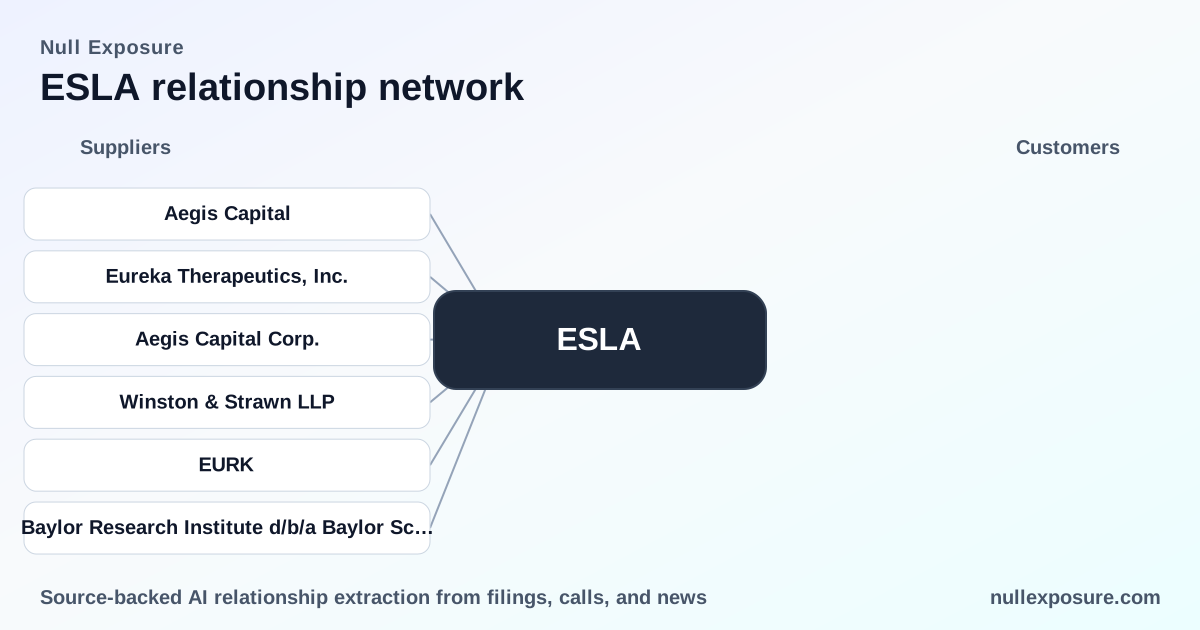
Below are every supplier/partner relationship referenced in the public record for ESLA and a plain-English, source‑backed takeaway for each.
Eureka / Eureka Therapeutics (parent licensor and service partner)
Eureka is the originator of the ARTEMIS® T‑cell platform and granted Estrella an exclusive license for CD19/CD22 programs while also contracting to provide clinical services, manufacturing supply and technical support under a Services Agreement and a $33 million SOW tied to STARLIGHT‑1; Estrella has made milestone and upfront payments to Eureka and continues to rely on Eureka operationally (10‑K, June 30, 2024; Biospace and company press releases, FY2024–FY2026). According to Estrella’s 10‑K (June 30, 2024), the company paid a $1.0M license fee and has completed milestone payments tied to IND submission and first‑patient dosing.
Aegis Capital / Aegis Capital Corp. (placement agent for equity financings)
Aegis Capital acted as exclusive placement agent for Estrella’s registered direct offering and concurrent private placements that closed in early 2026, enabling the company to raise growth capital (Markets FinancialContent/BizWire and related news coverage, Jan 6, 2026; TradingView and MEXC press items, FY2026). Multiple filings and press reports list Aegis as the execution partner for the financing.
Winston & Strawn LLP (transaction counsel)
Winston & Strawn acted as legal counsel to Estrella on the securities transactions, supporting documentation for the registered direct offering and private placement that closed in 2026 (Markets FinancialContent/BizWire, MEXC and AIJourn summaries, FY2026).
Baylor Research Institute d/b/a Baylor Scott & White Research Institute (clinical trial site)
Baylor Research Institute (Baylor Scott & White) was added as an additional clinical site for STARLIGHT‑1, expanding patient enrollment capacity for the EB103 Phase I/II trial (InsiderMonkey reporting, FY2025).
Constraints and what they signal for operators and investors
The public constraint evidence describes the shape and risk profile of Estrella’s supplier relationships. Where documents explicitly name counterparties, those constraints are attributed; where not, they are company-level signals.
- Licensing + exclusivity (explicit to Eureka): The License Agreement grants Estrella exclusive rights to ARTEMIS® for CD19 and CD22 and covers broad territories (licensed territory excludes China and ASEAN), confirming strategic dependence on a single IP source (10‑K, FY2024).
- Mixed contract tenors (explicit to Eureka): Estrella maintains short‑term services agreements (12‑month payment schedules totaling $10M) alongside a milestone‑driven, longer SOW ($33M) for the Phase I/II program, creating a blended contracting posture where near-term cash flow demands are material (10‑K and SOW disclosures).
- Operational criticality and manufacturer role (explicit to Eureka): Eureka is contractually responsible for supplying clinical‑grade product and certain manufacturing duties, making them operationally critical for on‑time clinical execution.
- Spend concentration (company signal, supported by excerpts): Public statements place material spend in the $10M–$100M band for services tied to STARLIGHT‑1, with $3.5M already paid as of June 30, 2024, indicating meaningful cash burn tied to these partnerships.
- Relationship stage (explicit to Eureka): The Eureka relationship is active and operational, with ongoing services and milestone payments recorded.
Investment implications: risk and opportunity
- Concentration risk is the dominant governance concern. Estrella’s license and core development work run through Eureka; interruption or commercial disagreement could materially impair the timeline and value creation.
- Capital markets execution is de‑risking short-term liquidity. The Aegis‑led financing and counsel support demonstrate the company’s ability to access equity capital when needed, but repeated financing dependence dilutes shareholders and shifts value realization to future clinical readouts or partner deals (Markets FinancialContent, Jan 2026).
- Clinical progress is the value trigger. The activation of additional sites like Baylor and reported clinical responses to EB103 (company press releases and Biospace coverage, FY2024–FY2026) are the primary operational catalysts for valuation inflection.
- Operators should prioritize contingency plans for manufacturing and tech‑transfer given Eureka’s central role; investors should treat Eureka as the single most important supplier to monitor.
If you need a tailored counterparty risk brief or monitoring dashboard for ESLA counterparties, start here: https://nullexposure.com/.
Actionable takeaways
- Monitor Eureka closely — license milestones, manufacturing timelines, and cash cadence are the most material operational indicators for Estrella.
- Track financing cadence and placement terms — Aegis Capital’s role confirms market access but raises dilution risk until products reach commercialization.
- Validate clinical capacity expansion — new sites such as Baylor reduce enrollment risk but operational execution will determine near-term readouts.
For a vendor-risk scorecard and continuous monitoring of these counterparties, visit https://nullexposure.com/.
This analysis consolidates the public supplier evidence on ESLA and translates contractual facts into investor-relevant signals — use it to prioritize diligence, model cash burn against milestone schedules, and align monitoring with the single most material counterparty: Eureka.