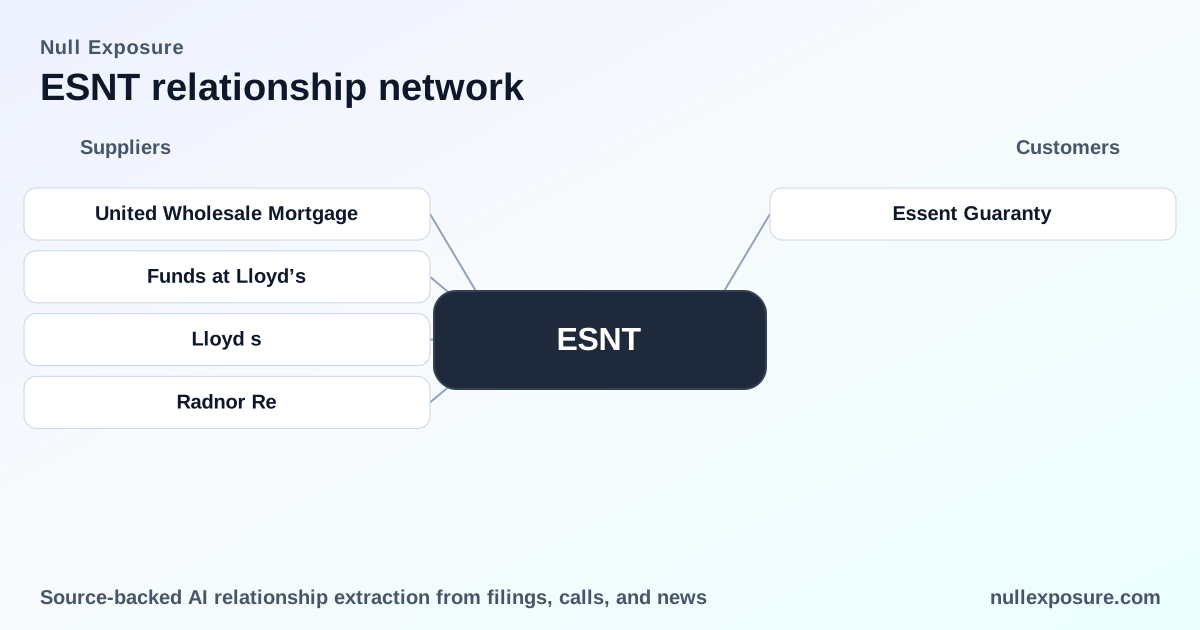
Essent Group Ltd (ESNT) — how the supplier and reinsurance relationships drive risk transfer and capital efficiency
Essent underwrites private mortgage insurance and reinsures portions of that risk to third parties, generating revenue via insurance premiums, ceding commissions on quota-share arrangements, reinsurance recoveries, and investment income on float. The business model monetizes origination volumes and underwriting margins while using long‑dated reinsurance programs and insurance‑linked financing to manage capital and regulatory exposure; one lender relationship exceeds 10% of revenue, and quota‑share/excess‑of‑loss contracts form a core part of risk architecture. For deeper supplier mapping and counterparty signals, visit https://nullexposure.com/.
Why the supplier and reinsurance picture matters to investors
Essent’s economics hinge on two levers: underwriting profitability on mortgage policies and the company’s ability to transfer and finance tail risk through reinsurance and specialty markets. The company uses a mix of long‑term excess‑of‑loss protection, quota‑share frameworks, panels of third‑party reinsurers, special purpose reinsurance and insurance‑linked notes to limit peak losses and secure regulatory capital relief. These arrangements are not cosmetic; they are active, material, and create counterparty credit exposure while leaving Essent ultimately liable as the direct insurer.
Key operating signals for investment diligence:
- Contracting posture: The firm operates with long‑term reinsurance coverages and standing quota‑share frameworks that systematically cede portions of new insurance written. These structures create predictable ceding economics and recurring commission flows.
- Concentration: One distribution partner supplies more than 10% of consolidated revenue, a single‑counterparty concentration that amplifies business risk.
- Criticality: Reinsurance counterparty performance is critical to capital adequacy and claims recovery; ceding does not remove Essent’s direct obligations.
- Maturity: Multi‑year contracts and continuous quota‑share programs indicate a mature, institutionalized reinsurance model rather than ad hoc purchases.
For a concise supplier map and to interrogate counterparty credit signals in context, see https://nullexposure.com/.
Who Essent is doing business with — the relationship list
United Wholesale Mortgage
United Wholesale Mortgage represented more than 10% of Essent’s consolidated revenue in FY2024, underscoring meaningful distribution concentration with a single originator. According to Essent’s FY2024 Form 10‑K, revenue from United Wholesale Mortgage exceeded the 10% threshold for the years ended December 31, 2024, 2023 and 2022.
Funds at Lloyd’s
Essent Re entered into quota‑share agreements backed by Funds at Lloyd’s to reinsure certain property and casualty risks effective in Q1 2026; the company disclosed these arrangements in its fourth‑quarter 2025 reporting. The company’s Q4 2025 earnings release and subsequent press coverage in March 2026 described quota‑share participation supported by Funds at Lloyd’s to backselect reinsurance capacity.
Lloyd’s (Lloyd’s of London capacity)
Essent disclosed quota‑share reinsurance agreements backed by Lloyd’s‑market capacity during its Q4 2025 reporting, indicating usage of Lloyd’s panels to support risk transfer. Coverage descriptions in public commentary on the fourth‑quarter results in March 2026 referenced quota‑share reinsurance agreements backed by funds at Lloyd’s to reinsure certain property and casualty risks.
Radnor Re
Radnor Re appears in Essent’s reporting as part of securitized or structured reinsurance activity (Radnor Re 2021‑1 is cited in Q4 2025 materials), reflecting the company’s use of special purpose reinsurers and pooled structures to monetize or transfer segments of risk. A March 2026 earnings release included line items referencing Radnor Re 2021‑1 in financial schedules summarizing reinsurance and securitization activity.
What these relationships imply for capital, credit and concentration
Essent’s supplier and reinsurance relationships reveal a deliberate capital‑management strategy: rotate risk off the balance sheet while preserving residual direct liability. Quota‑share frameworks provide predictable ceding commissions and profit‑sharing mechanics, while excess‑of‑loss contracts and special purpose reinsurers limit catastrophic exposures. Investors should weigh the following concrete implications:
- Counterparty credit is a first‑order risk. Essent remains liable to policyholders even when claims are ceded; recoverability from reinsurers and Lloyd’s‑backed arrangements directly impacts realized loss severity and capital ratios.
- Revenue concentration is material. The UWM relationship ( >10% of revenue in FY2024 ) creates single‑counterparty exposure on the top line and increases sensitivity to originator market share and credit cycles.
- Contracts are mature and structured. The presence of long‑running excess‑of‑loss programs covering windows from 2018 through 2024 and standing quota‑share frameworks signals institutionalized reinsurance practices that stabilize earnings but create multi‑year counterparty dependencies.
- Reinsurance is active, not passive. Evidence in filings emphasizes active ceding and engagement with external asset managers and special purpose vehicles to execute risk transfer and funding.
Tradeoffs and risks investors must price
- Counterparty performance risk: Recovery shortfalls from reinsurers or ILS structures will transmit to Essent’s loss experience and capital.
- Concentration risk: A material borrower/partner such as UWM introduces distribution concentration that affects new business volumes and premium growth.
- Regulatory and accounting complexity: Quota‑share and excess‑of‑loss mechanics influence reported earnings, loss ratio timing, and statutory capital — investors must reconcile GAAP and regulatory outcomes across time.
Practical next steps for research and sourcing
- Pull the reinsurance schedules and Note 5 from the FY2024 10‑K to quantify ceded limits, program windows, and ceded premium economics.
- Evaluate the creditworthiness and security features of panel reinsurers, Funds at Lloyd’s participation, and special purpose vehicles such as Radnor Re in the context of Essent’s largest ceded programs.
- Model downside scenarios where reinsurer recoveries are delayed or impaired and calibrate impacts to capital ratios and dividend capacity.
For a structured supplier view and to prioritize counterparty diligence, visit https://nullexposure.com/.
Bottom line: Essent runs a deliberate reinsurance and capital management program that stabilizes underwriting economics but concentrates operational exposure through a handful of critical counterparties. Investors should combine 10‑K reinsurance note analysis with counterparty credit assessment and distribution concentration stress testing before sizing exposure.