Esquire Financial (ESQ) — Supplier relationships that shape liquidity and operations
Esquire Financial Holdings operates as the bank holding company for Esquire Bank, a niche regional bank that monetizes through traditional commercial banking activities—net interest income on loans to legal firms, fee income from deposit and cash-management products, and periodic capital markets transactions. The firm leverages third‑party infrastructure for core processing and relies on wholesale liquidity facilities to support balance‑sheet flexibility; these supplier ties are therefore both operationally critical and strategically informative for investors. For a concise supplier risk map and ongoing monitoring, review the coverage at https://nullexposure.com/.
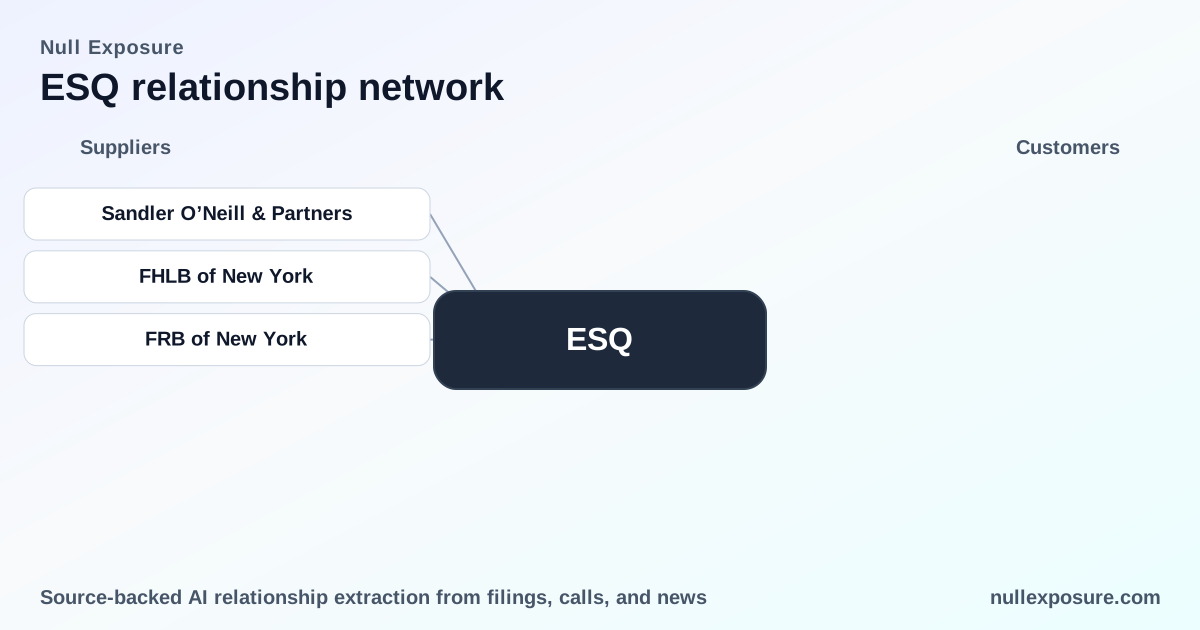
The supplier map: three relationships investors must know
Sandler O’Neill & Partners — the IPO underwriter role
Sandler O’Neill & Partners served as the underwriter for Esquire’s IPO, reflecting a transactional capital‑markets relationship rather than an ongoing operational dependence. MarketBeat’s instant alerts (January 23, 2026) referenced Sandler O’Neill’s role in underwriting the offering, which influences how management accesses equity capital and communicates with institutional investors.
FHLB of New York — committed secured borrowing capacity
As of December 31, 2025, Esquire reported the ability to borrow up to $455.6 million from the Federal Home Loan Bank of New York on a secured basis, establishing a significant committed liquidity backstop. This facility is disclosed in Esquire’s fourth quarter and full‑year 2025 results on PR Newswire and represents a material source of contingent funding that supports lending and liquidity management.
FRB of New York — discount window access
Esquire reported access to the Federal Reserve Bank of New York discount window, with the ability to borrow up to $48.1 million as of December 31, 2025, per the same PR Newswire earnings release. Discount window access provides emergency liquidity options and signals regulatory plumbing available to the bank when market conditions tighten.
What these supplier ties reveal about Esquire’s operating model
Esquire’s supplier footprint reveals a hybrid operating model where capital markets relationships and wholesale liquidity facilities coexist with outsourced infrastructure dependencies. Three company‑level signals crystallize this:
- Material operational exposure: The company discloses that interruptions to key suppliers could adversely affect business and financial results, perhaps materially, indicating that several outsourced services are treated as critical to daily operations.
- Service‑provider posture: Esquire explicitly outsources core systems processing, essential web hosting, deposit processing, and other internet systems, establishing third parties as primary service providers rather than peripheral vendors.
- Infrastructure concentration: The firm classifies these outsourced functions within an infrastructure segment of its vendor map, highlighting the reliance on a relatively small number of providers for platform stability.
These signals imply a contracting posture where Esquire acts as a purchaser of critical managed services rather than an integrated in‑house operator. Contract terms, service‑level guarantees, and contingency arrangements therefore materially affect operational resilience.
For investors conducting further diligence, review full supplier models and risk scoring at https://nullexposure.com/ — this can help quantify concentration and contractual protections.
Risk and opportunity implications for investors
Liquidity and capital access
- Strength: The FHLB and FRB facilities create a robust liquidity corridor that reduces short‑term funding risk and supports asset growth without immediate deposit repricing pressures.
- Caveat: Reliance on secured borrowing lines requires eligible collateral and prudent collateral management; abrupt shifts in collateral valuations would tighten usable capacity.
Operational resilience
- Strength: Outsourcing core processing can deliver scale, security, and cost efficiency when providers are mature and well‑contracted.
- Risk: The company’s own disclosure that supplier interruptions could be materially adverse is a red flag for single‑point‑of‑failure scenarios, particularly for deposit processing and essential web hosting.
Capital markets and strategic optionality
- Observation: Engagement with Sandler O’Neill as an underwriter demonstrates access to investment‑banking capabilities for equity transactions; this supports balance‑sheet management options such as follow‑on equity or shelf offerings.
Practical items for due diligence
Investors evaluating ESQ supplier risk should prioritize documentation and monitoring across three dimensions:
- Contractual strength and exit rights: Confirm minimum service levels, penalty regimes, and transition support for core systems providers.
- Collateral eligibility and concentration: Validate the quality and diversity of collateral supporting the FHLB line and stress‑test usable borrowing capacity under market stress.
- Operational redundancy and incident history: Request incident logs, recovery time objectives, and third‑party audit/attestation reports for outsourced infrastructure.
These checks turn qualitative supplier mentions into quantifiable exposures that feed valuation and scenario analysis. For an investor‑ready supplier due‑diligence pack, see https://nullexposure.com/.
Bottom line: where supplier relationships influence valuation and risk
Esquire’s supplier relationships create a mixed profile: substantial liquidity optionality through FHLB and FRB access and operational dependence on outsourced core systems. For investors, the key tradeoff is between the capital‑market optionality and the operational concentration that could amplify disruptions. The underwriting relationship with Sandler O’Neill is transactional but important for long‑term capital strategy; the FHLB and FRB facilities are ongoing levers for liquidity management.
Key takeaways
- Liquidity backbone: $455.6M FHLB line and $48.1M FRB discount window materially reduce short‑term funding risk (PR Newswire, FY2025 results).
- Operational exposure: Critical outsourcing of core systems and web hosting elevates supplier risk as a material company‑level issue.
- Capital markets access: Underwriter engagement with Sandler O’Neill supports balance‑sheet flexibility (MarketBeat, Jan 2026).
Next steps for an investor: validate contract terms for core service providers, stress collateral capacity for the FHLB line, and obtain third‑party assurance documentation. For a structured supplier risk report and real‑time monitoring, start with the supplier mapping resources at https://nullexposure.com/.