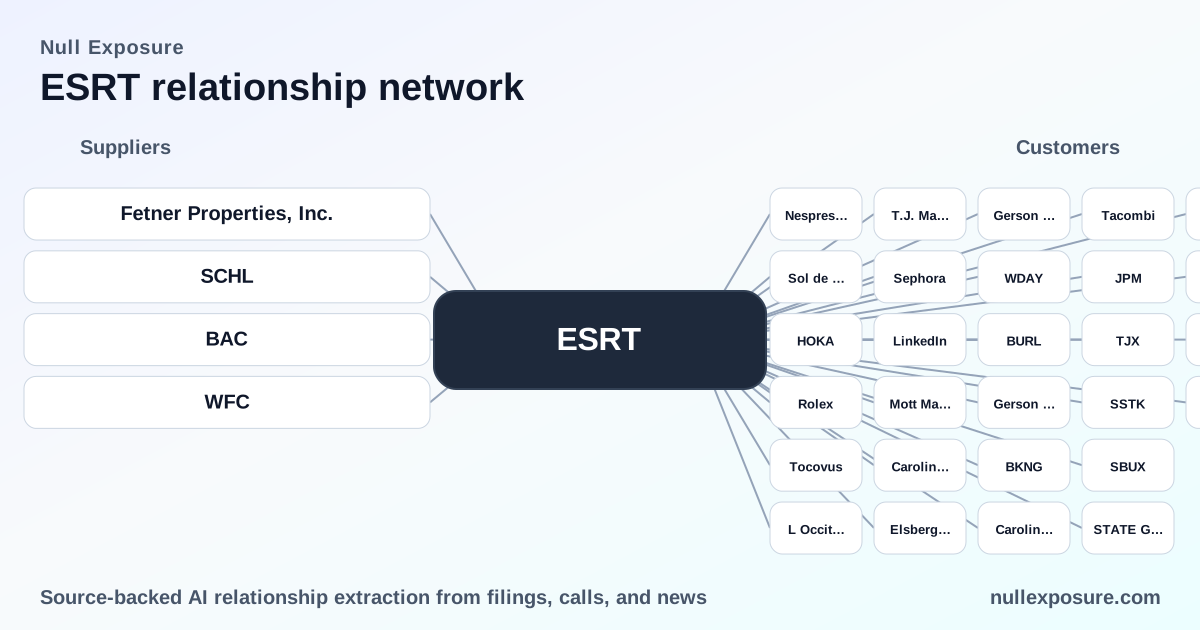
Empire State Realty Trust (ESRT): Supplier Relationships and Strategic Implications for Investors
Empire State Realty Trust operates as a Manhattan-focused REIT that owns, manages, and repositions office and retail real estate—including marquee assets such as the Empire State Building—and monetizes through rental income, property-level operations, asset dispositions, and selective acquisitions that increase cash flow and NOI. Its capital structure blends tenant cashflows with secured and unsecured credit facilities, creating a supplier and counterparty profile that is both capital-intensive and operationally concentrated in New York City. For a consolidated view of supplier exposures and to map counterparty concentration, visit https://nullexposure.com/.
Quick thesis: where value and supplier risk converge
ESRT’s value creation is driven by active asset management in Manhattan and targeted acquisitions that expand retail and office cashflow. Supplier relationships that matter for investors are capital providers (banks and lenders), transactional counterparties in property deals, and ongoing service providers for property operations and technology. These relationships determine liquidity flexibility, carrying costs of long-term ground leases, and operational resilience in a dense urban portfolio.
The supplier map, relationship by relationship
Below I cover every supplier relationship surfaced in public reporting and news monitoring tied to ESRT’s FY2025 activity.
Fetner Properties, Inc.
ESRT completed an acquisition of the remaining stake in a Manhattan multifamily asset from Fetner Properties as part of its FY2025 deal activity. This transaction represents a direct property consolidation consistent with ESRT’s strategy of aggregating income-producing real estate in targeted submarkets (reported March 9, 2026 via Simply Wall St — https://simplywall.st/stocks/us/real-estate/nyse-esrt/empire-state-realty-trust).
Scholastic Corporation (SCHL)
ESRT agreed to acquire 555–557 Broadway from Scholastic Corporation for $386 million, expanding its retail footprint and likely capturing a stabilized rent roll from a single-asset sale by a large corporate landlord (reported March 9, 2026 via Simply Wall St; transaction cited as FY2025 activity — https://simplywall.st/stocks/us/real-estate/nyse-esrt/empire-state-realty-trust).
Bank of America (BAC)
Bank of America is a named lender in ESRT’s amended and expanded credit agreement that closed November 14, 2025, providing a senior unsecured term loan facility of US$210 million (expandable to $310 million) to support working capital and general corporate needs through January 2029. This lender relationship materially improves near-term liquidity and underwrites operating flexibility (reported December 1, 2025 by Sahm Capital; original agreement dated November 14, 2025 — https://www.sahmcapital.com/news/content/empire-state-realty-trust-esrt-expands-credit-facility-with-new-210-million-loan-will-liquidity-shift-drive-strategic-flexibility-2025-12-01).
Wells Fargo Bank (WFC)
Wells Fargo is another syndicate member in the November 14, 2025 amended credit agreement that supplied the $210 million senior unsecured term loan facility, reinforcing ESRT’s access to unsecured bank funding and extending its debt runway into 2029 (reported December 1, 2025 by Sahm Capital; agreement referenced November 14, 2025 — https://www.sahmcapital.com/news/content/empire-state-realty-trust-esrt-expands-credit-facility-with-new-210-million-loan-will-liquidity-shift-drive-strategic-flexibility-2025-12-01).
What the relationships imply about ESRT’s operating model
The mix of counterparties—large corporate sellers, major banks, and service providers—creates a combination of strategic concentration and institutional funding depth:
- Contracting posture and maturity: ESRT carries long-dated contractual commitments rooted in property ownership structures, including ground leases that extend decades into the future. These long-dated obligations translate into predictable cash outflows and make the company a long-horizon counterparty in property markets.
- Counterparty concentration and criticality: The lender syndicate comprised of major banks and transactional counterparties like Scholastic indicate counterparties are large enterprises and therefore credit and operational relationships are with firms that have substantial institutional practices—reducing counterparty execution risk but increasing systemic exposure to changes in wholesale credit markets.
- Service provider dependency: ESRT uses Managed Service Providers and Managed Security Services Providers for 24/7 network and security operations, reflecting an enterprise IT outsourcing posture that is operationally critical for tenant services, billing, access control, and cybersecurity.
- Liquidity and strategic flexibility: The November 2025 unsecured term loan facility demonstrates ESRT’s ability to tap unsecured institutional credit for working capital and strategic transactions, lowering immediate refinancing pressure while preserving asset-level flexibility.
These are company-level signals drawn from contract excerpts: the ground leases extend to as late as 2077 and ESRT carries contractual rent obligations (company filings through FY2024–FY2025). The lender and service-provider constraints show an operator balancing long-term property commitments with institutional funding and outsourced operational capabilities.
If you want a full supplier-risk assessment tailored to ESRT’s credit profile and counterparty network, start here: https://nullexposure.com/.
Investment implications and risk factors
- Balance-sheet optionality improved: The $210M unsecured term loan increases near-term liquidity and pushes significant refinancing decision points into 2029, which reduces immediate refinancing risk and funds working capital needs for asset repositioning.
- Concentration in NYC is a double-edged sword: Owning and operating in Manhattan drives premium rents but also concentrates market and tenant risk; property-level acquisitions (e.g., Scholastic asset) expand exposure to specific submarkets and tenant mixes.
- Long-term lease obligations require sustained cash generation: Contractual rent obligations and long-dated ground leases impose a steady cash burden that demands consistent occupancy and leasing execution.
- Operational resilience depends on third-party providers: Reliance on MSP/MSSP for 24/7 operations and SOC functions makes vendor continuity and cybersecurity governance a material operational risk.
Key takeaway: ESRT’s supplier relationships are a hybrid of strategic property sellers and institutional lenders combined with outsourced operational support—this configuration supports active asset management but requires disciplined capital allocation and vendor risk oversight.
Actions for investors and operators
- For investors: focus on covenant terms in ESRT’s loan agreements, occupancy trends across the recently acquired assets, and ESG/cybersecurity vendor continuity plans that could affect tenant operations.
- For operators and counterparties: monitor the maturity profile of ground leases and the degree to which unsecured facilities are drawn versus available; these metrics drive negotiation leverage.
Explore a deeper counterparty breakdown and scenario stress-testing tools at https://nullexposure.com/ to translate supplier exposures into actionable investment signals.
Final assessment
Empire State Realty Trust’s supplier landscape in FY2025 reflects a pragmatic combination of institutional bank funding, strategic property acquisitions from large corporate counterparties, and outsourced critical operational services. Together these relationships give ESRT the liquidity and operational capacity to execute asset-level repositioning while embedding long-term contractual obligations that require steady cashflow execution. Investors should weight the improved near-term liquidity from the late-2025 credit package against persistent concentration and long-dated lease commitments when sizing positions or underwriting new exposure.
For a tailored supplier risk report and ongoing monitoring of ESRT counterparties, visit https://nullexposure.com/—the fastest path from relationship intelligence to investment decision.