Elastic NV (ESTC) — supplier relationships that shape growth and risk
Elastic NV operates a subscription and cloud-services model built around its Elasticsearch-based search, observability, and security products. The company monetizes through recurring software subscriptions, hosted Elastic Cloud offerings (including a serverless indexing product sold via cloud partners), and professional services; its topline is subscription- and cloud-driven while gross margins remain healthy even as operating profitability fluctuates. For investors and operators evaluating supplier exposure, the critical takeaway is that Elastic’s commercial scale is tightly coupled to cloud-hosting commitments and a mix of strategic channel and technology partners. Learn more about supplier intelligence at NullExposure: https://nullexposure.com/
How Elastic makes money and why supplier links matter
Elastic’s Revenue TTM of $1.677B and gross profit of $1.275B show that the company successfully converts customer demand into margin, but operating and net metrics (a near-zero operating margin and negative EPS) reflect continued investment in go-to-market and R&D. Elastic drives revenue through:
- Recurring subscriptions and support contracts for its search and observability stacks.
- Elastic Cloud — a hosted offering that Elastic sells directly and through infrastructure partners such as AWS.
- Professional services and committed cloud-hosting spend that underpin production deployments.
These dynamics make supplier relationships—especially cloud hosts and channel partners—core to Elastic’s cost structure and product distribution. Institutional ownership is high (~91.7%) and management has public purchase and hosting commitments that create predictable cash flows but raise concentration and contractual maturity risks. For a deeper supplier risk view visit https://nullexposure.com/
What the underwriting roster signals about market access
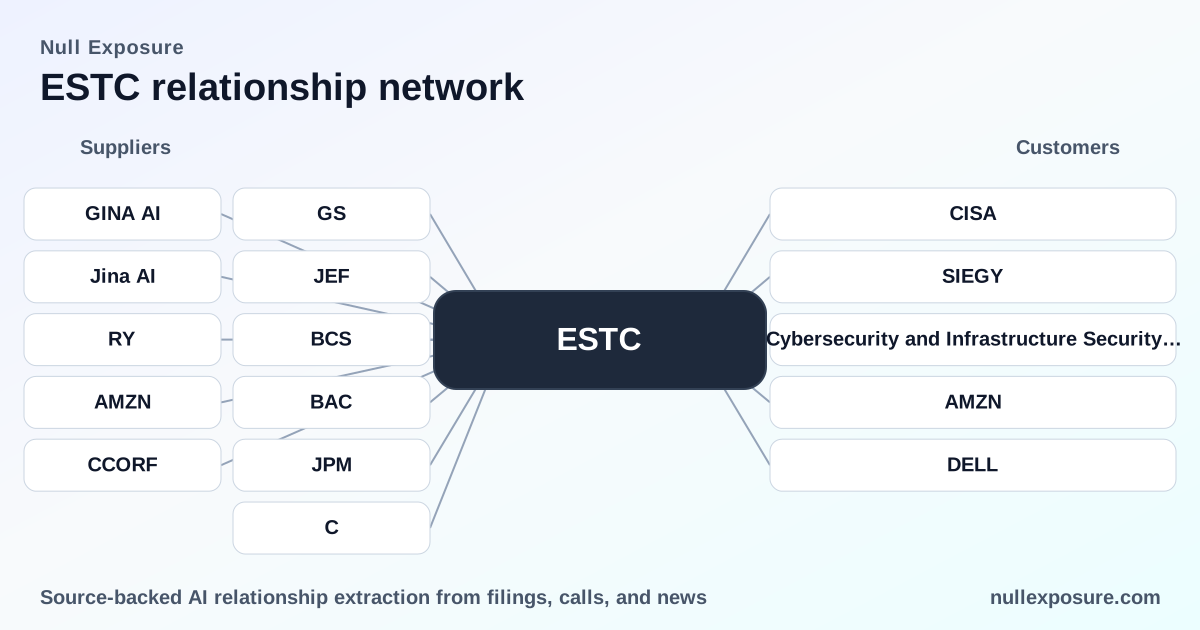
Goldman Sachs, J.P. Morgan, Barclays, RBC Capital Markets, BofA Merrill Lynch, Citigroup, Jefferies, and Canaccord Genuity are all listed as underwriters or co-managers tied to public market activity for Elastic. That group’s involvement is a signal of established investment-banking relationships that support capital markets access and research coverage.
- Goldman Sachs served as an underwriter on Elastic’s public offering, reflecting a top-tier banking relationship; MarketBeat documented the underwriting roster in a January 2026 alert (MarketBeat, Jan 2026: https://www.marketbeat.com/instant-alerts/barclays-cuts-elastic-nyseestc-price-target-to-10000-2026-01-12/).
- J.P. Morgan was among the underwriters, providing institutional distribution muscle for equity transactions (MarketBeat, Jan 2026).
- Barclays acted as an underwriter/co-manager on the transaction noted by MarketBeat, and was also the source of a price-target revision in January 2026 (MarketBeat, Jan 2026).
- RBC Capital Markets is identified as an underwriting participant, supporting regional and institutional placement capacity (MarketBeat, Jan 2026).
- BofA Merrill Lynch appears as a co-manager on underwriting activities, signaling another major banking tie (MarketBeat, Jan 2026).
- Citigroup participated as a co-manager on the offering, rounding out a broad syndicate (MarketBeat, Jan 2026).
- Jefferies served as a co-manager and remains part of Elastic’s capital markets relationships (MarketBeat, Jan 2026).
- Canaccord Genuity was included as a co-manager in the underwriting syndicate for Elastic’s market activity described by MarketBeat (MarketBeat, Jan 2026).
Implication: this breadth of investment-bank relationships supports Elastic’s access to public financing and sell-side research; for investors, that institutional support reduces liquidity and capital-raise execution risk.
Strategic tech partners and product integrations that move the needle
Elastic has integrated third-party AI and cloud services into its inference and serverless offerings—relationships that influence product capability and go-to-market reach.
- Amazon: Elastic expanded an upgraded Elastic Cloud Serverless offering that is available via AWS, increasing indexing throughput and reducing latency—an integration that deepens AWS channel distribution and operational dependency (FinViz, 2026: https://finviz.com/news/293166/why-elastic-could-be-the-next-ai-winner-in-2026).
- GINA AI: Elastic expanded its Elastic Inference service to include GINA AI’s multilingual re-ranking models, enhancing search relevance in multilingual deployments as discussed in an earnings call transcript (The Globe and Mail / press release coverage, Q3 FY2026: https://www.theglobeandmail.com/investing/markets/stocks/ESTC/pressreleases/458265/elastic-estc-q3-2026-earnings-call-transcript/).
- Jina AI: Company commentary also referenced adding Jina AI’s multilingual re-ranking models to Elastic Inference, supporting higher-quality retrieval for global customers (InsiderMonkey, Q3 FY2026 earnings-call coverage: https://www.insidermonkey.com/blog/elastic-n-v-nyseestc-q3-2026-earnings-call-transcript-1706214/).
Implication for operators: these integrations are product-differentiating and expand Elastic’s addressable market, but they also create a dependency on third-party model suppliers and cloud delivery platforms for performance and feature velocity.
Contracting posture, concentration and maturity — company-level constraints
Elastic publicly disclosed significant purchase commitments that reveal the supplier exposure profile: $812.3M in purchase commitments related to cloud hosting services, $29.9M in minimum lease payments, and $73.2M in other contract commitments as of April 30, 2025. This is a company-level signal, not tied to any single named supplier in the excerpt.
- Contracting posture: Elastic carries sizeable committed spend for cloud hosting, which indicates multi-year contractual relationships and limited short-term flexibility to eliminate hosting costs without disruption.
- Concentration: the magnitude of hosting commitments suggests potential dependency on a small number of hyperscalers for infrastructure capacity and commercial terms.
- Maturity profile: these commitments are multi-period and indicate long lead times and budgeted operating expense that create predictability but also persistence of fixed costs.
For investors, the combination of high committed hosting spend and strategic cloud integrations is a central risk dimension for gross-margin sensitivity and vendor negotiation leverage.
Explore more supplier constraint intelligence at NullExposure: https://nullexposure.com/
What this means for investment and operational decisions
- Operator focus: prioritize contract-negotiation playbooks with cloud providers and ensure service-level protections for critical Elastic Cloud components; the company’s purchases create leverage but also lock-in.
- Investor focus: monitor Elastic’s Azure/AWS/GCP partner outcomes and Elastic Cloud adoption metrics as leading indicators of durable subscription growth; watch hosting-commitment amortization and any renegotiation that could alter margins.
- Risk signals to watch: concentration with hyperscalers, third-party model dependence for inference quality, and the cost trajectory tied to committed hosting spend.
Key takeaways and action items
- Elastic is a subscription-first company with meaningful cloud-hosting commitments that shape cost and product delivery.
- A diverse underwriting syndicate supports market access, while AWS and third-party AI partners extend product capability and distribution.
- Committed hosting spend (~$812M) is the single material supplier-related constraint investors should track for margin and operational risk.
For a concise supplier-risk briefing tailored to investors and operators, visit NullExposure: https://nullexposure.com/