Energy Transfer LP (ET): Underwriting, trustees and what the syndicate reveals for counterparties
Energy Transfer LP is a large U.S. midstream operator that monetizes through fee-bearing pipeline, storage and processing services and commodity flows across its network; the company finances operations and growth with recurring capital-market activity, illustrated by a recent $3.0 billion senior notes transaction that relied on a broad underwriting syndicate and a bank trustee. ET’s business model blends stable fee-based cashflow with periodic reliance on debt markets to optimize capital structure. For investors and counterparties, the counterparties to that financing provide a direct window into ET’s contracting posture, counterparty diversity and market access profile.
Learn more about how we map supplier and counterparty relationships at https://nullexposure.com/.
The deal and the players: who showed up for ET’s $3.0bn senior notes
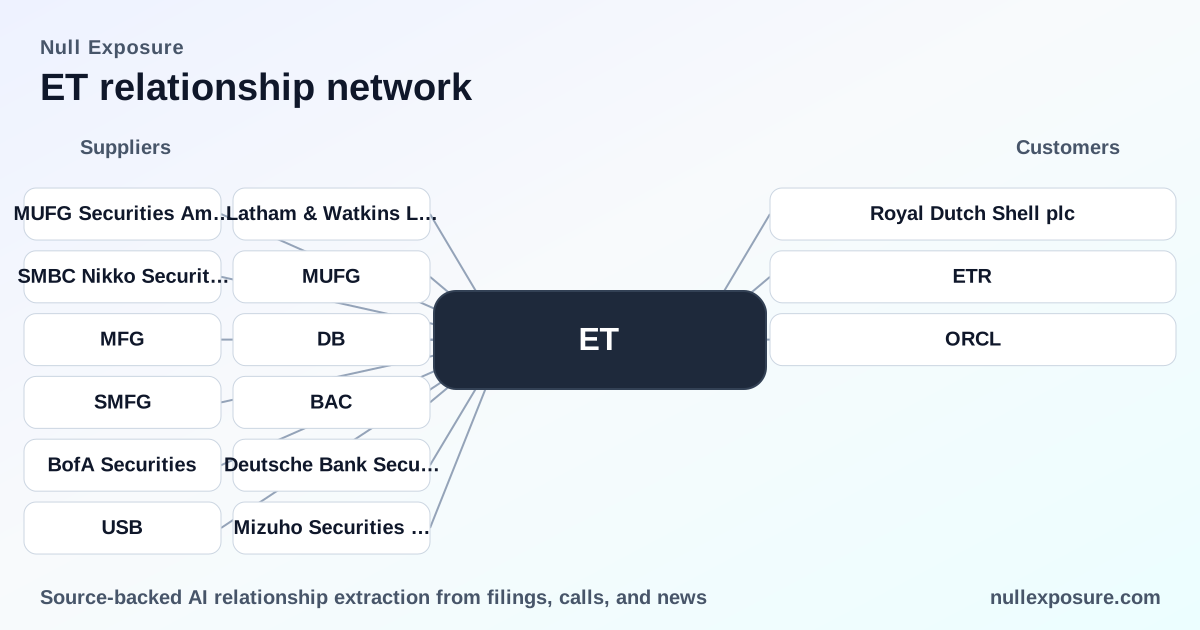
Energy Transfer executed an underwritten public offering totaling $3.0 billion comprised of three tranches of senior notes and signed a supplemental indenture with a bank trustee. Below are the counterparties named in public reporting along with concise, plain-English takeaways for each relationship.
-
Latham & Watkins LLP — Legal counsel for ET in the offering. Latham’s Houston corporate team is listed as representing Energy Transfer in connection with the senior notes offering, indicating ET used established external counsel for transaction documentation and regulatory filings. (Latham announcement, March 2026: https://www.lw.com/en/news/2026/01/latham-advises-energy-transfer-senior-notes-offering)
-
BofA Securities, Inc. / BofA Securities — Joint book‑running manager and representative of the underwriters. BofA served as a lead underwriter on the offering, reflecting ET’s use of top-tier U.S. investment banking distribution to place multi‑year debt. (Hunton Andrews Kurth press release, March 2026; TradingView summary, March 2026: https://www.hunton.com/news/hunton-advises-on-energy-transfers-3b-senior-notes-offering, https://www.tradingview.com/news/tradingview:74299846845eb:0-energy-transfer-signs-underwriting-agreement-with-bofa-securities-and-others/)
-
Deutsche Bank Securities Inc. / Deutsche Bank Securities — Joint book‑running manager and underwriter representative. Deutsche Bank joined the syndicate as a book‑runner, supporting distribution to institutional fixed‑income accounts. (Hunton release; TradingView notice, March 2026: https://www.hunton.com/news/hunton-advises-on-energy-transfers-3b-senior-notes-offering, https://www.tradingview.com/news/tradingview:74299846845eb:0-energy-transfer-signs-underwriting-agreement-with-bofa-securities-and-others/)
-
Mizuho Securities USA LLC / Mizuho Securities USA — Joint book‑running manager and underwriter representative. Mizuho’s inclusion broadens geographic and investor reach to Asia‑linked fixed‑income desks. (Hunton release; TradingView summary, March 2026: https://www.hunton.com/news/hunton-advises-on-energy-transfers-3b-senior-notes-offering, https://www.tradingview.com/news/tradingview:74299846845eb:0-energy-transfer-signs-underwriting-agreement-with-bofa-securities-and-others/)
-
MUFG Securities Americas Inc. / MUFG Securities Americas — Joint book‑running manager and underwriter representative. MUFG’s role signals engagement from globally networked banks that handle large public note placements. (Hunton release; TradingView notice, March 2026: https://www.hunton.com/news/hunton-advises-on-energy-transfers-3b-senior-notes-offering, https://www.tradingview.com/news/tradingview:74299846845eb:0-energy-transfer-signs-underwriting-agreement-with-bofa-securities-and-others/)
-
SMBC Nikko Securities America, Inc. / SMBC Nikko Securities America — Joint book‑running manager and underwriter representative. SMBC Nikko’s participation adds another Asia‑focused wholesale counterparty to the syndicate. (Hunton release; TradingView summary, March 2026: https://www.hunton.com/news/hunton-advises-on-energy-transfers-3b-senior-notes-offering, https://www.tradingview.com/news/tradingview:74299846845eb:0-energy-transfer-signs-underwriting-agreement-with-bofa-securities-and-others/)
-
U.S. Bank Trust Company — Trustee under a Tenth Supplemental Indenture. U.S. Bank Trust Company acts as trustee under the supplemental indenture executed when the notes were issued, a standard trustee role for bondholder administration. (TradingView notice, March 2026: https://www.tradingview.com/news/tradingview:56831909d656f:0-energy-transfer-signs-tenth-supplemental-indenture-with-u-s-bank-trust-company/)
Key takeaway: ET used a large, multi‑bank syndicate plus major legal counsel and a traditional bank trustee—an archetypal structure for high‑grade capital markets funding by mature midstream operators.
Why these relationships matter to investors and suppliers
The composition of banks, counsel and trustee in a financing is not decorative—it signals ET’s contracting posture, market access and counterparty appetite. The presence of multiple global book‑runners demonstrates ET’s ability to layer distribution across U.S. and Asia‑linked investors and to source meaningful liquidity in one execution.
- Contracting posture: ET executed an underwritten offering, indicating a preference for certainty of execution and rapid access to long‑dated funding rather than private bilateral loans.
- Counterparty concentration: The syndicate is diversified across several global banks, reducing single‑counterparty concentration risk for placement and secondary market liquidity.
- Counterparty maturity and criticality: External counsel and trustee are established providers used for repeat debt programs, underscoring operational maturity in ET’s financing playbook.
For a deeper mapping of ET’s supplier footprint and counterparty exposures, visit https://nullexposure.com/.
Constraints and company‑level signals investors should note
Public reporting tied to ET also surfaces a small set of company‑level constraints worth factoring into counterparty diligence:
- Materiality (cybersecurity): ET states that certain cybersecurity incidents occurred but that management is not aware of any threats that have materially affected the Partnership financially or operationally (company 10‑K excerpt). This is a company‑level signal that incidents have been contained to date and not escalated to material impact.
- Relationship roles (buyer / service_provider): Filings reference ET acting as a buyer in the context of pipeline modifications and associated transportation contracts, and also cite the role of service providers when discussing cybersecurity incidents—an indication that ET both purchases services and engages third‑party providers in its operations.
These constraints describe ET’s operating reality: active contracting across infrastructure projects and reliance on external service providers for both construction and ongoing operations. They are company‑level signals and are not attributed to any single counterparty.
Financial context and what underwriting tells us about balance‑sheet strategy
Energy Transfer’s scale and recent capital activity align: Revenue TTM ~$85.5bn and EBITDA ~$15.0bn provide ample coverage to support periodic debt issuance; market capitalization is roughly $64.5bn and EV/EBITDA sits near 8.8x, consistent with an investment‑grade style approach to capital markets access. The use of three tranches of notes (2031, 2036, 2056) indicates a staggered maturity strategy to match cashflow profiles and extend the company’s debt maturity ladder while preserving flexibility for operations and distributions.
Practical monitoring checklist for operators and counterparties
Continue active monitoring across these vectors:
- Legal and trustee documentation for covenant language and cross‑default provisions following each issuance.
- Syndicate composition changes as a signal of shifting access or investor appetite.
- Public statements on operational incidents and remediation timelines, given prior cybersecurity mentions.
- Cashflow coverage metrics around interest and distributions; use reported EBITDA and revenue trajectories to gauge cushion for future debt placements.
Visit https://nullexposure.com/ for subscription access to persistent counterparty monitoring and relationship scoring.
Conclusion: what this means for investors and operators
The March 2026 senior notes offering confirms ET’s ongoing reliance on the public debt markets and its capacity to attract a diversified global underwriting syndicate, supported by major law firms and a standard trustee arrangement. For counterparties and business partners, this translates into predictable capital access and operational maturity, while the company‑level cybersecurity and buyer/service‑provider signals deserve continued attention in due diligence. For actionable counterparty intelligence and relationship tracking, see https://nullexposure.com/.
Bold counterparties, clear market access, and disciplined use of capital markets: those are the headline takeaways for investors evaluating ET supplier relationships.