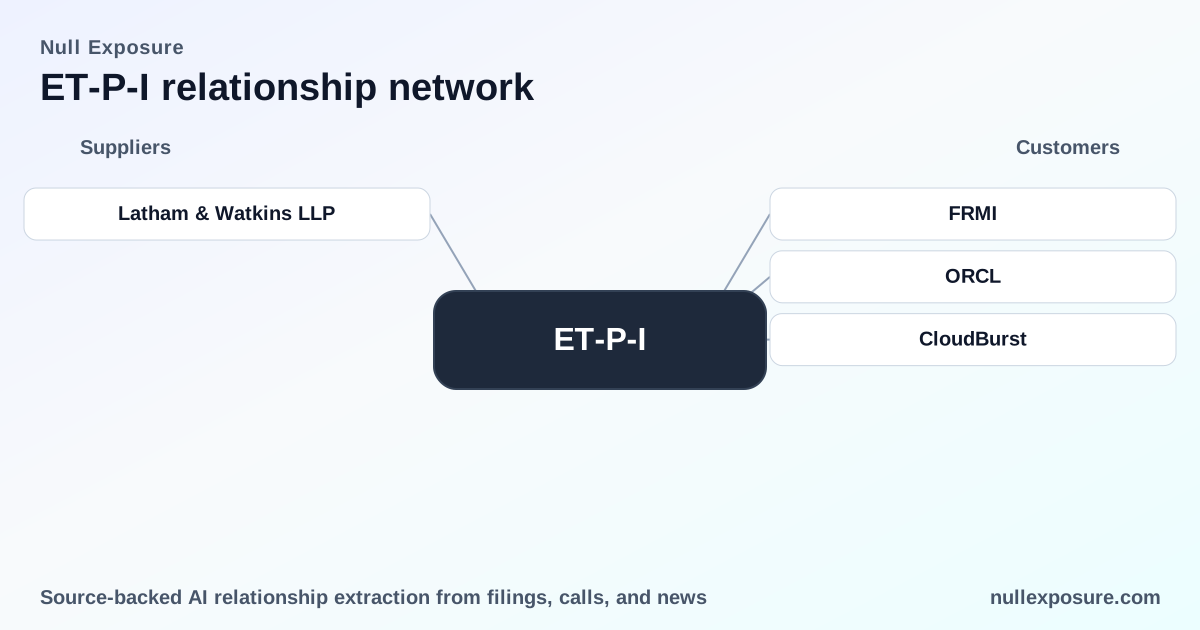
ET-P-I: Supplier Map and What it Means for Investors and Operators
ET-P-I operates as an investment firm focused on financing and building clean-energy projects and infrastructure, generating returns through equity stakes, project cash flows, and strategic exits. The firm monetizes by sourcing capital for transformational energy assets, sponsoring development platforms, and taking positions in operating businesses that deliver predictable, long-term cash yield. For investors and operators, the supplier footprint of ET-P-I is a direct window into how the firm underwrites transactions, manages legal and regulatory friction, and scales deployment across markets.
Explore supplier coverage and relationship intelligence at https://nullexposure.com/.
Why supplier relationships matter for an energy-focused investment firm
Supplier selection reveals how ET-P-I transacts. A small roster of elite professional services firms suggests a contracting posture that prioritizes legal certainty and transaction speed, whereas a broad, regional supplier base would signal operational decentralization. From an investor standpoint, supplier relationships drive deal execution risk, operational continuity, and reputational exposure — all inputs to valuation and governance oversight.
- Contracting posture: ET-P-I’s visible supplier profile indicates the firm uses established, full-service advisors for capital markets and complex financings. This reduces execution risk on large offerings but increases reliance on a small number of high-capability partners.
- Concentration and criticality: When legal or capital markets counsel are the primary visible suppliers, they are functionally critical to closing financings and navigating regulatory reviews. Counterparty concentration can therefore be a single-point execution risk.
- Maturity signal: Engagement with top-tier advisors signals institutional sophistication and an ability to access large pools of capital; it also reflects the need for bespoke legal work in structured financings.
If you want a deeper read on supplier concentration and contract-level risk for ET-P-I, start here: https://nullexposure.com/
What we found in the supplier relationships
The supplier coverage for ET-P-I in our records is narrowly focused and dominated by legal advisory activity. Below is every supplier relationship surfaced in the available results, with plain-English summaries and source context.
Latham & Watkins LLP — legal counsel observed on a major financing
Latham & Watkins LLP acted as legal advisor to Energy Transfer LP in a transaction offering $2.0 billion of junior subordinated notes, a mandate that reflects the firm’s role in advising complex capital markets transactions relevant to energy-sector financing. According to Latham & Watkins’ announcement in August 2025, the corporate team led the representation on that offering (https://www.lw.com/en/news/2025/08/latham-watkins-advises-energy-transfer-lp-in-offering-of-us2-billion-junior-subordinated-notes).
(Note: This is the sole supplier relationship surfaced in the scope provided; no other supplier entries were present in the results.)
How these relationships shape ET-P-I’s operating model
With a narrow, high-caliber supplier footprint, ET-P-I demonstrates several operating characteristics investors should understand:
- Execution-first contracting posture. ET-P-I prioritizes top-tier professional services to minimize friction when raising capital or executing complex transactions. That posture supports faster deal close and cleaner documentation, which are essential for large-scale energy infrastructure projects.
- High criticality, manageable operational breadth. Legal and capital-markets advisors are operationally critical but do not imply a sprawling third-party operations dependency; ET-P-I’s model emphasizes strategic partnerships rather than extensive outsourced operations.
- Concentration risk exists but is intentional. Reliance on a small set of elite suppliers is a deliberate trade-off: it raises systemic vendor risk but lowers transaction risk and supports access to institutional capital pools.
- Maturity and market access. Engaging established firms signals ET-P-I can access sophisticated capital structures and institutional counterparties — an advantage for scaling capital-intensive energy projects.
Because the constraints dataset contains no explicit supplier constraints, the absence itself is a company-level signal: no publicly recorded contractual restrictions or adverse supplier covenants were detected in this coverage window, which supports an interpretation of standard, market-oriented supplier arrangements.
Risk and opportunity implications for investors and operators
For investors evaluating ET-P-I exposure, the supplier footprint points to a few actionable themes:
- Operational continuity depends on maintaining high-quality advisory relationships. Any disruption to those legal or capital markets ties can delay closings and extend financing timelines — a material value risk for project-level investments.
- Counterparty selection is a competitive advantage. ET-P-I’s use of top-tier advisors improves deal credibility with institutional buyers and lenders, enabling tighter pricing on capital and more predictable syndication outcomes.
- Governance focus should include vendor resilience. Boards and investors should request visibility into vendor concentration, alternative counsel arrangements, and SLAs for critical transactions to reduce single-point failure risk.
If you want structured analysis on vendor concentration and contractual risk for ET-P-I portfolios, visit https://nullexposure.com/ for proprietary supplier intelligence.
Practical next steps for investors and operators
- Demand transparency on the roster of critical suppliers and contingency plans for key transaction activities.
- Insist on contractual terms that allow rapid replacement of critical advisors without material execution delay.
- Monitor counterparties’ regulatory or litigation exposure — disruptions at a major advisor can cascade to sponsored projects.
Bottom line: ET-P-I runs a lean supplier footprint concentrated on high-end legal and capital markets partners, which supports rapid, high-stakes dealmaking but creates measurable vendor concentration risk that should be monitored as part of standard diligence.
For ongoing supplier intelligence and to benchmark ET-P-I’s vendor posture against peers, continue your research at https://nullexposure.com/.
Acknowledgement of sources: ET-P-I’s public profile describes the firm as an investment sponsor focused on energy transition projects, and the supplier relationship with Latham & Watkins is documented in Latham & Watkins’ August 2025 announcement regarding a $2.0 billion junior subordinated notes offering (https://www.lw.com/en/news/2025/08/latham-watkins-advises-energy-transfer-lp-in-offering-of-us2-billion-junior-subordinated-notes).