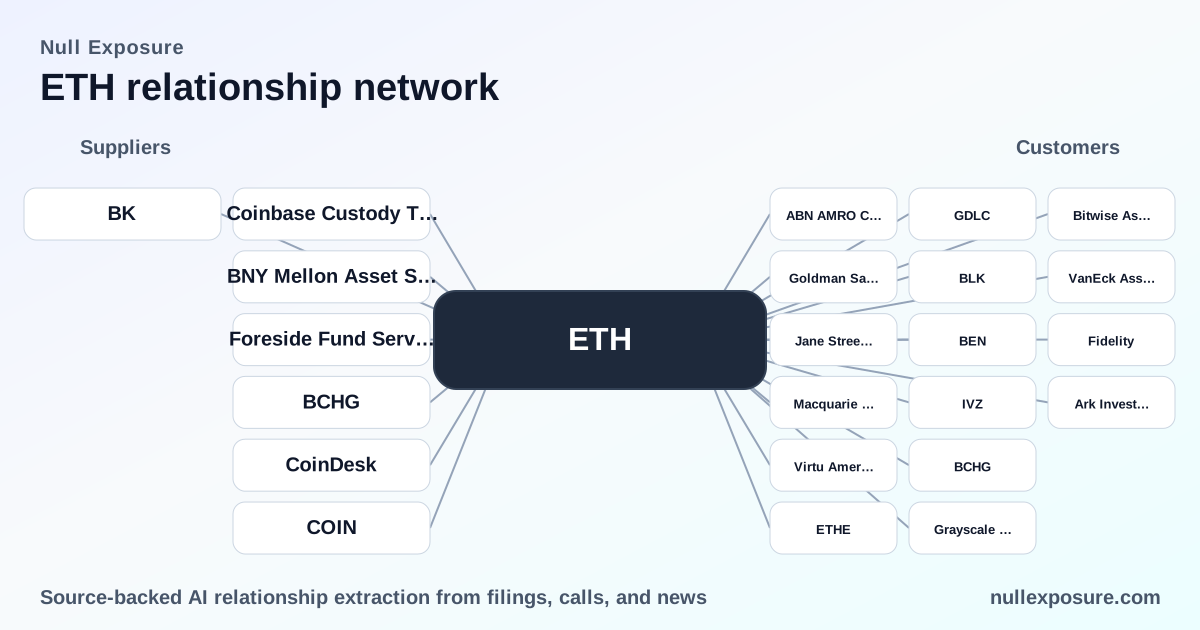
Grayscale / ETH suppliers: custody, administration and the third‑party map investors need to price risk
Thesis — The Grayscale Ethereum vehicle generates economics by sponsoring and packaging Ether exposure into a trust structure, collecting a Sponsor’s Fee while outsourcing custody, administration, transfer agency and marketing to specialist counterparties; those outsourced relationships are operationally critical to NAV integrity and liquidity, and fee flows concentrate economic control with the Sponsor and a handful of service providers. For detailed counterparty profiles and monitoring tools visit https://nullexposure.com/.
A compact supplier map investors can use today
Below are the counterparties disclosed in the source set and what each does in plain English.
- Coinbase Custody Trust Company, LLC — Qualified custodian and fiduciary. The Trust’s FY2024 Form 10‑K identifies Coinbase Custody as the qualified custodian and a fiduciary under New York Banking Law responsible for safeguarding the Trust’s Ether and holding the private keys. (FY2024 10‑K filing.)
- BNY Mellon Asset Servicing — Fund administrator and accounting provider. The Sponsor has an explicit Fund Administration and Accounting Agreement with BNY Mellon Asset Servicing to perform administration and accounting services for the Trust. (FY2024 10‑K filing; DisruptionBanking coverage, 2025.)
- Foreside Fund Services, LLC — Marketing agent. Public filings and press coverage list Foreside as the Marketing Agent, responsible for facilitating Participation Agreements, distributing prospectuses and filing marketing materials. (GlobeNewswire press release, Jan 5, 2026.)
- Grayscale Investments (the Sponsor) — Sponsor, operator and fee recipient. Grayscale is named as the Sponsor responsible for day‑to‑day administration, selecting service providers and receiving a Sponsor’s Fee; Grayscale also activated staking functionality for its U.S. Ethereum ETPs in late 2025. (Form reporting and press coverage; ETFdb and GlobeNewswire, 2026.)
- CoinDesk (Index Provider / Licensor) — Index licensor for Ether pricing. The Grayscale Ethereum product follows the CoinDesk Ether Price Index and the Sponsor uses an index license agreement (dated Feb 1, 2022) to calculate the Index Price. (ETFdb coverage citing CoinDesk; Index License Agreement referenced in filings.)
If you want a consolidated watchlist of these suppliers and live alerts, start here: https://nullexposure.com/.
What the contract excerpts and constraints reveal about how the Trust runs
The disclosures and constraint excerpts sketch an operating model that is service‑outsourced, legally structured and single‑point sensitive in multiple dimensions.
- Contracting posture — outsourced, license‑centric. The Sponsor leverages long‑form service agreements: an Index License Agreement governs pricing inputs, a Prime Broker/Custody agreement governs wallet control and custody, and discrete administration and marketing contracts assign operational duties. Those contracts centralize operational control with named counterparties rather than internal functions. (Index License Agreement, Feb 1, 2022; FY2024 10‑K.)
- Concentration and criticality — small set of providers, high impact. The Trust explicitly relies on third‑party custodians, administrators, transfer agents and liquidity providers; replacement of any of these service providers would be operationally challenging and could affect safekeeping and operations. That makes counterparty performance and stability an investment‑grade consideration on par with custody insurance and operational continuity planning. (FY2024 10‑K; constraint excerpts on materiality.)
- Geography and market inputs — global price discovery. Ether valuations are sourced from multiple global trading platforms and an index license feeds pricing into NAV calculation, so market data integrity and index licensing are part of the value chain. (Index License Agreement and market commentary in filings.)
- Relationship stage and maturity — active, contractually persistent. The Prime Broker and Custody agreements remain in force with contractual notice periods and operational transition protections, indicating mature, operationally integrated relationships rather than ad‑hoc dependencies. (Prime Broker Agreement language in FY2024 10‑K.)
Relationship‑level takeaways investors must price
- Custody risk is the core operational risk. Coinbase Custody stores private keys and holds safekeeping responsibility; any custody failure would be immediately material to NAV and redemption mechanics. Grayscale’s reliance on a qualified custodian elevates counterparty assessment from a compliance checkbox to a principal investment risk. (FY2024 10‑K.)
- Administration and accounting are outsourced to an incumbent bank operator. BNY Mellon Asset Servicing handles fund accounting and administration, which limits operational execution risk but creates concentration risk tied to large custodian/administrator platforms. (FY2024 10‑K; DisruptionBanking, 2025.)
- Marketing and distribution are delegated but contractually specified. Foreside as Marketing Agent centralizes investor communications and participation operations—disruptions here can affect liquidity and authorized participant flows. (GlobeNewswire, Jan 5, 2026.)
- Index licensing is a non‑trivial dependency. The Trust uses CoinDesk Indices under a license agreement; index integrity and licensing continuity are essential to fair NAV calculation and secondary market confidence. (Index License Agreement referenced in filings; ETFdb/coinDesk reporting.)
- Sponsor economics and expense allocation concentrate incentives. The Sponsor receives a Sponsor’s Fee and is contractually required to cover many ordinary course expenses, which aligns the Sponsor’s financial incentives with product distribution but concentrates economic control. (FY2024 10‑K excerpts on Sponsor’s Fee and Sponsor‑paid Expenses.)
For a deeper counterparty scorecard and covenant monitoring for these suppliers, explore our premium supplier analytics at https://nullexposure.com/.
Operational and investment implications
- Valuation and liquidity are second‑order dependent on operational counterparties. Even with liquid underlying Ether markets, trust NAV accuracy, bid/offer tightness and redemption mechanics will depend on the robustness of custody, administration and AP relationships.
- Due diligence should be dual track: financial health and operational resilience. Investors must evaluate the custody provider’s regulatory posture and insurance, the administrator’s reconciliation controls, the index licensor’s governance, and contractual exit mechanics. The filings show contractual protections, but they do not remove the economic sensitivity.
- Active monitoring is mandatory for staked‑Ether products. With Grayscale activating staking for U.S. ETPs in late 2025, staking custody and reward distribution processes become additional operational vectors to monitor alongside traditional custody and accounting flows. (GlobeNewswire, Jan 5, 2026.)
Bottom line and what to do next
Grayscale’s ETH product is a fee‑driven wrapper that outsources critical operational functions to a compact set of large, regulated providers; that structure reduces in‑house operational burden but concentrates counterparty and contractual risk. Investors should treat supplier diligence as primary portfolio risk work, not a secondary compliance exercise.
If you manage capital or operate crypto enabled products, get a focused supplier risk briefing and ongoing monitoring at https://nullexposure.com/. For bespoke counterparty intelligence and alerts, request a trial or a tailored watchlist at https://nullexposure.com/ — the return on due diligence is direct protection of NAV and liquidity.