Eton Pharmaceuticals: supplier relationships that shape a rare‑disease commercialization strategy
Eton Pharmaceuticals operates as a specialty pharmaceutical acquirer and commercializer, monetizing by in‑licensing and purchasing U.S. commercialization rights to niche, often orphan or rare‑disease products, and then commercializing those assets through direct sales and royalty arrangements. Revenue comes from marketed products and the economics of licensed or acquired assets (upfronts, milestones, and royalties), while margins and growth hinge on a small set of purchased franchises and third‑party manufacturing relationships. For a focused read on supplier exposures and commercial counterparties, visit https://nullexposure.com/.
How Eton sources products and converts them to revenue
Eton’s operating model is transaction‑driven: the company acquires or licenses marketed or near‑market products and then applies a focused commercial effort in the U.S. market. This model produces lumpy but potentially accretive revenue roll‑ups when new rights perform above expectations. Key business model characteristics are licensing‑heavy contracting, geographic concentration in North America, and a reliance on third‑party manufacturers and service providers.
- Contracting posture: Eton routinely signs licensing and asset‑purchase agreements that include upfront payments, contingent milestones, and royalties — a capital‑efficient way to scale a rare‑disease portfolio without broad internal R&D. Evidence of licensing activity is explicit in company disclosures describing recent deals.
- Supplier concentration and criticality: The company discloses dependence on a small number of third‑party suppliers to manufacture active ingredients and finished product, creating single‑point risks for supply continuity.
- Maturity and risk profile: The firm is a commercial-stage consolidator rather than a fully integrated manufacturer; relationships with licensors, manufacturers, and specialized service providers determine execution risk and product availability.
For practitioners evaluating counterparty risk, the licensing pattern, U.S.-focused geography, and third‑party manufacturing dependence are the central signals to monitor (see company filings and press releases cited below). If you’re tracking supplier dynamics for portfolio decisions, see more at https://nullexposure.com/.
What the filings and press releases actually list — relationship by relationship
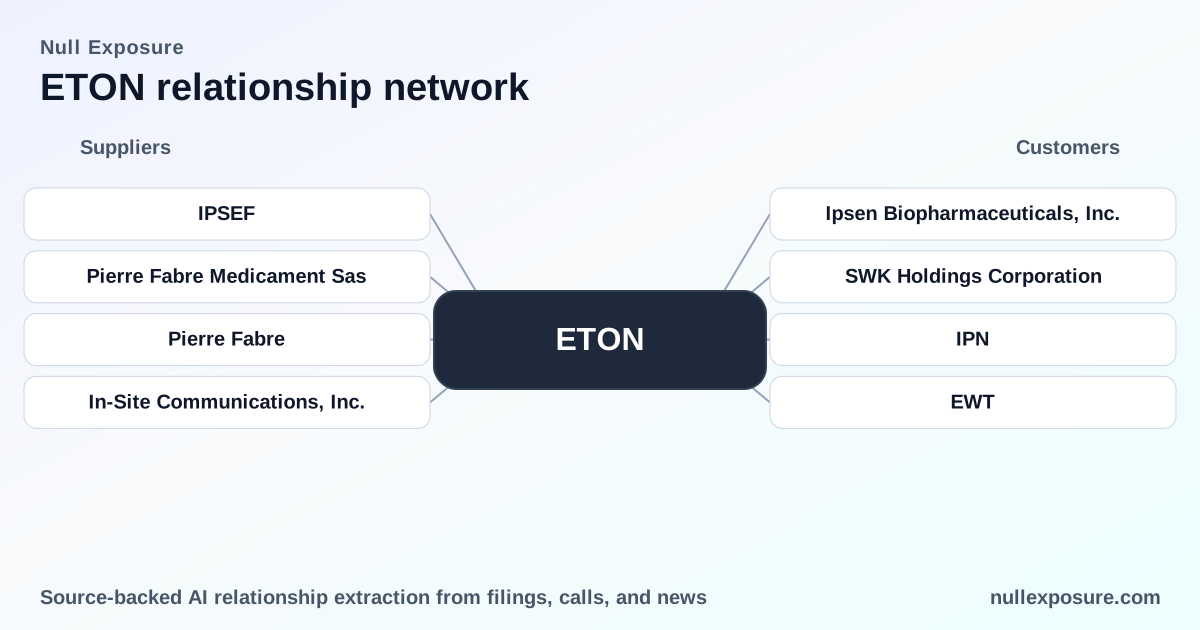
Ipsen
Eton’s FY2024 10‑K records a deferred consideration payable to Ipsen of $5,000, reflecting an acquisition‑related deferred payment obligation. This is a post‑acquisition contingent cash commitment recorded as deferred payments in the company’s financial statements. According to Eton’s FY2024 10‑K filing, deferred payments represent the acquisition‑date fair value of the $5,000 deferred consideration to be paid to Ipsen in connection with the transaction reported in that filing.
Pierre Fabre Medicament Sas / Pierre Fabre
In early March 2026, Eton announced it in‑licensed U.S. commercialization rights to HEMANGEOL (propranolol hydrochloride oral solution) from Pierre Fabre Medicament Sas; press coverage frames the deal as an exclusive U.S. marketing license. This transaction follows Eton’s strategy of acquiring U.S. rights to rare‑disease or pediatric products and is presented as near‑term accretive to revenue. The GlobeNewswire press release (March 2, 2026) describes the in‑license, and market commentary (reported March 2026) indicates analysts updated price targets and outlooks following the deal.
In‑Site Communications, Inc.
Multiple Eton press releases from FY2025–FY2026 list Lisa M. Wilson of In‑Site Communications, Inc. as the investor relations contact. In‑Site functions as Eton’s external investor‑relations or communications vendor in company disclosures, reflecting reliance on specialist service providers for capital‑markets communications. This appears in Eton press releases reporting financial results and investor conference participation in late 2025 and early 2026.
What the company‑level constraints tell investors about operational risk
Eton’s disclosures and the extracted constraint signals produce a compact risk map that investors should interpret as operational characteristics, not isolated statistics.
- Licensing is core to the model. Company text explicitly documents licensing transactions (for example, a November 2024 licensing agreement to acquire U.S. rights to Amglidia), which establishes licensing as a repeatable contracting approach rather than one‑off activity.
- North America is the dominant geography. The firm repeatedly acquires U.S. commercialization rights in disclosed transactions (an explicit reference to U.S. acquisitions in March 2024 is included in filings). This concentration focuses return potential but amplifies single‑market regulatory and reimbursement risk.
- Roles include licensor, seller and manufacturer relationships. Eton both acquires assets (seller interactions) and contracts as licensee/licensor, while also depending on third‑party manufacturers; the company discloses substantial reliance on a small number of suppliers for active ingredients and finished product.
- Specialized service providers are embedded in operations. External cyber‑security, investor‑relations, and compliance consultants are named in disclosures as ongoing service providers, showing Eton leverages boutique vendors for operational capabilities.
These signals together mean execution on supply agreements and effective post‑acquisition commercialization are the primary drivers of investment outcomes, not long lead internal R&D programs.
Investment implications and risk checklist
For investors and operators evaluating Eton as a supplier counterparty or portfolio holding, focus on three points:
- Supply chain concentration risk. A failure at a single third‑party manufacturer can interrupt product supply and revenue recognition; confirm redundancy and contingency plans in due diligence.
- Deal economics transparency. Upfronts, milestone caps, and royalty rates govern long‑term economics; scrutinize deferred payment schedules (for example, the $5,000 Ipsen deferred consideration in FY2024) and potential future liabilities.
- Commercial integration capability. Success hinges on Eton’s ability to relaunch or sustain niche products in the U.S. payer and provider environment; prior examples (Hemangeol license) demonstrate the firm’s repeatable approach but not guaranteed uptake.
If you’re evaluating counterparties or want a deeper supplier risk brief, visit https://nullexposure.com/ for tailored coverage and monitoring tools.
Bottom line and next steps for analysts
Eton is a commercially oriented consolidator of rare‑disease assets; the firm’s upside is transaction‑driven and its primary risks are supplier concentration and commercialization execution. For investors, the March 2026 Hemangeol license and the FY2024 deferred obligation to Ipsen are immediate evidentiary points that underline both Eton’s growth playbook and its contingent liabilities.
For ongoing monitoring and supplier risk intelligence tailored to small‑cap specialty pharma, explore more at https://nullexposure.com/.