ETS (Elite Express Holding Inc.): Underwriters, Advisors and What They Signal for Investors
Elite Express Holding Inc. (Ticker: ETS) operates as a small-cap logistics and express-delivery operator that monetizes through freight and expedited shipment services to commercial and consumer customers, supplemented by technology-driven routing and capacity management. The company recently completed a public offering that injected cash into the business while formally establishing a set of external financial counterparties (underwriters and an advisor) who will influence its access to capital and market visibility. For investors evaluating supplier and counterparty exposure, the underwriting lineup and the company’s concentrated ownership profile are the primary near-term factors to monitor. For detailed tracking of counterparties and supplier relationships, visit https://nullexposure.com/.
Market snapshot: ETS is a nascent public company with limited scale — trailing twelve-month revenue of roughly $2.7M, negative EBITDA and earnings, high insider ownership (~61%), and very low institutional ownership (~1.8%). The firm’s public equity float is small, which increases the practical importance of its chosen underwriters and advisors for liquidity and follow-on financing.
Why the IPO counterparties matter for supplier-risk analysis
Underwriters and financial advisors are not operational suppliers in the traditional trucking sense, but they are critical commercial counterparties for an emerging issuer: they determine initial price discovery, provide distribution to investors, and influence access to future capital. For a company with constrained margins and limited institutional sponsorship, the credibility and role of these counterparties translate directly into financing runway and the ability to scale asset-intensive operations.
- Contracting posture: The recent IPO closing signals a vendor-style, transactional engagement with finance providers focused on capital placement rather than long-term strategic capital partnerships.
- Concentration and control: High insider ownership signals that strategic choices and supplier contracting will track management preferences, with outside financial counterparties playing an episodic role unless follow-on financings are required.
- Criticality and maturity: ETS is in a formative stage of public-market maturity; underwriting relationships are high-impact for corporate liquidity but not recurring operational suppliers like carriers or terminals.
If you want a centralized view of how these relationships affect counterparty risk across small-cap logistics firms, start here: https://nullexposure.com/.
The underwriters and advisor — what the filings and press release say
Below I cover every counterparty reported in public communications related to ETS’s offering. Each is summarized in plain English and tied to the public announcement.
Dominari Securities LLC
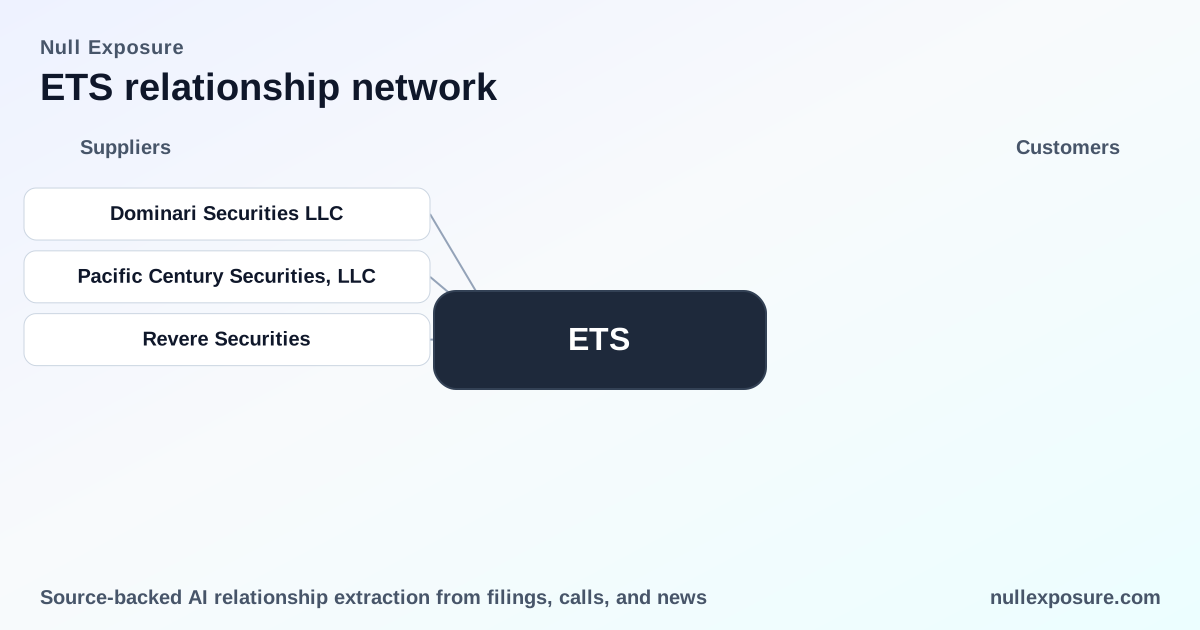
Dominari Securities acted as the representative of the underwriters for ETS’s initial public offering, taking the lead role in managing and syndicating the deal. According to the GlobeNewswire press release announcing the closing of the $15.2 million IPO on August 22, 2025, Dominari was the underwriting representative for the offering. (GlobeNewswire, August 22, 2025)
Revere Securities
Revere Securities served as a co-underwriter alongside Dominari, sharing distribution responsibility and underwriting risk for the transaction. The same GlobeNewswire release lists Revere Securities explicitly as a co-underwriter for the offering that closed in August 2025. (GlobeNewswire, August 22, 2025)
Pacific Century Securities, LLC
Pacific Century Securities is identified as the advisor to ETS in connection with the offering, providing deal advisory services rather than serving as a lead underwriter. The GlobeNewswire release announcing the offering closing names Pacific Century Securities as an advisor to the company. (GlobeNewswire, August 22, 2025)
What these relationships mean for investor risk and operations
The underwriting and advisory lineup associated with ETS’s IPO communicates three practical implications:
- Access to capital is event-driven. The arrangement is positioned around a single transaction that raised $15.2 million; there is no public evidence of a broader long-term financing syndicate. For a company with negative operating margins and limited institutional support, follow-on financing will be a recurrent risk factor.
- Market-making and liquidity constraints persist. A small free float and concentrated insider ownership limit secondary market liquidity; underwriters who are not top-tier bulge brackets reduce the natural market-making depth available to shareholders.
- Operational execution still drives value. Underwriters and advisors address funding and distribution, but ETS’s long-term performance will hinge on improving unit economics, margin recovery, and scaling revenue beyond current levels reported through the quarter ended November 30, 2025 (latest quarter). According to its public financials, revenue for the trailing twelve months was roughly $2.67M with negative EBITDA and EPS at -$0.16. (Company financials, quarter ended 2025-11-30)
For investors focused on supplier and counterparty risk, the most important signal is that financial counterparties are transactional and event-focused, while operational suppliers and customers will ultimately determine enterprise value.
If you want to monitor how these counterparties evolve or to compare them across similar small-cap logistics issuers, see our portal: https://nullexposure.com/.
Practical takeaways and next steps for investors and operators
- Underwriting credibility matters more than size: For ETS, the underwriting group facilitated the IPO but does not on its face solve the company’s scale or margin challenges. Evaluate the underwriting firms’ track records on follow-on financings and secondary-market support when modeling financing scenarios.
- Concentrated insider control increases execution risk: With insiders owning the majority of shares, governance and related-party contracting deserve careful scrutiny in future filings.
- Liquidity and capital runway are immediate concerns: Negative operating margins and small market cap mean ETS will likely return to the capital markets or negotiate other financing terms within a short horizon; the quality of its financial advisors will shape terms and timing.
Actionable next steps:
- Review the August 22, 2025 GlobeNewswire release that announced the IPO closing and underwriting roles for transaction-specific details.
- Monitor quarterly filings for any engagement letters, fees paid to the underwriters or advisor, and disclosures about follow-on financings.
- Track operational metrics (load factor, yield per mile, driver utilization) as these will determine how quickly ETS reduces its reliance on capital markets.
For a consolidated, ongoing view of supplier and counterparty relationships affecting ETS and comparable logistics names, visit https://nullexposure.com/.
Closing assessment
Elite Express is a capital-constrained, founder-controlled logistics operator that has just completed a public capital raise through a compact underwriting syndicate. The immediate supplier-risk takeaway is straightforward: these underwriting and advisory relationships provided necessary funding and market access for the IPO, but they do not substitute for the operational improvements required to reach sustainable profitability. Investors should prioritize monitoring follow-on financing activity, insider governance, and the company’s progress on key operational metrics over the next two quarters.