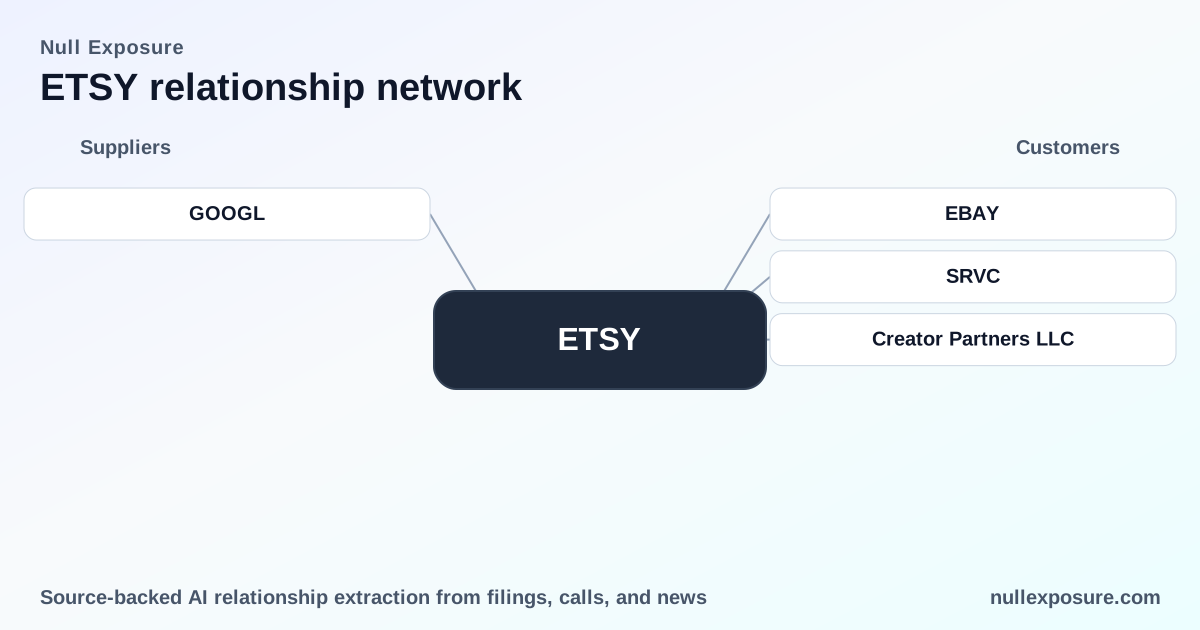
Etsy, Inc. (ETSY) — supplier relationships and operational levers investors should price in
Etsy operates a curated marketplace for handmade, vintage and craft supplies and monetizes primarily through marketplace fees, listing fees, and payments and advertising services that extract a percentage of seller transactions and platform spend. The company’s gross-retail volume scales network effects, while profitability depends on controlling infrastructure and marketing costs and integrating third-party distribution channels. For investors and operators, the key questions are concentration of critical infrastructure, commercial distribution partnerships with major tech platforms, and the fixed-cost posture of corporate operations. For deeper supplier-risk analytics and contract visibility, visit https://nullexposure.com/.
Why supplier relationships matter to Etsy’s valuation
Etsy is a platform business whose unit economics are highly leverageable: modest changes in take-rate or traffic mix translate directly to margins. That structure makes supplier relationships—particularly cloud infrastructure and distribution partnerships—direct drivers of both operational resilience and growth optionality. Long-term leases and active relationships with large service providers raise the cost of failure and the bar for continuity planning. Investors should value Etsy not only on GMV growth but on the stability and terms of these third-party relationships.
What the public record shows about Etsy’s Google ties
Etsy has multiple public touchpoints with Google in early FY2026 that span both infrastructure reliance and commercial distribution experiments.
-
A Sahm Capital report (February 13, 2026) states that Etsy partnered with Google as a co-developer on the Universal Commerce Protocol, signaling collaboration on standards for commerce across platforms. This indicates strategic interoperability rather than a simple reseller agreement.
Source: Sahm Capital news analysis, Feb 13, 2026. -
A FinancialContent markets piece (February 20, 2026) described Etsy’s late‑2025 rollout of “Agentic Commerce” partnerships that enable AI assistants like Google Gemini and ChatGPT to search and complete purchases on Etsy through conversational interfaces, which can materially change traffic sourcing and buyer acquisition economics.
Source: FinancialContent/Markets article, Feb 20, 2026.
Takeaway: Google is both a distribution channel for buyer acquisition and a collaborator on commerce protocols—creating upside from expanded reach and downside from concentration risk.
All supplier relationships surfaced in the public results
The results returned two distinct public mentions—both tied to Google—each revealing a different facet of the relationship:
-
Sahm Capital reported that Etsy and Google are co-developing the Universal Commerce Protocol, a collaboration that positions Etsy inside cross-platform commerce standards and could improve checkout friction for buyers using Google surfaces. Source: Sahm Capital (Feb 2026).
-
A FinancialContent markets article documented Etsy’s Agentic Commerce initiative, which plugs Etsy inventory into conversational AI assistants (including Google Gemini), enabling direct purchase flows without traditional search intermediaries. Source: FinancialContent / Markets (Feb 2026).
Both mentions are active in FY2026 and should be treated as complementary: one is standards/protocol collaboration, the other is distribution via AI assistants.
Contracting posture and other company-level constraints investors need to price
Etsy’s public disclosures and excerpts highlight several operating characteristics that determine supplier risk and financial sensitivity:
-
Long-term fixed-cost posture: Etsy occupies approximately 225,000 square feet in its Brooklyn headquarters under a lease that expires in 2039, reflecting a long-term real-estate commitment and fixed overhead that reduces short-term flexibility but signals permanence. This is a company-level signal drawn from corporate filings.
-
Service-provider dependence: The company explicitly states its operations depend on multiple third-party service providers—cloud, marketing platforms, payments and shipping providers—which means outsourcing risk is a recurring operating exposure rather than a marginal one.
-
Active relationship posture: Disclosures classify these third-party relationships as active components of operations, not merely contingent arrangements.
These constraints imply Etsy’s operating model blends scalable network economics with persistent fixed-cost commitments and concentrated third-party dependency, which amplifies both operational leverage and supplier risk.
The Google Cloud constraint is material and explicit
Etsy’s own disclosures name Google Cloud in the risk language, making the dependency distinct from generic vendor exposure: “Any significant disruption of, or interference with, our use of Google Cloud would negatively impact our operations, and our business would be seriously harmed.” That wording elevates the relationship to critical infrastructure, not peripheral utility.
- Implication for investors: Treat Google Cloud as a single point of failure for certain backend services; price potential outage scenarios into short-term operating volatility and consider management’s mitigation plans when modeling downside scenarios. This is a company-level constraint that explicitly names Google Cloud.
What this means for growth and risk
-
Upside: Agentic Commerce and protocol-level collaboration with Google can unlock new demand channels and reduce friction for mobile and AI-driven buyers, supporting revenue growth without proportional marketing spend increases.
-
Downside: Concentration on Google Cloud and integrated distribution via Google surfaces concentrate systemic risk—a prolonged outage or unfavorable commercial terms could compress margins quickly given Etsy’s reliance on third parties for core infrastructure and customer acquisition.
-
Operational posture: Long real-estate leases and active third-party reliance mean Etsy’s short-term cost structure is relatively inelastic; therefore, margin recovery depends more on revenue-side levers (take-rate, advertising monetization) than rapid cost cutting.
For a supplier-focused risk assessment and contract inventory that helps quantify these tradeoffs, explore our platform at https://nullexposure.com/.
How investors should act
-
Model several scenarios that explicitly vary Google-related exposure: a normal-growth path that assumes improved AI-driven conversion, a price-shock path where cloud costs or search fees increase, and an outage path that simulates service disruption impact on revenue and gross margin.
-
Interrogate management on redundancy and exit options for critical infrastructure, plus the economics and contractual terms of the Google collaborations—are they revenue-sharing, referral-fee, or technology co-development arrangements?
-
Monitor adoption metrics for Agentic Commerce: conversion rates from AI assistants, average order value through those channels, and any displacement of organic search traffic.
Ready for a deeper supplier-risk read? Investigate contract-level exposure and vendor concentration with our tools at https://nullexposure.com/.
Final verdict for operators and investors
Etsy’s business proposition is intact: scale in a specialty market with monetization through marketplace fees and platform services. The firm’s strategic collaboration with Google introduces credible upside through new distribution and standards work, but the same set of disclosures also elevates Google Cloud to a critical vendor status that constrains downside resilience. Investors should price both the growth optionality of AI-driven commerce and the concentrated operational risk into forward multiples rather than treating them as offsetting forces.