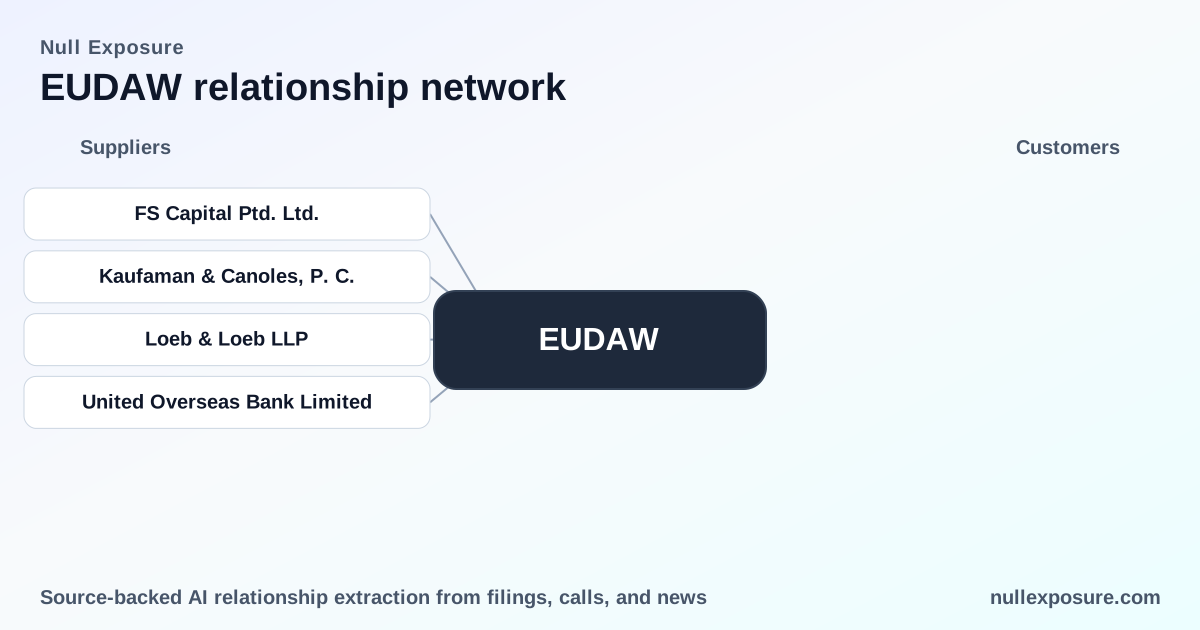
EUDA Health Holdings (EUDAW): supplier, lender and legal counterparties that shape near-term execution
EUDA Health Holdings operates as a hybrid healthcare platform and biotech developer — monetizing through clinical services, product sales and commercialization pathways while funding operations with a mix of short-term borrowings and vendor credit. The company runs a platform that relies on contract physicians and third‑party technology distribution channels, and its cash flow profile is supported by modest service revenues alongside convertible and promissory financing arrangements disclosed in the FY2022 filing.
For a concise operational risk and supplier map, visit https://nullexposure.com/ for detailed relationship intelligence and reporting.
How to read EUDA’s supplier and financing footprint
EUDA’s public disclosures reveal a compact set of credit and professional relationships that matter to near‑term liquidity and operational continuity. The FY2022 10‑K discloses a mix of short‑term bank collateral, a repaid institutional facility, a legal firm with equity consideration and a promissory note with steep default interest — each item alters the company’s cash flow flexibility and counterparty risk profile.
- Contracting posture is mixed: the company lists both short‑term lease obligations and longer finance leases, indicating staggered maturity buckets for fixed obligations.
- Supplier concentration is low at the vendor level, as no single vendor accounted for 10% or more of purchases in 2022, but service criticality is high because core offerings depend on third‑party hosting, payments and streaming.
- Spend scale is modest: several relationships sit in the $100k–$1m band, consistent with an early commercial operation that outsources significant services rather than vertically integrating.
Explore deeper supplier mapping at https://nullexposure.com/ to align your diligence model with EUDA’s capital structure and vendor exposures.
FS Capital Ptd. Ltd.
FS Capital provided a debt facility that was fully repaid in February 2022 and carried an 18.0% rate; the debt was guaranteed by CEO Kelvin Chen Weiwen and Kent Ridge Health Private Limited, which ties executive and related‑party risk to that financing. This detail is disclosed in EUDA’s FY2022 Form 10‑K.
Kaufaman & Canoles, P. C.
Kaufaman & Canoles is recorded as a promissory note holder with a face amount of $170,000 and a contractual default interest rate of 15% per annum beginning February 15, 2023, which creates acute downside cost if repayment timelines slip. This arrangement is described in the FY2022 10‑K filing.
Loeb & Loeb LLP
Loeb & Loeb received 60,000 ordinary shares in connection with a convertible note arrangement; those shares are subject to return and cancellation if EUDA repays the convertible note in full or in part, embedding an equity‑linked fee structure in legal provisioning. The share issuance and repayment condition are disclosed in the FY2022 10‑K.
United Overseas Bank Limited
EUDA pledged accounts receivable totaling roughly $0.6 million (SGD 0.8 million) as collateral against a short‑term loan from United Overseas Bank as of December 31, 2022, establishing a lien on cash inflows tied to receivables. This pledge is recorded in the FY2022 10‑K.
What these relationships collectively imply for investors and operators
The mix of covenanted short‑term bank borrowing, a repaid high‑rate facility, a small promissory note with punitive default interest and legal counsel compensated with equity tells a consistent story about capital tightness and creative counterparty arrangements.
- Liquidity posture: Collateralized receivables and a history of high‑rate financing indicate constrained liquidity and reliance on non‑traditional lenders or related parties for bridge capital.
- Counterparty risk: Guarantees by the CEO and related entities signal concentrated owner support but also potential conflicts if related parties are intertwined with operating vendors.
- Operational criticality: EUDA’s platform depends on third‑party technology and contract physicians for delivery, making service providers mission critical despite vendor‑level spend dispersion.
- Contract maturity mix: Evidence of both short‑term lease payments due within one year and longer finance leases shows staggered payment obligations that require active cash management.
These are company‑level signals derived from the FY2022 disclosures and should be treated as primary inputs for commercial and credit diligence.
Practical diligence checklist — what to verify now
- Confirm the status and terms of the Kaufaman & Canoles promissory note (outstanding balance, repayment schedule and any default triggers that could accelerate the 15% default rate).
- Validate whether the UOB receivables pledge remains in place and the degree to which pledged receivables overlap with core revenue streams.
- Review the conversion and cancellation mechanics tied to the Loeb & Loeb share issuance to assess potential dilution or readjustment of legal fee obligations.
- Audit third‑party hosting, payment and streaming contracts for SLA, indemnity and termination rights given the high operational criticality of those vendors.
- Map related‑party transactions, especially payments to Cadence Health Pte. Ltd. (historically significant), to evaluate related‑party exposure and governance controls.
Risk‑adjusted thematic view and operating recommendations
EUDA is an early commercial healthcare platform that demonstrates revenue generation but tight financings, meaning equity investors and strategic partners must price for refinancing risk and operational delivery risk. For operators, negotiating stronger vendor SLAs and reducing collateralized borrowings will materially reduce execution risk. For capital allocators, the presence of executive guarantees and equity‑based legal compensation affects recovery dynamics in stressed scenarios.
- If you are a potential strategic partner, insist on clarity around receivables liens and confirm tech vendor redundancy.
- If you are an investor, model sensitivity to the 15% default interest mechanics and the timing of any convertible note repayments that trigger share cancellations.
For a comprehensive supplier risk profile and to download the full relationship disclosures, visit https://nullexposure.com/.
Bottom line and next steps
EUDA’s supplier and financing profile is compact but consequential: a handful of legal and credit relationships materially shape liquidity, while third‑party technology and contract physicians create critical operational dependencies. Prioritize covenant review, receivables collateral mapping and vendor SLA verification in your next round of diligence.
Engage with detailed relationship intelligence and bespoke reporting at https://nullexposure.com/ to convert these public disclosures into actionable investment and operating decisions.