Eureka Acquisition (EURK) — supplier relationships and operational signals investors need
Eureka Acquisition Corp (EURK) operates as a classic blank‑check vehicle: it monetizes through sponsor capital, finder arrangements and recurring administrative arrangements while pursuing a definitive business combination that would convert the shell into an operating enterprise. There is no operating revenue today; the company’s economics are driven by sponsor support, monthly administrative fees and the timing of an announced business combination or liquidation. For investors evaluating counterparty exposure, the supplier map is narrow, contractually defined and materially influenced by the sponsor relationship and finder agreements. Learn more at https://nullexposure.com/.
One supplier on the public map — what it's doing and why it matters
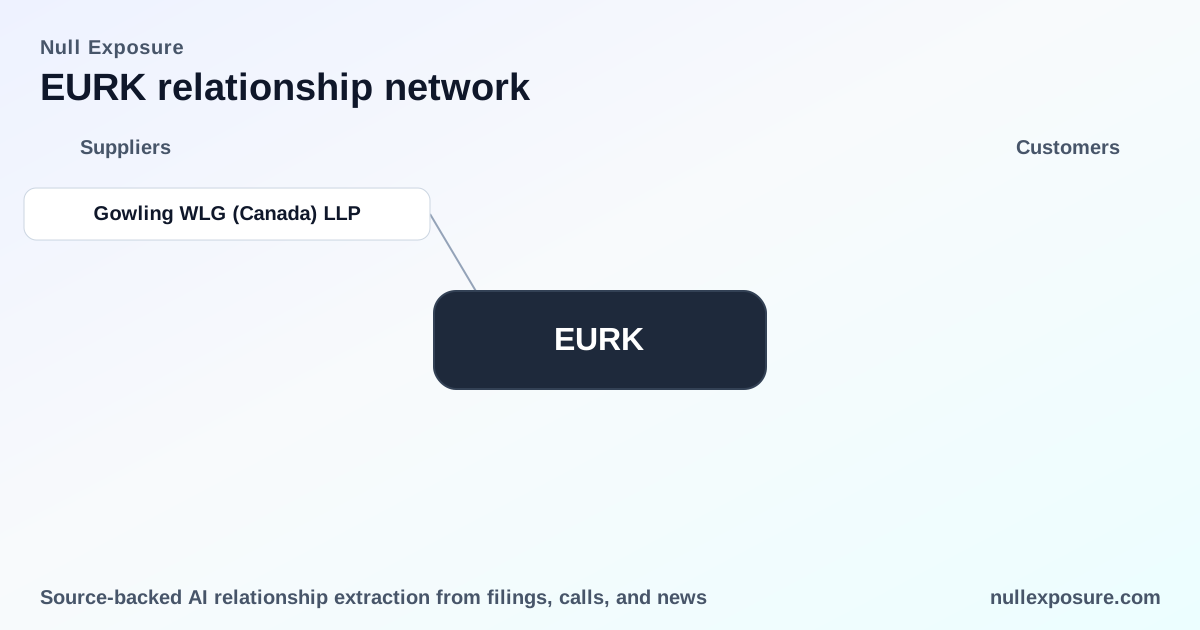
Gowling WLG (Canada) LLP — retained as legal counsel
Gowling WLG (Canada) LLP is serving as legal counsel to Eureka in connection with corporate transactions tied to the SPAC’s deal activity, which positions the firm as a transaction‑support supplier for deal documentation and regulatory work. A Canadian Lawyer Magazine article published March 9, 2026 notes Gowling WLG’s role advising Eureka on merger and related matters. (Canadian Lawyer, March 9, 2026: https://www.canadianlawyermag.com/news/deals/gowling-wlg-crease-harman-assist-eureka-capital-empire-hydrogen-merger/388356)
Company-level contractual signals that shape all supplier relationships
Eureka’s supplier posture is driven by a small set of standing contractual commitments and a narrow operating footprint. These are company‑level signals — they govern how the SPAC engages suppliers generally rather than identifying which supplier performs which duty, unless explicitly stated.
- Recurring administrative payments define a predictable base spend. The company committed to pay its sponsor (and an affiliate of the sponsor) $10,000 per month for office space, utilities and secretarial/administrative support beginning with the IPO registration effective date; this payment continues until the initial business combination closes or the SPAC liquidates. Company filings detail this obligation, including entries for the years ended September 30, 2025 and 2024.
- Active service relationships are in place today. The filing language describing ongoing monthly payments and finder arrangements confirms active service contracts rather than one‑off consulting engagements.
- Run‑rate spend is modest but non‑negligible. The company recorded $120,000 of related expenses for the fiscal year ended September 30, 2025 (with $50,000 of that included in accrued expenses), placing total external and affiliate spend in the mid‑six‑figure range annually.
- Arrangement diversity includes finders and sponsors. A Finder’s Agreement with Alpha Innovators Limited (BVI) creates an ongoing channel for target introductions, and the service model includes sponsor affiliates providing core office and administrative functions.
These signals come directly from the company’s registration statement and subsequent fiscal disclosures for FY2024–FY2025 and demonstrate a contracting posture that favors long‑dated administrative contracts with sponsor affiliates and targeted finder relationships rather than broad market procurement.
What this means for investors and operators evaluating counterparty risk
Eureka’s supplier footprint shows three investment‑relevant facts that drive counterparty risk and operational resilience:
- Concentration and criticality: A large share of operational functions—office, secretarial, administrative and deal facilitation—are concentrated in sponsor affiliates and a named finder. That concentration reduces vendor management complexity but creates single‑point dependency for routine operations and deal origination.
- Maturity and predictability: The monthly administrative fee creates a predictable cost base; with $10,000 per month and ~$120k recorded in FY2025, cash drain from supplier relationships is visible and manageable relative to a SPAC’s typical cash trust, but it is an ongoing obligation until a combination or liquidation.
- Contractual termination tied to lifecycle events: Payments cease upon the completion of the initial business combination or liquidation, aligning supplier incentives to get a transaction closed and placing commercial pressure on counterparties to support timely execution.
- Legal counsel is transaction‑level but essential: Gowling WLG’s role as legal counsel is typical for SPACs and is mission‑critical for deal execution and regulatory compliance, even if its spend is small relative to administrative fees.
Investors should treat supplier exposure not as broad procurement risk but as deal execution and sponsor‑dependency risk. If the sponsor shifts strategy, or the finder channel dries up, the SPAC’s ability to identify and complete a deal could slow, extending administrative spend and delaying potential liquidity events.
(Explore supplier intelligence and tracking at https://nullexposure.com/.)
Risk checklist for an investor due diligence memo
- Sponsor concentration: high — core administrative services provided by sponsor affiliates.
- Liquidity sensitivity: medium — recurring fees are modest but continuous until a transaction or wind‑down.
- Legal and regulatory execution risk: high importance — counsel relationships such as Gowling WLG affect timing and regulatory approvals.
- Counterparty diversification: low — finder and sponsor relationships dominate the supplier landscape.
- Transparency and disclosure: adequate — filings disclose payments and agreements; investors should confirm any subsequent amendments.
Practical recommendations for operators and portfolio analysts
- Confirm the status and term of the $10,000/month administrative agreement and any successor arrangements post‑transaction; understand whether fees are arm’s length or affiliate‑discounted.
- Validate the Finder’s Agreement scope with Alpha Innovators Limited to assess the pipeline and exclusivity terms that could limit or accelerate deal flow.
- Engage counsel review of Gowling WLG’s engagement letter and fee structure if you are pricing transaction readiness or preparing to underwrite a potential business combination.
- Monitor accruals and cash flow lines tied to administrative spend; these are a visible leading indicator of operational runway ahead of a business combination.
Closing call to action
For investors building a supplier risk profile or operators validating counterparty readiness, focus on sponsor dependency, recurring administrative obligations, and the legal counsel pipeline as the primary drivers of outcome and timing. For a deeper supplier relationship analysis and ongoing monitoring, visit https://nullexposure.com/.
Final takeaway: Eureka’s supplier landscape is compact, contractually anchored and execution‑centric — the critical questions for investors are not how many vendors are on the roster, but how the sponsor, finder and legal counsel ecosystem influence the SPAC’s ability to close a deal and preserve shareholder value.